When to Plant Tomatoes in South Africa
Every page says to plant after the last frost and none of them say when that is. Here is the date for your town, and the crops that share it.
Almost every South African gardening page answers this the same way. Plant tomatoes in spring, after the last frost. It is correct, and it is useless, because not one of those pages tells you when the last frost actually is where you live.
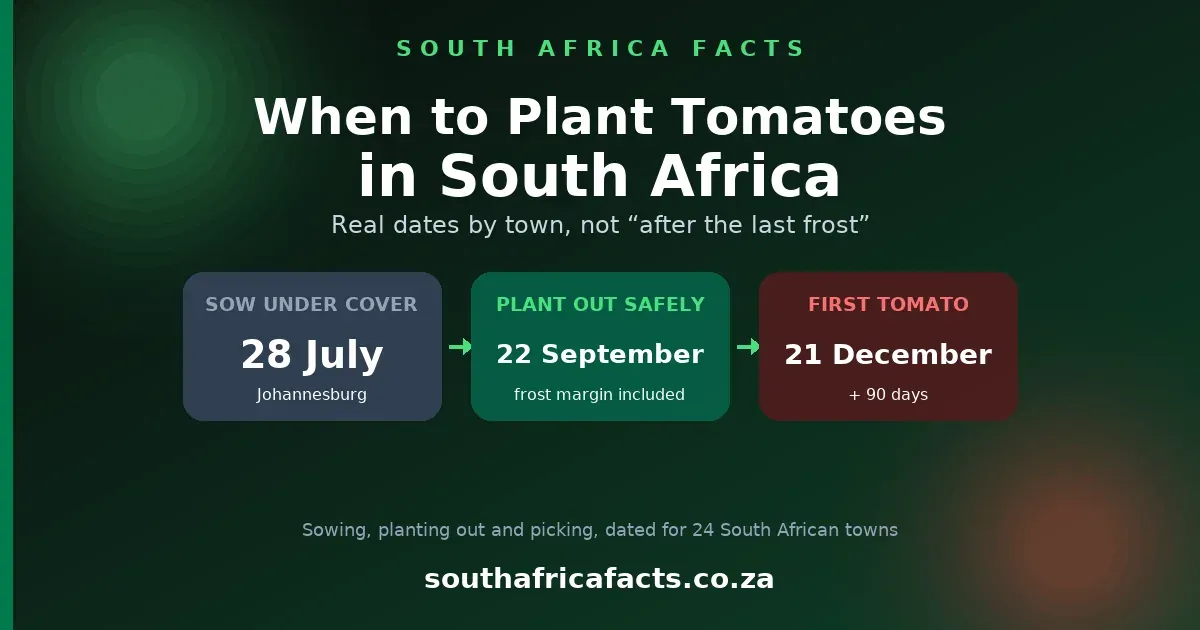
So here is the answer with a date on it. In Johannesburg the last frost of the season typically falls around 5 September, and the date it is genuinely safe to put tomato plants outside is 22 September. If you want to raise your own from seed, you start about six to eight weeks before that, which puts sowing between 28 July and 11 August, under cover, on a windowsill or in a tray in a warm room.
Those dates move around the country by more than a month, and along the coast they stop mattering at all. The rest of this covers where yours falls, what to do if you missed it, and why the crop everyone plants alongside tomatoes wants almost exactly the same date.
The date you actually need is not the last frost
There are two useful dates and they are not the same one. The typical last frost is the middle of the distribution, the date frost has historically stopped in an average year. Plant on it and you are taking a coin-flip, because roughly half of all years run later than average, and a tomato seedling does not get a second chance at a frosty night.
The safe date is that typical date pushed later by a deliberate margin. On our Planting Dates & Frost Calculator that margin is 16 days, measured from how far the calibrated dates missed at real weather stations rather than picked to feel cautious. It is the difference between the date frost usually ends and the date you can plant without watching the forecast every night.
For most of the interior that date lands in the same week. Of the 24 towns with a real frost reference behind them, 18 share a safe planting date of 22 September, which is close enough to give the Highveld a rule of thumb: the last full week of September.
When to plant tomatoes in your town
The sowing window below is counted back from the safe date, and the first pick is counted forward from it using the Department of Agriculture's figure of about 90 days to the first pick.
| Town | Province | Sow under cover | Safe to plant out | First pick, roughly |
|---|---|---|---|---|
| Johannesburg | Gauteng | 28 July to 11 August | 22 September | 21 December |
| Pretoria | Gauteng | 28 July to 11 August | 22 September | 21 December |
| Rustenburg | North West | 8 July to 22 July | 2 September | 1 December |
| Bloemfontein | Free State | 28 July to 11 August | 22 September | 21 December |
| Bethlehem | Free State | 28 July to 11 August | 22 September | 21 December |
| Kimberley | Northern Cape | 28 July to 11 August | 22 September | 21 December |
| Upington | Northern Cape | 28 July to 11 August | 22 September | 21 December |
| Nottingham Road | KwaZulu-Natal | 2 August to 16 August | 27 September | 26 December |
| Middelburg | Mpumalanga | 28 July to 11 August | 22 September | 21 December |
| Graaff-Reinet | Eastern Cape | 2 August to 16 August | 27 September | 26 December |
| De Aar | Northern Cape | 7 August to 21 August | 2 October | 31 December |
| Robertson | Western Cape | 28 July to 11 August | 22 September | 21 December |
Those are dates for planting without protection. You can beat them by two or three weeks with a cloche, a plastic tunnel or even a bucket over each plant on cold nights, which is exactly what commercial growers on the Highveld do to get early fruit onto the market. The safe date is the date you can stop paying attention.
The full list of 24 towns, with first-frost dates and growing season lengths as well, is on the frost date calculator. If your town is not there, the nearest listed town at a similar altitude is a better guide than the nearest one by road, because a few hundred metres of elevation shifts frost more than a hundred kilometres of distance does.
Altitude, not latitude
The spread across the calibrated towns runs from 2 September in Rustenburg to 2 October in Calvinia and De Aar. That is a month of difference inside one country, and it does not follow the map the way people expect.
Rustenburg and Johannesburg are about two hours apart, and Rustenburg plants a fortnight earlier, because it sits several hundred metres lower. Upington is far to the north and plants on the same date as Bloemfontein. The Karoo towns are among the last to clear, despite being some of the hottest places in the country in summer, because clear dry winter nights radiate heat away fast and the temperature falls off a cliff after sunset.
This is also why the hardiness zone numbers you find online do not help here, and there is a section on that further down.
Seed or seedlings, and why the dates differ
Buying seedlings from a nursery is the simple path. You plant them on the safe date and that is the whole decision.
Raising your own from seed gets you cultivars the nurseries do not stock, and it costs you a planning step. The KwaZulu-Natal Department of Agriculture's tomato guideline puts tomato seedlings at about 30 days from sowing to transplanting size under warm conditions, stretching to 60 days or more when it is cold. Late winter on the Highveld is firmly in the second category, which is where the six to eight week rule comes from.
Two things go wrong at this stage, and both are worth naming.
The first is sowing too early. Seed sown in June sits in cold soil doing very little. The same guideline gives 15°C to 30°C as the useful germination range, with emergence in seven to ten days, and notes that at 10°C the same seed can take three weeks or more and come up patchy. A tray on a cold windowsill in July is closer to 10°C than most people think.
The second is sowing early and succeeding. Seedlings that hit transplant size in mid-August with five weeks still to run get tall, thin and weak in the tray, and a short sturdy seedling of 100mm to 150mm transplants better than a lanky one every time. If yours are ready before the date, pot them on into something bigger rather than putting them out.
Worth knowing: the Department's own commercial sowing calendar for cold, heavy-frost areas is September to November, straight into a seedbed with no protection at all. That schedule harvests later than a home gardener wants, and it is completely frost-proof. If you would rather not fuss with trays indoors, sowing in the ground in October is the version that has never needed a weather forecast.
The coast and the Lowveld are a different question entirely
Warm and low enough, and the frost question mostly evaporates. Another 12 towns on the calculator, among them Ballito, Durban, East London, Gqeberha and Hazyview, get no reliably dated frost at all. Frost is not what limits your tomatoes there.
Heat and humidity are. The KZN guideline puts the optimum at a daily mean of 20°C to 24°C, and notes that above 35°C flowers drop and fruit fails to set, and that continuous warm wet weather is what makes tomato leaf diseases so hard to control. That is a fair description of a Durban midsummer. The provincial sowing calendar for frost-free areas reflects it: it recommends December to March and July to September, deliberately skipping the hottest, wettest stretch that the Highveld considers prime tomato season.
So on the KZN north coast, in the Lowveld, or around Gqeberha, you have two seasons rather than a start date, and midsummer is the one to be careful with.
Can you plant tomatoes in winter?
In most of the country, no, and the reason is not only frost.
The KZN guideline is blunt about it: even in frost-free areas, winter tomato production should not be attempted where mean temperatures frequently drop below 12°C. Below that the plant may survive and simply refuse to set fruit, because tomato flowers shed rather than pollinate in the cold. A plant that lives through winter and gives you nothing is a worse outcome than one that dies, since you watered it for four months.
Where winter tomatoes do work is the frost-free subtropical strip. The Department of Agriculture's own market profile puts it plainly: winter production is very limited, and tomatoes can only be grown in winter in frost-free areas or under protection like tunnels. That is a fair part of why more than 75 percent of South Africa's tomato area sits in Limpopo, in the Northern Lowveld and the far north of the province.
Everywhere else, winter is for planting under cover or not at all.
The same date runs most of your summer garden
Tomatoes are the crop people ask about, but the date you work out for them is the date for nearly everything tender. Green beans, peppers, chillies and sweetcorn are all warm-season crops that a frost will take out overnight, and the official planting calendars for them line up closely with the tomato one.
| Crop | Cold areas, heavy frost | Warm areas, light frost | Frost-free areas |
|---|---|---|---|
| Tomatoes | September to November | August to December | December to March, July to September |
| Green beans | September to January | August to February | February to September |
| Sweetcorn and green mielies | September to December | August to February | January to March, July to September |
| Chillies and peppers | September to October | August to October | July to October, January to February |
| Potatoes | August to October, January | July to September, February | March to June |
Those are sowing windows from the provincial and national production guidelines, so they are commercial schedules for planting straight into the ground. Read them as the safe, unprotected version of the same advice.
Two crops deserve a note. Green beans are sown direct, not transplanted, so their date is your safe date and not six weeks before it, and they need soil at 20°C to 30°C to come up in five to ten days. Potatoes work backwards from the other end: frost kills the foliage rather than the tubers, so in frost-free areas the main crop is planted in autumn and grown right through the winter.
What planting zone is South Africa in?
This question comes up constantly, and the honest answer is that it is the wrong question.
The zone numbers you find are USDA plant hardiness zones, an American system built from the average coldest night of the year. They were designed to answer whether a shrub will survive your winter, which is a real question for perennials and no help at all for a tomato. A tomato is an annual. You are not asking whether it survives winter, you are asking when winter finishes.
Worse, the zone maps applied to South Africa are extrapolated from global temperature grids, not fitted to local records, and they flatten exactly the thing that matters here. Johannesburg and Durban are 500km apart on similar latitudes and have completely different frost regimes, because one of them is 1 700m above the sea. A system that sorts by minimum temperature loses that; a last-frost date keeps it.
If you have landed here after reading that South Africa is "zone 9b" or "zone 11", ignore it for vegetable planting. Use a last-frost date for your own town.
If a late frost catches you
It happens, and the calculator's safe date is built to make it rare rather than impossible. Late frost is usually a still, clear, dry night, so the forecast that should worry you is a cold front followed by a windless night with no cloud.
Covering plants works, and it works because it traps heat rising from the soil rather than because the cover is warm. Anything counts: a bucket, a cardboard box, a sheet, a plastic bag propped off the leaves. Put it on in the evening, before the ground has given up its heat, and take it off in the morning. Watering the soil in the late afternoon helps too, since wet soil holds more heat than dry soil.
If you lose a plant, it is not the end of the season. Tomatoes need about 90 days to the first pick and then bear for another 80 or so, and the interior's frost does not return until 5 June in Johannesburg, so a replant in early October still has a full season ahead of it.
Common questions
When should I plant tomatoes in Johannesburg?
Put plants outside from 22 September, which is the safe date once a frost margin is added to the typical last frost of 5 September. If you are raising seedlings yourself, sow between 28 July and 11 August indoors. With a cloche or tunnel you can plant two to three weeks earlier, but then you are committed to covering them on cold nights.
Which month is best for planting tomatoes in South Africa?
There is no single month, which is why the generic answer never satisfies anyone. On the Highveld and in the Free State it is late September into October. In the Lowveld and along the KZN coast it is closer to July to September or December onwards, avoiding peak summer heat. In the Karoo and the higher Northern Cape towns it is October. The month follows your frost date, not the country.
Is it too late to plant tomatoes in December?
No, not in most of the country. Tomatoes take about 90 days to the first pick, so a December planting fruits in March, and the interior's first frost does not arrive until around 5 June in Johannesburg. You will get a shorter picking season than a September planting, and you are planting into the hottest, wettest part of the year, so watch for leaf disease.
Should I buy seedlings or grow from seed?
Seedlings if you want one decision and no timing risk. Seed if you want cultivars the nurseries do not carry, and are willing to start six to eight weeks earlier under cover. Sowing straight into the ground works too and needs no protection at all, it just harvests later.
How long from planting to the first tomato?
The Department of Agriculture's production summary gives about 90 days to the first pick, with picking then running for roughly another 80 days. From seed, add the six to eight weeks in the tray before that.
What temperature kills a tomato plant?
Anything at or below freezing will damage or kill an unprotected plant, and the KZN guideline notes that even a few degrees above freezing can seriously damage both plant and fruit. Well before that, at a sustained mean below 12°C, the plant stops setting fruit even though it looks alive.
Do I need to worry about frost in Durban or Cape Town?
Durban, no. It is one of the 12 coastal towns on the calculator with no reliably dated frost, and heat and humidity are what limit tomatoes there instead. Cape Town is genuinely marginal and the national frost surface has no dated band for the city bowl, so the calculator deliberately leaves it out rather than guessing. Frost is rare in the city and real in the colder inland suburbs and the Boland.
Where do these dates come from?
The frost dates are from the Planting Dates & Frost Calculator, which corrects long-run daily minimum temperature data against South Africa's ARC-ISCW national frost surface and, for two Free State towns, against published weather-station records. The crop timings are from the KwaZulu-Natal Department of Agriculture's vegetable production guidelines and the national Department of Agriculture's Vegetable production in a nutshell.
Sources
- KwaZulu-Natal Department of Agriculture and Rural Development, Tomato production guideline: temperature ranges, germination, seedling timing and sowing calendars by frost class.
- KwaZulu-Natal Department of Agriculture and Rural Development, Green beans and Sweet-corn production guidelines.
- Department of Agriculture, Vegetable production in a nutshell: growth periods and sowing times for tomatoes, chillies and potatoes.
- Department of Agriculture, Land Reform and Rural Development, A profile of the South African tomato market value chain: provincial production areas and the limits on winter production.
- Planting Dates & Frost Calculator, South Africa Facts, for the per-town frost and safe planting dates.
Once you have your date, the Vegetable, Herb & Fruit Planting Calendar covers what else goes in the ground in the same month for your region.
What do you think?
Join the conversation on our South African community forum. Share your perspective, ask a question, or just say hello.