
Planting Dates & Frost Calculator (South Africa)
Works out when it's safe to plant in your town, calibrated against South Africa's national frost surface, with two towns additionally cross-checked against real weather-station records, plus a built-in safety margin rather than a single guessed date.
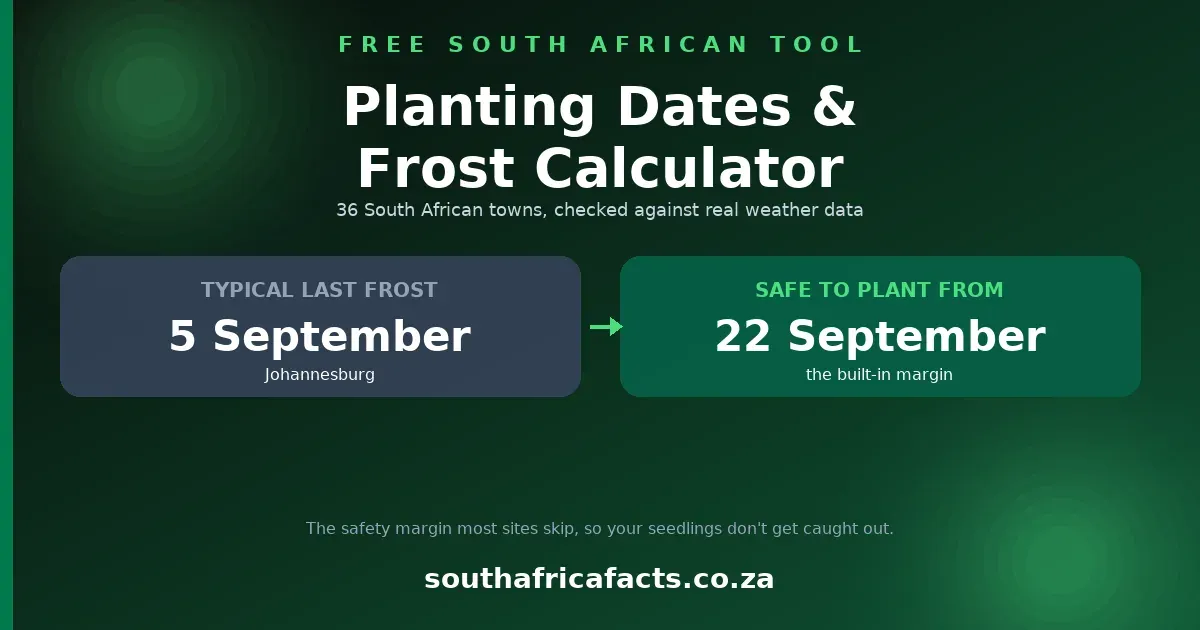
Planting Dates & Frost Calculator, South Africa
Pick your town to see when frost usually ends in spring and starts again in autumn, and how long that leaves you to grow frost-tender crops. Every town is checked against a South African Weather Service or ARC frost reference, not raw satellite data, which runs frost dates weeks off in the unsafe direction if left uncorrected.
This is not a forecast for this year. It is what the long-term record says is typical for your town, which is the right baseline for deciding when to plant out, not for a specific week ahead. Check a real forecast before you actually plant.
My town is not on the list
💬 Discuss this tool on the forum
When is it safe to plant in your town?
For most of the South African interior the safe planting date lands in the same week: 18 of the 24 calibrated towns share a safe date of 22 September, among them Johannesburg, Pretoria, Bloemfontein, Kimberley, Centurion, Sandton and 12 others. That is the date this tool suggests waiting for before you put out anything frost-tender, and it is deliberately later than the typical last frost, because a typical date is beaten by roughly half of all years.
The spread across the country runs from 2 September in Rustenburg to 2 October in Calvinia and De Aar. Altitude drives most of that gap, and distance from the coast drives the rest, which is why two towns an hour apart can differ by a fortnight.
Warm and low enough, and the question mostly does not arise. Another 12 of the listed towns, along the coast and in the Lowveld, among them Ballito, Durban, East London, Gqeberha and Hazyview, get no reliably dated frost at all, so the limit on planting there is heat and rainfall rather than cold.
Frost dates for South African towns
South Africa's frost season runs roughly May to September across most of the interior, but the exact dates vary by hundreds of kilometres and by a few weeks town to town, and no South African site published them with numbers before this. The table below lists the typical last frost of spring and first frost of autumn for the 24 towns this tool has a real frost reference for, plus how many days that leaves for frost-tender crops.
| Town | Province | Typical last frost | Safe to plant from | Typical first frost | Frost-free days |
|---|---|---|---|---|---|
| Beaufort West | Western Cape | 5 September | 22 September | 31 May | 268 |
| Bethlehem | Free State | 7 September | 22 September | 10 May | 245 |
| Bloemfontein | Free State | 6 September | 22 September | 12 May | 248 |
| Calvinia | Northern Cape | 16 September | 2 October | 6 June | 263 |
| Centurion | Gauteng | 5 September | 22 September | 6 June | 275 |
| Clarens | Free State | 4 September | 22 September | 5 May | 244 |
| De Aar | Northern Cape | 15 September | 2 October | 27 May | 255 |
| Graaff-Reinet | Eastern Cape | 13 September | 27 September | 8 June | 269 |
| Hartbeespoort | North West | 26 August | 12 September | 7 June | 286 |
| Johannesburg | Gauteng | 5 September | 22 September | 5 June | 274 |
| Kimberley | Northern Cape | 6 September | 22 September | 31 May | 267 |
| Krugersdorp | Gauteng | 5 September | 22 September | 8 June | 276 |
| Mahikeng | North West | 7 September | 22 September | 1 June | 268 |
| Middelburg MP | Mpumalanga | 5 September | 22 September | 8 May | 245 |
| Montagu | Western Cape | 5 September | 22 September | 8 June | 276 |
| Nottingham Road | KwaZulu-Natal | 9 September | 27 September | 5 June | 269 |
| Pretoria | Gauteng | 5 September | 22 September | 6 June | 275 |
| Prince Albert | Western Cape | 4 September | 22 September | 9 June | 278 |
| Robertson | Western Cape | 5 September | 22 September | 8 June | 276 |
| Rustenburg | North West | 16 August | 2 September | 6 June | 294 |
| Sandton | Gauteng | 4 September | 22 September | 6 June | 275 |
| Upington | Northern Cape | 7 September | 22 September | 31 May | 267 |
| Vereeniging | Gauteng | 5 September | 22 September | 1 June | 269 |
| Welkom | Free State | 7 September | 22 September | 28 May | 263 |
Which towns are frost-free?
12 of the 36 listed towns rarely or never get regular frost, per South Africa's national frost surface: Ballito, Durban, East London, Gqeberha, Hazyview, Hillcrest, Jeffreys Bay, Kenton-on-Sea, Paternoster, Port Alfred, Richards Bay, Umhlanga. Light frost on an unusually cold, clear, still night is still possible in most of these, just not reliably dated.
For what to do with that date, when to plant tomatoes in South Africa works the same frost dates into sowing windows, plant-out dates and first-harvest dates, for tomatoes and the crops that share their season.
Once you know when it is safe to plant, the Vegetable, Herb & Fruit Planting Calendar covers what to plant for your region and the month you're in.
Common questions
When is the last frost in Johannesburg?
Typically around 5 September, though it varies year to year. To be safe rather than typical, this tool suggests waiting until around 22 September before planting out anything frost-tender, which is that extra margin built in on purpose rather than a single best-guess date.
When is it safe to plant in Pretoria?
Pretoria's typical last frost is around 5 September, and the safe date this tool suggests planting out on is 22 September. Frost returns around 6 June, which leaves about 275 frost-free days in between. Gauteng's other listed towns sit within a few days of that, since they share an altitude and a distance from the coast.
What planting zone is South Africa in?
That question usually means a USDA hardiness zone, and it is the wrong tool for this job in South Africa. A hardiness zone is built from the average annual coldest night, so it tells you whether a perennial will survive the winter. It says nothing about when frost stops in spring, which is the date a vegetable gardener actually needs. It also flattens South Africa badly, since altitude does more to our frost risk than latitude does, and the widely quoted zone numbers for South African cities come from overseas maps that were never fitted to local data. A last-frost date is the answer to the question people are really asking.
What is the difference between light, moderate and hard frost?
Light frost is a screen minimum temperature at or below 2 degrees Celsius, enough to damage tender seedlings like tomatoes and beans. Moderate frost, the standard definition and this tool's default, is at or below 0 degrees. Hard frost is at or below minus 2 degrees, cold enough to damage even hardy, established plants.
Why does this show two dates, a typical one and a safe one?
Because the calibrated typical date still runs a measured bias in the unsafe direction: at the weather stations this tool was checked against, the typical last-frost date came out too early and the typical first-frost date too late. The safe dates already have enough margin built in, 16 days later for last frost and 9 days earlier for first frost, to cover most of those stations rather than only the average one, so you can plant to whichever date suits how much risk you want to take.
How accurate are these frost dates?
It depends on the town, and this tool says which for each one. Two towns, Bethlehem and Bloemfontein, are cross-checked against a nearby weather station. Every other listed town is calibrated against South Africa's national frost surface instead, which typically comes within about 7 days of a real station where both exist, with a worst case of about 21 days. That gap is exactly why the safe date carries its own margin.
Why isn't my town on the list?
Only towns with a real frost reference to calibrate against are listed, 36 of them. An uncalibrated frost date would not be a safer guess, it would just be an unchecked one, and this tool would rather leave a town out than print a date nobody verified. If your town is missing, pick the listed one closest to you in altitude and distance from the coast, which affects frost far more than it affects rainfall.
Is Cape Town on this list?
No. South Africa's national frost surface has no dated frost band for Cape Town's true city-bowl coordinate, so rather than guess or borrow a nearby town's number, this tool leaves it out entirely.
What is a frost-free growing season?
The number of days between the last frost of spring and the first frost of the following autumn, the stretch when frost-tender crops can generally stay in the ground. In Johannesburg on the standard threshold that is about 274 days.
Which towns does this tool say are frost-free?
12 of the 36 listed towns, all in the warmer coastal and lowveld parts of the country, including Durban, Richards Bay and Gqeberha. South Africa's national frost surface flags these as rarely or never getting regular frost rather than giving them a first or last date, so this tool follows that rather than forcing a date onto a town that does not reliably have one. An unusually cold, still, clear night can still bring a light touch of frost in most of them, just not on a predictable date.
Is this a forecast for this year?
No. It is what the long-term record says is typical for your town, which is the right baseline for deciding roughly when to plant, not for a specific week. Always check a real short-range forecast before you actually plant out or bring plants in.
Where does this data come from?
Daily minimum temperature from the Open-Meteo ERA5 archive, corrected against South Africa's ARC-ISCW national frost surface and, for two towns, cross-checked against published weather-station frost dates from Moeletsi, Tongwane and Tsubo's 2016 study of frost in the Free State. Raw satellite-reanalysis data alone runs frost dates five to eight weeks off in the unsafe direction if used uncorrected, so every date on this page is calibrated against a real reference, never used raw.
Why does the light-frost date differ so much from the hard-frost date?
Because a colder threshold is reached on fewer nights. Light frost is the widest window: it starts earliest in autumn and ends latest in spring. Hard frost is the narrowest, since a night has to get considerably colder for it to count.
Does this replace checking a real weather forecast?
No. It tells you what is typical for your town across many years, which is the right tool for planning months ahead, booking seedling trays, or deciding when a nursery should stop stocking tender plants. In the week before you actually plant, check a real short-range forecast instead.