Fertiliser Grades and Prices in South Africa: A Plain Guide
Decode the numbers on the bag, the elemental N-P-K difference, the urea versus LAN question, and what the common fertilisers cost in South Africa.
Buying fertiliser in South Africa means reading a code most people are never taught. A bag says 2:3:2 (22) or 3:2:1 (25), or simply LAN, urea or MAP, and none of it tells you in plain language how much plant food you are actually paying for. On top of that, South Africa labels its fertiliser differently from most of the world, which quietly trips up anyone who reaches for an international calculator or recommendation.
This guide unpacks all of it, what the numbers on the bag mean, why the South African labelling matters, whether urea or LAN is the cheaper way to buy nitrogen, and what the common products cost right now. When you are ready to turn a rate into bags and rands, our fertiliser calculator does the arithmetic in a few seconds.
What the numbers on a fertiliser bag mean
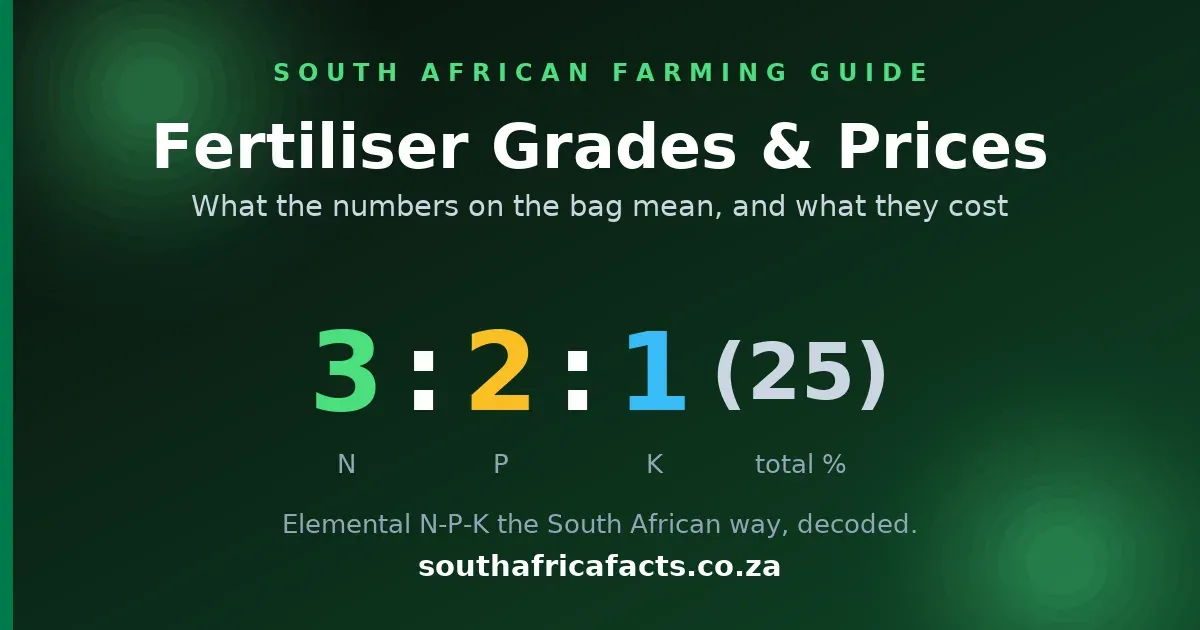
A grade like 3:2:1 (25) is really two pieces of information. The three numbers are the ratio of nitrogen to phosphorus to potassium, always in that order, N then P then K. The number in brackets is the total plant food in the bag as a percentage, so the rest of the bag is carrier material that spreads the nutrients evenly and does not feed the plant.
Working out the actual content is easier than it looks. For 3:2:1 (25) the parts add up to six, so nitrogen is three sixths of the 25 percent, which is 12.5 percent, phosphorus is two sixths, about 8.3 percent, and potassium is one sixth, about 4.2 percent. In a 50 kilogram bag that is roughly 6.25 kilograms of nitrogen, 4.2 kilograms of phosphorus and 2.1 kilograms of potassium, and the remaining 37 or so kilograms is carrier. The same reading works for any grade, so 2:3:2 (22) leans towards phosphorus, 4:3:4 (33) is a stronger balanced blend, and a code like 5:1:5 carries plenty of nitrogen and potassium with very little phosphorus. One warning, a grade such as 5:1:5 is sold in more than one strength, so always check the bracket number printed on your own bag rather than assuming it.
Straight products carry a single main nutrient and are simpler. LAN is 28 percent nitrogen, urea is 46 percent nitrogen, MAP carries phosphorus with a little nitrogen at 11 percent nitrogen and 22 percent phosphorus, and potassium chloride, the common potash also sold as MOP, is about 51 percent potassium. Here is what a 50 kilogram bag of each of the common products actually holds.
| Product | Nitrogen (N) in a 50 kg bag | Phosphorus (P) in a 50 kg bag | Potassium (K) in a 50 kg bag |
|---|---|---|---|
| LAN (28% N) | 14.0 kg | none | none |
| Urea (46% N) | 23.0 kg | none | none |
| MAP (11% N, 22% P) | 5.5 kg | 11.0 kg | none |
| Potassium chloride / MOP (51% K) | none | none | 25.5 kg |
| 3:2:1 (25) blend | 6.25 kg | 4.2 kg | 2.1 kg |
| 2:3:2 (22) blend | 3.1 kg | 4.7 kg | 3.1 kg |
| 4:3:4 (33) blend | 6.0 kg | 4.5 kg | 6.0 kg |
Elemental versus oxide, the South African difference
This is the one that catches people out, and it can cost real money. South Africa expresses phosphorus and potassium in their elemental form, as plain P and K, while most of the world, including the United States and much of Europe, uses the oxide form, P₂O₅ and K₂O. The catch is that the oxide numbers are larger than the elemental numbers for the exact same amount of actual nutrient.
So if you pick up a recommendation from an overseas source, or run your figures through an international fertiliser calculator built for oxide numbers, and then apply it as if it were elemental, you will over-apply phosphorus and potassium. That wastes money and can harm your soil and nearby water. To convert an oxide figure to the South African elemental basis, multiply P₂O₅ by 0.436 to get P, and multiply K₂O by 0.830 to get K. Our calculator works in elemental N, P and K throughout, and the soil test tab has a toggle that does this conversion for you if your recommendation happens to be in oxides.
Is urea or LAN cheaper for nitrogen?
This is the single most common fertiliser value question in South Africa, and the trap is comparing the price of the bag instead of the price of the nutrient. Urea is 46 percent nitrogen while LAN is only 28 percent, so a bag of urea holds far more nitrogen than a bag of LAN of the same weight. The fair comparison is cost per kilogram of actual nitrogen.
At mid-2026 reference prices that works out to roughly R46 for a kilogram of nitrogen from urea, against about R68 a kilogram from LAN, so on the nitrogen price alone urea usually wins comfortably, even though a bag of urea has the higher sticker price. That is not the whole story, LAN still earns its place, it is gentler on the soil, it supplies a little calcium, and it is less prone to losing nitrogen to the air in hot, dry conditions the way surface-applied urea can. But if you are buying nitrogen purely on cost, work in rands per kilogram of nitrogen, not rands per bag. The calculator shows this cost per kilogram of nutrient for whichever product you pick.
What fertiliser costs in South Africa
Fertiliser is a globally traded commodity priced in dollars, so South African prices move with international nitrogen, phosphate and potash markets, the rand exchange rate, and shipping costs. They spiked sharply after 2022 and, while they have come off that peak, they were still running well above the level of a year earlier through 2026. As a rough guide, here are recent bulk commodity reference prices from SA Grain, useful mainly for sanity-checking a quote.
| Product | Per ton (bulk) | Per 50 kg bag |
|---|---|---|
| LAN (28% N) | R19 125 | R956 |
| Urea (46% N) | R21 009 | R1 050 |
| MAP (11% N, 22% P) | R22 860 | R1 143 |
| Potassium chloride / MOP / potash (51% K) | R11 242 | R562 |
Reference fertiliser prices (SA Grain, July 2026), bulk commodity figures, retail bags cost more.
Two things to keep in mind with any fertiliser price. These are bulk commodity figures, so the price of a retail bag from your local co-op or agri shop is higher, sometimes considerably so for small quantities. And because the numbers move around so much from month to month, the sensible way to budget is to get your own current quote and work from that, which is exactly why the calculator lets you type in your own price per ton, per bag or per kilogram rather than trusting a figure that may already be out of date.
How many bags do you need per hectare?
Once you have a rate, the bag count is simple arithmetic. Multiply your application rate in kilograms per hectare by the number of hectares to get the total kilograms, then divide by your bag size and round up to the next whole bag. As a worked example, a rate of 300 kilograms per hectare across 5 hectares is 1 500 kilograms, which is 30 bags of 50 kilograms each.
The important word there is rate. This guide, and the calculator, will happily turn a rate into bags and cost, but neither will tell you what the rate should be, because the honest answer depends on your soil, your crop and your target yield, which only a soil test can tell you. The Fertiliser Association of Southern Africa and every co-op agronomist say the same thing, sample the soil first. Treat any single number you see online for how much fertiliser maize or any other crop needs as a rough sanity check at best, never as a recommendation for your land.
Work it out for your own fertiliser
The tables above give you the shape of the answer, but your own product, area, rate, bag size and price all move the final number, and stacking that up by hand is easy to get wrong. Our fertiliser calculator takes all of it and gives you the bags needed, the total kilograms and cost, an honest elemental N, P and K breakdown, and the cost per kilogram of nutrient that lets you compare unlike products fairly. It holds the common South African grades and straights, takes a custom grade or your own analysis, and has a second tab that checks a multi-product plan against a soil test target. While you are planning the farm, you can also work out what your borehole pump costs to run, check whether solar would pay off, work out what the diesel for each pass costs, which is the other big input line alongside fertiliser, or browse all our free South African tools and calculators.
Frequently asked questions
What does a fertiliser grade like 2:3:2 or 3:2:1 mean?
The three numbers are the ratio of nitrogen to phosphorus to potassium, in that order, and the number in brackets is the total plant food as a percentage of the bag. For 3:2:1 (25) the parts add up to six, so a 50 kilogram bag holds about 6.25 kilograms of nitrogen, 4.2 kilograms of phosphorus and 2.1 kilograms of potassium, with the rest being carrier material. Always check the bracket number on your own bag, because the same ratio, like 5:1:5, is sold in more than one strength.
What is the difference between elemental and oxide N-P-K?
South Africa labels phosphorus and potassium in elemental form, as plain P and K, while most of the world uses the oxide form, P₂O₅ and K₂O, which are larger numbers for the same amount of actual nutrient. If you apply an oxide-based recommendation as if it were elemental you will over-apply and waste money. To convert, multiply P₂O₅ by 0.436 to get P, and K₂O by 0.830 to get K.
Is urea or LAN cheaper for nitrogen?
Compare them on cost per kilogram of nitrogen, not on the bag price. Urea is 46 percent nitrogen and LAN is 28 percent, so even though a bag of urea costs more, each kilogram of nitrogen from urea is usually cheaper, roughly R46 against about R68 at mid-2026 reference prices. LAN still has its place because it is gentler on the soil and less prone to losing nitrogen in hot, dry conditions, but on nitrogen price alone urea normally wins.
How many bags of fertiliser do I need per hectare?
Multiply your rate in kilograms per hectare by your hectares to get total kilograms, then divide by your bag size and round up. For example, 300 kilograms per hectare across 5 hectares is 1 500 kilograms, or 30 bags of 50 kilograms. The rate itself should come from a soil test or a co-op recommendation, not a number to guess at, and the calculator turns it into bags and cost for you.
Why are fertiliser prices in South Africa so high?
Fertiliser is a globally traded commodity priced in dollars, so local prices track international nitrogen, phosphate and potash markets, the rand exchange rate and shipping costs, none of which are under local control. Prices rose steeply after 2022 and, although they have eased from the peak, they remained well above earlier levels through 2026. Because they move so much, it is worth getting a current quote rather than relying on a figure from a few months ago.
This guide gives general information to help you understand and budget for fertiliser, it is not a substitute for a soil analysis or advice from a qualified agronomist, and fertiliser rates should come from a soil test for your own land and crop. Nutrient contents are typical South African values and reference prices are bulk commodity figures from SA Grain, July 2026, retail prices are higher. Last reviewed July 2026.
What do you think?
Join the conversation on our South African community forum. Share your perspective, ask a question, or just say hello.