
Vegetable, Herb & Fruit Planting Calendar (South Africa)
What to plant now, by South African province and region, not a generic overseas calendar. Vegetables, herbs and fruit with harvest month, sun, water and difficulty.
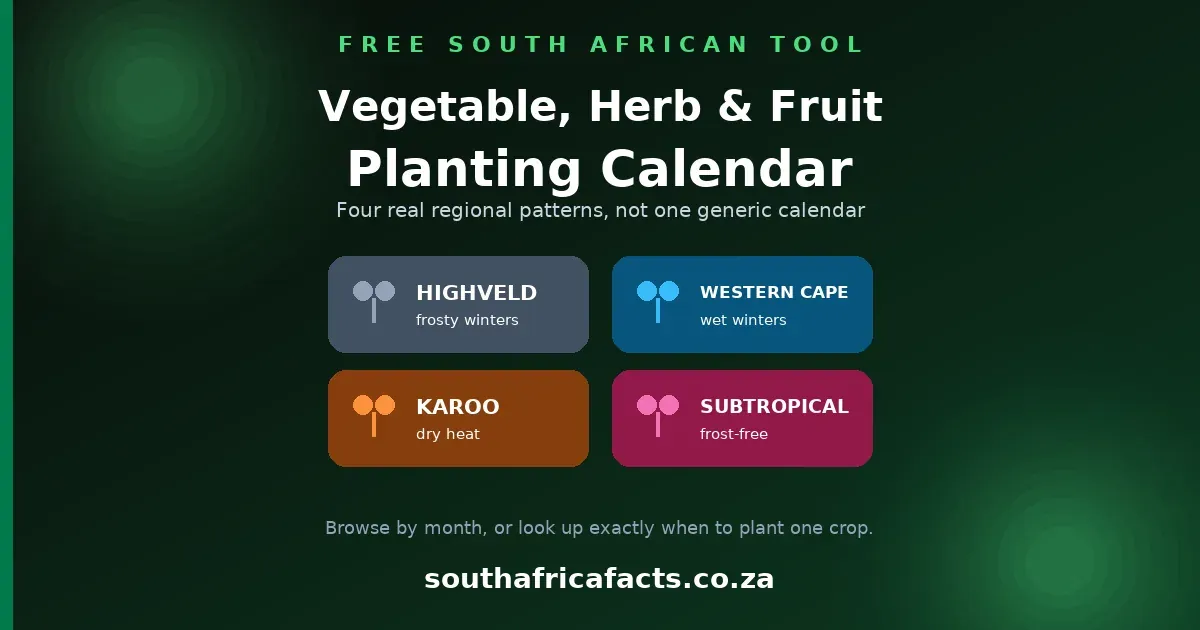
South Africa spans several distinct rainfall and frost patterns, so a single national planting calendar is not accurate for the whole country. Pick your province (and, for the few that span more than one climate, which part of it), then either browse what to plant this month, or look up the best planting months for one specific crop, using regional South African vegetable planting charts and standard South African planting conventions for herbs and fruit, not a generic overseas calendar.
Sow / plant means put seed directly in the ground now. Start in trays means start seed indoors or in seedling trays now, for planting out later. Transplant seedlings means put out nursery seedlings now, generally too late in the season for seed sown directly to mature before the weather turns. Expected harvest for vegetables and herbs is an approximate sow-to-harvest estimate for that specific planting month, actual timing varies with variety and weather. Fruit trees and vines do not fruit the season you plant them, so their card shows the typical bearing season once mature and how many years that usually takes. In "When do I plant a specific crop?" mode, the 12-box strip is a mini calendar for that one crop, coloured boxes are plantable months (green for sow/plant, blue for transplant, brown for start in trays), grey boxes are months to skip, and the text below spells out the exact sowing and harvest range for each window.
💬 Discuss this tool, or tell us about your region, on the forum →
A South African planting calendar that actually knows which hemisphere you're in
Most planting calendars found online are written for the Northern Hemisphere, so July reads as midsummer instead of the Highveld's coldest month, and the seasons run backwards for a South African garden. This tool is built from South African regional planting charts, not a generic overseas one, and picks between four genuinely different regional patterns, the summer-rainfall Highveld, the winter-rainfall Western Cape, the semi-arid Northern Cape interior, and the frost-free subtropical coast and lowveld, based on your province and, for the handful that genuinely span more than one climate, which part of it you're in.
Looking for other South African gardening and farming tools? Not sure exactly when your last frost is, rather than which region you are in? Our Planting Dates & Frost Calculator gives an actual typical and safe frost date for your town, checked against real weather data, rather than a regional pattern. If you are planning a new bed rather than planting an existing one, our Raised Bed Soil Calculator works out the litres, bags and bagged-versus-bulk cost to fill it. Our Fertiliser Calculator works out how much N-P-K your vegetable beds actually need, and our full list of free South African tools and calculators covers farming, finance, health and more.
South Africa's four planting regions
South Africa does not have one growing season. Most of the interior gets its rain in summer and frost in winter, the Western Cape is the reverse (wet winters, dry summers), the Northern Cape is dry and hot most of the year, and the KwaZulu-Natal coast and the Mpumalanga and Limpopo lowveld stay warm and frost-free year-round. This tool uses one of four regional charts based on your province, and for the handful of provinces that genuinely span more than one of these patterns, a second question lets you pick which part of the province you're actually in.
| Where | Pattern used | Climate |
|---|---|---|
| Gauteng, Free State, North West, Mpumalanga highveld, Limpopo highveld | Summer-rainfall Highveld | Hot summer, cold winter with frost |
| Western Cape | Winter-rainfall Cape | Wet mild winter, dry hot summer |
| Northern Cape | Semi-arid interior | Very dry, hot summer, brief winter frost |
| KwaZulu-Natal coast, Mpumalanga & Limpopo lowveld | Subtropical / frost-free | Warm and humid year-round, no frost |
| Eastern Cape | Your choice of area | Spans all four patterns above, see FAQ |
Frequently asked questions
Why isn't there just one South African planting calendar?
Because South Africa spans several genuinely different rainfall and frost patterns, not one climate. Most of the interior, Gauteng, the Free State, North West and the Mpumalanga and Limpopo highveld, gets its rain in summer and frost in winter. The Western Cape is the opposite, wet mild winters and dry hot summers. The Northern Cape is dry and hot for most of the year. The KwaZulu-Natal coast and the Mpumalanga and Limpopo lowveld stay warm and frost-free all year. A calendar built for one of those patterns, or copied from a Northern Hemisphere source, will get whole seasons backwards for the others.
What vegetables can I plant this month in South Africa?
It depends entirely on where you garden, which is the whole point of this tool, pick your province (and, where a province genuinely spans more than one climate, which part of it) and the month, and the vegetables, herbs and fruit cards above update to your actual region's pattern. As a general steer, though: the summer-rainfall interior (Gauteng, Free State, North West, the Mpumalanga and Limpopo highveld) plants most of its warm-season crops, tomatoes, beans, sweetcorn, cucumbers, in spring, September to November, and its cool-season crops, cabbage, carrots, onions, in autumn, February to April, with a quiet frosty gap in the middle of winter. The Western Cape, with its wet winters, runs closer to the opposite pattern for several crops. There isn't one answer for the whole country, which is exactly why a generic national planting calendar gets South Africa wrong.
What can I plant in Gauteng, Cape Town or Durban right now?
Select Gauteng, Western Cape or KwaZulu-Natal above and the current month, and the vegetables, herbs and fruit cards update immediately, no extra questions needed for any of those three, since Gauteng and the Western Cape each follow a single pattern, and the Durban coast is KwaZulu-Natal's default. Gauteng follows the summer-rainfall Highveld pattern, frosty winters and a spring planting rush. Cape Town and the rest of the Western Cape follow the reverse, winter-rainfall pattern. Durban and the rest of the KwaZulu-Natal coast are frost-free and subtropical, though if you're inland in KwaZulu-Natal's colder Midlands rather than on the coast, pick the "Midlands / Drakensberg" option that appears once you select the province, since that part of the province follows the Highveld pattern instead.
Where does this tool's data come from?
Vegetable planting months for the summer-rainfall Highveld region come from Organic Seeds' South African Summer Rainfall Region planting calendar, a multi-source compilation that distinguishes sowing seed directly, starting seed in trays, and transplanting seedlings. The Western Cape, Northern Cape and subtropical regions use Seeds for Africa's own province-by-province South African planting charts. Garlic is not covered by either source in enough detail, so it uses the standard South African autumn planting window (February to April) in every region. Herb windows are not lifted from a source chart, since no South African source publishes one at this level of regional detail, they are modelled from each herb's known cool-season, warm-season, or hardy-perennial habit applied to the same regional temperature pattern already sourced for the vegetables, and disclosed as a model rather than a scraped fact. Fruit tree bare-root planting windows and typical bearing seasons are standard South African nursery convention for deciduous and subtropical fruit.
Why does the tool ask a second question for some provinces?
Because a handful of provinces genuinely span more than one climate pattern, and there's no single town name that would work for everyone reading this. KwaZulu-Natal's Durban coast is frost-free and subtropical, but its Midlands and Drakensberg foothills, around Hilton, Howick and Nottingham Road, get real winter frost and behave like the Highveld. Mpumalanga and Limpopo are mostly cool highveld, but their lowveld pockets, around Hazyview, Nelspruit/Mbombela, Hoedspruit and Tzaneen, are warm, frost-free bushveld. The Eastern Cape spans all four patterns in this tool depending on where you are in the province. For those four provinces, a short second question lets you pick whichever description and example towns best match where you actually are, rather than guessing at a single province-wide answer. We tried this as a free-text town search first, but that only helped if you already knew which of our handful of listed towns was climatically closest to you, and it broke badly on iPhones, where Safari's autocomplete suggestion can visually cover the input as you type. Picking a plain-language description is more reliable and, if anything, more honest about what the tool actually knows, since there was never real town-by-town data behind it, just these same four regional patterns.
I'm not sure which option to pick for my province, what happens if I get it wrong?
Pick whichever description and example towns feel closest to where you actually are, full sun and frost pattern matter more than being right next to one of the named example towns. If you skip the question entirely, the tool uses the pattern that's typical for most of that province, the same information a generic provincial planting chart would give you, which is accurate for most people in most of these provinces and only a rough fit if you're in one of the less typical corners of the Eastern Cape, Mpumalanga, Limpopo or KwaZulu-Natal.
Why does the Eastern Cape work differently from the other provinces?
The Eastern Cape is the one province where we could not find a single reliable source chart. A commonly cited per-province planting chart for the Eastern Cape had every warm-season crop, tomatoes, cucumbers, melons, sweetcorn, shifted roughly five to six months into winter, which is not physically plausible anywhere in South Africa and was unusable. Since the Eastern Cape genuinely spans a winter-rainfall western strip near the Cape border, a warm humid central and eastern coast, a dry semi-arid Karoo-edge interior, and frosty interior highlands, we instead offer a direct choice between the other three regions' sourced charts, whichever actually matches your climate, with the subtropical coastal chart as the default for most of the province.
What's the difference between "sow/plant", "start in trays" and "transplant seedlings"?
These are the three actions the Highveld region's source data distinguishes. "Sow/plant" means put seed directly in the ground now. "Start in trays" means start seed indoors or in seedling trays now, to plant out once it's grown on. "Transplant seedlings" means put out nursery-bought or already-started seedlings now, generally because it's too late in the season left for seed sown directly outdoors to reach maturity before the weather turns. The Western Cape, Northern Cape and subtropical regions' source data doesn't distinguish these three actions as finely, so every month shown for those regions is a simple sow or plant action.
I already know what I want to grow, can I just look up when to plant it?
Yes, switch to "When do I plant a specific crop?" above the month field. Pick your crop from the dropdown and the tool shows a 12-month strip for your region, coloured boxes mark the months it can go in (green for sow/plant, blue for transplant, brown for start in trays), with the exact sowing and expected harvest range spelled out underneath. It reads the same regional data as the main month-by-month view, just organised the other way round, by crop instead of by month, so the two modes never disagree with each other. A handful of crops genuinely have no good planting window in a particular region, Melon in the Northern Cape's dry interior is one, and the tool says so directly rather than showing a blank result.
How is "expected harvest" worked out?
For vegetables and herbs, it's your selected planting month plus that crop's typical sow-to-harvest time, rounded to the nearest month, a standard seed-packet-style estimate. Actual timing shifts with variety, weather and how warm or cool the season runs. For fruit trees and vines it works completely differently, since a newly planted tree does not fruit in its planting season, so the fruit section instead shows the typical bearing season once the tree or vine is mature, together with roughly how many years that usually takes.
Why do some months show few or no vegetables or herbs for my region?
Winter genuinely is a quiet month for direct in-ground planting in the colder, frost-prone regions, and the source data reflects that honestly rather than padding it out. Two things are still usually worth doing in a thin month: check the fruit section, since bare-root deciduous fruit trees are planted specifically in winter while dormant, and check whether anything is flagged "start in trays" for the Highveld region, since trays let you get ahead of the season under cover even when direct sowing outdoors would fail.
Do sun, water and difficulty change by region?
No, these three ratings are general per-crop growing requirements, full sun versus part shade, how thirsty a crop typically is, and how fussy it generally is to grow well, and don't change by region in this tool. What changes by region is when you can plant each crop, not how much sun or water it wants once it's growing.
Why do deciduous fruit trees only appear in three of the four regions?
Apples, pears, peaches, plums, apricots, figs and grape vines are deciduous and need a real winter chill to break dormancy and fruit properly, which the Highveld, Western Cape and Northern Cape regions all get. The subtropical region, the KwaZulu-Natal coast and the Mpumalanga and Limpopo lowveld, is frost-free and doesn't get that chill, so these trees generally perform poorly or fail to fruit there. Instead, the subtropical region's fruit list is frost-tender fruit that actually suits that climate: banana, pawpaw, granadilla, guava, mango and litchi. Strawberries, which aren't frost-chill dependent, appear in every region.
Is this a guarantee that these crops will grow well for me?
No, it's a general regional guide, not a site-specific guarantee. Your own microclimate, altitude, soil, an unusually early or late frost, and how sheltered your garden is can all shift these windows by a few weeks in either direction, and growing under cover or in a greenhouse extends most of them further. Treat the result as a well-sourced starting point for your region, not the last word for your specific garden.
This tool gives regional planning guidance, not a site-specific guarantee. See the FAQ above for full sourcing and methodology. Last reviewed July 2026.