The Cheapest Way to Fill a Raised Garden Bed in South Africa
What to use instead of soil at the bottom of a deep bed, when bulk beats bagged soil, and what a real bed costs to fill in South Africa.
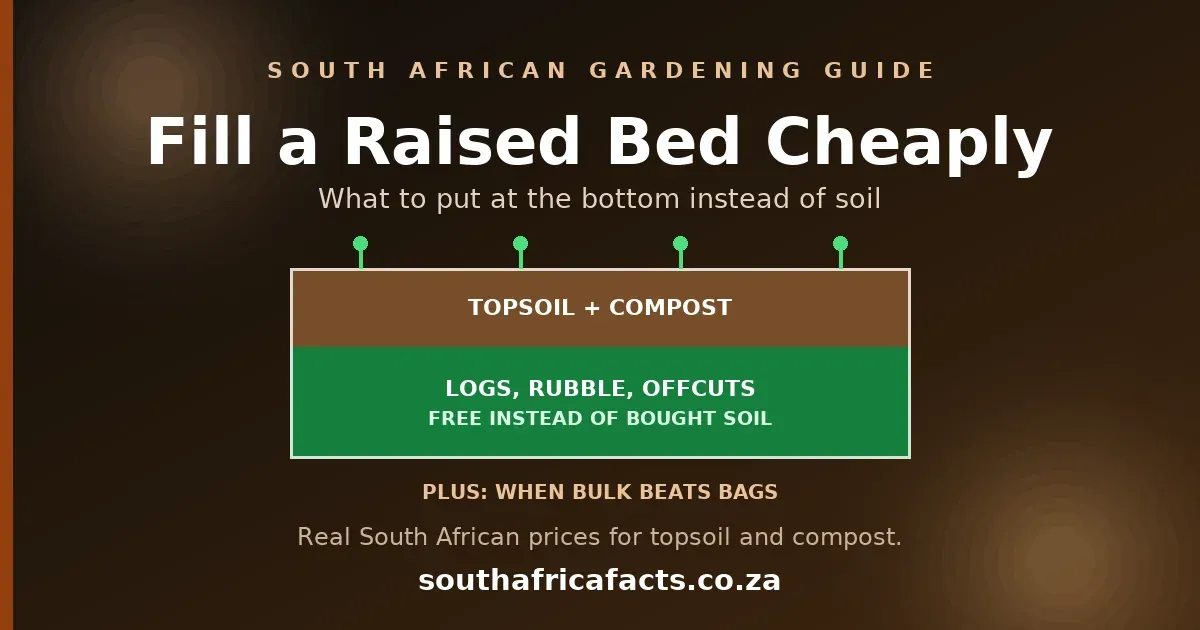
A raised bed looks simple until you work out what it actually takes to fill one. A single 240cm by 120cm bed at a modest 30cm deep needs almost 900 litres of growing medium, and a lot of new gardeners only discover that once they are standing in the garden centre aisle doing the maths on the back of a receipt. Fill it the obvious way, bag by bag, all the way to the bottom, and a deep bed in particular can cost far more than it needs to.
There are two things that move the price the most, and neither of them is about finding a cheaper bag of soil. This guide covers both, then works through what a real bed actually costs in South Africa. When you are ready to work it out for your own bed, our Raised Bed Soil Calculator does the litres, bags and bagged-versus-bulk comparison in a few seconds.
Don't fill a deep bed with good soil all the way to the bottom
The single biggest saving on a deep bed is also the oldest trick in the book. Roots that matter for growing vegetables mostly work in the top 20 to 30cm of soil, so a bed that is 60, 80 or 90cm deep does not need proper growing mix for its full depth, it needs it in the top layer only. Everything below that can be filled with something cheaper, or free.
Logs, branches, offcuts from pruning or firewood, straw, cardboard and clean builder's rubble all work as a base-fill layer, a mini version of what permaculture gardeners call hugelkultur. Gum poles and braai wood offcuts are an easy, very South African version of the same idea if you have access to them. The organic material breaks down slowly over months and years, improving drainage and feeding the bed from below, while the rubble or coarse material simply takes up volume you would otherwise have paid for in soil. The only rule worth keeping is to leave that proper 20 to 30cm of topsoil and compost above it, so roots never actually reach the base-fill layer while they are establishing.
Why does this matter more for South African beds specifically? A local metal raised-bed manufacturer sells two standard heights, 500mm for general planting and 900mm waist-height beds built specifically to reduce bending for people with mobility considerations. That extra height is a genuinely useful, deliberate design choice, not a growing requirement, and it is exactly the kind of bed where a base-fill layer saves the most money, since a large share of a 90cm-deep bed would otherwise be soil doing nothing but taking up space.
Buy bulk, not bags, once you're filling more than a bed or two
The second saving is in how you buy, not what you buy. A bagged trip to the garden centre, 20, 30, 40 or 50 litres at a time, carries the cost of the bag itself, the packing, and a retail markup on top of the soil. A bulk order, delivered and priced by the cubic metre, strips most of that out. For a single small bed the difference may not be worth the hassle of arranging a delivery, and a bulk supplier's minimum order or delivery fee can eat the saving entirely. But once you are filling several beds, or one large one, bulk is typically noticeably cheaper per litre than the same material bought bag by bag.
The break-even point depends entirely on your own numbers, your supplier's bag price, their bulk rate, and their delivery fee for your area, so there is no single rule of thumb that holds everywhere. That is exactly why it is worth pricing both ways for your specific bed rather than assuming.
Get the mix right, so you don't overspend on either layer
A widely used South African starting point, sold as a premade raised-bed mix by at least one Cape Town composting supplier, is 70% topsoil to 30% compost for filling a new bed. Straight compost alone is usually too rich and holds too much moisture on its own, while topsoil alone lacks the organic matter and nutrients a new bed needs, so the two are blended rather than used on their own. Topping up a bed that is already established needs far less topsoil, mostly compost, since the structure and drainage are already there.
Kraal manure, well-rotted cattle manure, is a cheap, widely available South African alternative or addition to bought compost, often sold in the same 30 litre bag size and priced similarly or a little less. Many South African gardeners use it for some or all of the compost portion of the mix.
What it actually costs to fill a raised bed in South Africa
| Material | Bagged (per 30L bag) | Bulk (per m³) |
|---|---|---|
| Topsoil | R25 | R700 |
| Compost | R40 | R1 000 |
Reference South African garden centre and bulk supplier prices, July 2026. They vary by region and supplier, always get your own quote.
Working through a real example: that same 240cm by 120cm by 30cm starter bed, filled at the 70/30 topsoil-to-compost mix with no base-fill layer, needs roughly 605 litres of topsoil and 259 litres of compost. Bought in 30 litre bags at the reference prices above, that comes to about 30 bags and a noticeably higher total than buying the same volume in bulk. A deep 160cm by 80cm by 90cm accessible bed with a 40cm base-fill layer at the bottom cuts the topsoil and compost needed by well over a third compared with filling it solid, on top of whatever the bulky base-fill layer saved by not being bought soil at all.
These are regional reference prices only, they vary by supplier and by distance from a bulk yard, always get your own quote before you commit to a large order.
Work it out for your own bed
The figures above give you the shape of the answer, but your own bed's dimensions, mix ratio, base-fill depth and local prices all move the final number. Our Raised Bed Soil Calculator takes all of it and gives you the litres, the topsoil and compost split, bags needed for whichever bag size you buy, and a bagged-versus-bulk cost comparison priced from your own numbers, with popular bed size presets to start from if you have not settled on dimensions yet. Once the bed is built, our Vegetable, Herb & Fruit Planting Calendar tells you what to plant in it this month for your part of the country, or browse all our free South African tools and calculators.
Frequently asked questions
What is the cheapest way to fill a raised garden bed?
Two things matter most. Buy bulk rather than bags once you are filling more than a bed or two, since bagged soil carries the cost of the bag, the packing and the retail markup on top of the soil itself. And for a deep bed, part-fill the bottom with logs, branches, straw, cardboard or clean builder's rubble rather than good growing mix all the way down, keeping proper topsoil and compost only in the top 20 to 30cm where roots actually feed.
What can I use to fill the bottom of a deep raised bed instead of soil?
Logs, branches, pruning or firewood offcuts, straw, cardboard and clean builder's rubble all work, a mini version of what permaculture gardeners call hugelkultur. The organic material breaks down slowly and feeds the bed from below over time. Keep it to the lower portion of the bed only, leaving at least 20 to 30cm of proper growing mix above it for roots.
Is it cheaper to buy raised bed soil in bags or in bulk?
It depends on volume. For a single small bed, bagged is usually simplest and a bulk supplier's delivery fee or minimum order can wipe out any saving. Once you are filling several beds, bulk ordered and delivered by the cubic metre is typically noticeably cheaper per litre than the same material in bags.
What is the best soil mix for a raised bed, and can I just use compost on its own?
A common South African starting point is 70% topsoil to 30% compost for a new bed, sold premixed in that ratio by at least one Cape Town supplier. Straight compost alone is usually too rich and holds too much moisture, while topsoil alone lacks organic matter, so the two are blended. Topping up an established bed needs far less topsoil, mostly compost.
How much does it cost to fill a raised bed in South Africa?
It depends on the size of the bed, the mix, and whether you buy bagged or bulk, but as a rough guide a common 240cm by 120cm by 30cm starter bed costs several hundred to around a thousand rand to fill at typical South African garden centre prices, less if bought in bulk or if part of the depth is a base-fill layer instead of bought soil. Our calculator works this out precisely for your own bed size and prices.
This guide gives general gardening information to help you plan and budget, it is not a substitute for advice from your own nursery or supplier. Reference prices are regional estimates from South African garden centre and bulk supplier listings, they vary by region and supplier, always confirm your own quote. Last reviewed July 2026.
What do you think?
Join the conversation on our South African community forum. Share your perspective, ask a question, or just say hello.