What It Costs to Plant a Hectare of Maize in South Africa
The real cost of working a hectare of maize, broken down pass by pass in litres and rands, with South African trial data and current diesel prices.
Ask what it costs to plant a hectare of maize in South Africa and you get two very different answers depending on what you mean. The whole cost, seed through harvest insurance, runs into the tens of thousands of rand: Grain SA's own 2025/26 budget for irrigated maize in Limpopo totals R44 525 a hectare. The cost of the machinery work itself, the actual passes across the land, is a much smaller number and the one most farmers are really asking about when they are deciding whether to plough again this year or hire someone.
This article breaks down the second one properly, pass by pass, in litres and rands, using South African diesel prices and South African trial data. It also says clearly what it cannot tell you, which is what a contractor will quote you, and why.
Where the money actually goes
Fuel is not the big line, and it is worth getting that straight before optimising the wrong thing. Grain SA puts fertiliser at roughly 30 to 35 percent of total variable cost for maize, the single largest item, running from about R3 300 a hectare in North West at lower yield targets to nearly R6 900 at higher ones, and up to about R8 900 a hectare in the Eastern Free State. For the 2025/26 season nitrogen prices fell about 13 percent while phosphate rose 22.3 percent and potassium 12 percent, and chemicals jumped 14.5 percent. Fuel, by comparison, eased about 4.6 percent.
Diesel typically lands somewhere around a tenth of a dryland maize budget. That still makes it worth costing accurately, because unlike fertiliser it is a line you can genuinely cut by changing how you work the land rather than by accepting less yield.
What the diesel costs, pass by pass
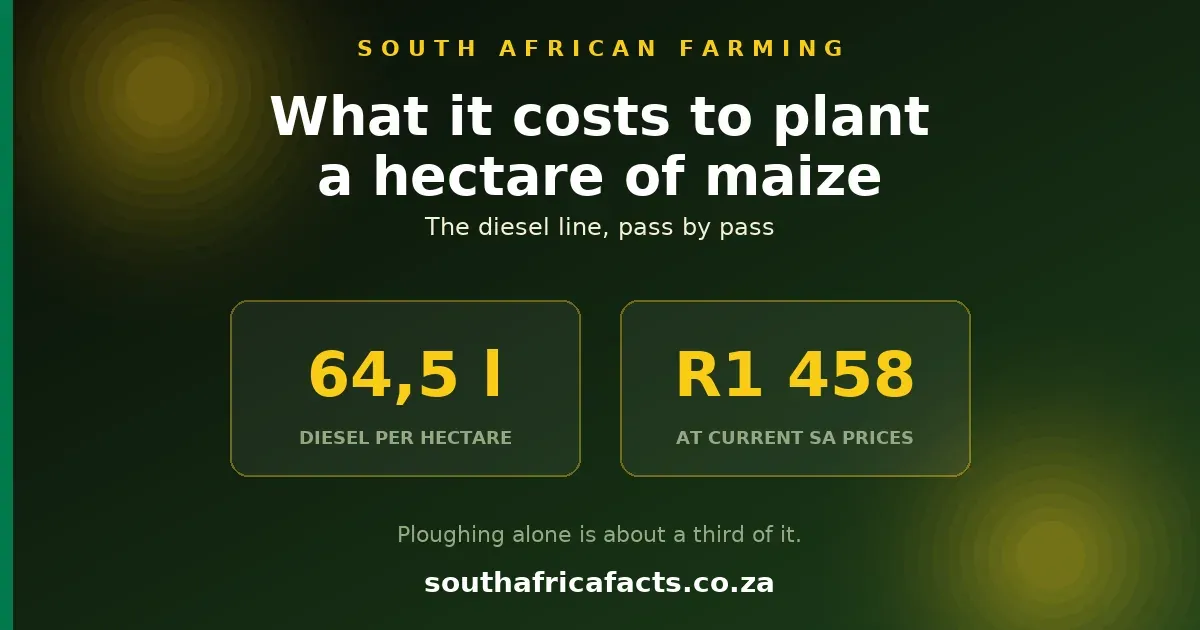
Here is a conventional dryland maize programme on loam, from knifing in fertiliser through to combining. Litres per hectare come from published machinery management figures; the rand column uses the August 2026 inland 50ppm diesel price of R26.41 a litre, less the SARS diesel refund of 382.2 cents a litre, so an effective R22.59 a litre.
| Pass | L/ha each | L/ha total | Diesel cost |
|---|---|---|---|
| Knifing in fertiliser | 5.5 | 5.5 | R125 |
| Mouldboard ploughing | 20.9 | 20.9 | R473 |
| Disking (x2) | 7.0 | 14.0 | R317 |
| Surface planting | 4.7 | 4.7 | R106 |
| Spraying (x2) | 2.0 | 3.9 | R89 |
| Mechanical weeding | 4.0 | 4.0 | R91 |
| Combining | 11.4 | 11.4 | R258 |
| Whole programme | 64.5 | R1 458 |
Ploughing alone is about a third of that total. It is by far the most expensive pass you make, which is why the tillage question below matters more than anything else on this list.
Your soil changes the answer more than your tractor does
The same programme on clay or clay loam takes about 77.0 litres a hectare instead of 64.5, because primary tillage on heavy soil takes 35 to 45 percent more diesel and secondary tillage 15 to 20 percent more. On sand and sandy loam it drops to about 57.9 litres. In rands, that is the difference between roughly R1 740 and R1 308 a hectare for identical work. Most of the Highveld is the heavy case, so a figure quoted for loam is usually flattering.
Tillage system is the biggest lever you control
A South African trial at Cedara in KwaZulu-Natal measured the diesel and time to establish a maize crop under four tillage systems. These cover land preparation and planting only, not harvesting or later spraying, so they are lower than the full programme above.
| Tillage system | L/ha | Hours/ha | Diesel cost/ha |
|---|---|---|---|
| Conventional (disc, plough, disc) | 53.4 | 4.74 | R1 207 |
| Chisel plough and disc | 46.6 | 4.22 | R1 053 |
| Stubble mulch (chisel plough) | 30.8 | 3.02 | R696 |
| No-till | 20.3 | 2.38 | R459 |
What will a contractor charge?
This is the question behind most searches for the cost of ploughing a hectare, and the honest answer is that there is no published South African rate card to point you at. Contractor price guides exist elsewhere, the British NAAC guide is the one that usually surfaces in a search, but those rates are built on a different fuel price, a different labour cost and a different machinery market, and they do not transfer.
What you can do is use the diesel figure as a floor. A contractor has to cover the fuel plus labour, repairs, tyres, insurance, the tractor's own depreciation and a margin, and on a typical machinery budget fuel is only around a sixth of the total cost of ownership and operation. So a quote that comes in at several times the diesel line is not necessarily expensive, and a quote close to the diesel line is either a favour or a mistake. Knowing your own fuel cost per hectare turns a quote from a number you have to accept into one you can interrogate.
A benchmark to check yourself against
Grain SA's 2025/26 budget for irrigated maize in Limpopo carries a fuel line of R1 670,88 a hectare, with machinery repairs a separate R1 333,73. That budget lists irrigation cost and contract harvesting as their own lines, so its fuel figure covers field operations without the harvest, on an irrigated farm that will make more passes than a dryland one. It is not a like for like comparison with the R1 458 above, and it should not be read as one, but landing in the same order of magnitude from two independent directions is a good sign that neither is wildly wrong.
Work out your own number
Every figure here shifts with your soil, your implements, your diesel price and how many passes you actually make. Our Tractor Fuel Consumption Calculator builds the whole season pass by pass, adjusts each tillage figure for sandy, loam or clay soil, and gives you litres and rands per hectare and per ton produced, with the SARS diesel refund on an explicit line. If you are working out the refund claim itself, the SARS Diesel Rebate Calculator follows SARS's own published method, and for the fertiliser side, which is the bigger line, the Fertiliser Calculator works out bags, cost and cost per kilogram of nutrient.
Frequently asked questions
What does it cost to plant a hectare of maize in South Africa?
Counting everything, seed, fertiliser, chemicals, fuel, repairs, insurance and finance, a commercial maize budget runs into the tens of thousands of rand a hectare. Grain SA's own 2025/26 budget for irrigated maize in Limpopo puts the total at R44 525 a hectare. Dryland is a good deal lower, and the single biggest line is fertiliser, which Grain SA puts at roughly 30 to 35 percent of total variable cost, somewhere between about R3 300 and R6 900 a hectare in North West depending on your yield target and up to about R8 900 in the Eastern Free State. Diesel is a much smaller line than most people expect. On a conventional dryland programme it works out near R1 458 a hectare at August 2026 prices.
How much diesel does it take to plant a hectare of maize?
About 64.5 litres a hectare on loam for a full conventional programme, from knifing in fertiliser through ploughing, disking twice, planting, two sprays, a weeding pass and combining. That is close to the roughly 60 litres a hectare Grain SA gives as a typical grain farm's annual use. On clay or clay loam the same programme takes about 77.0 litres, and on sand about 57.9 litres. Ploughing alone is roughly a third of it.
What does a contractor charge to plough a hectare in South Africa?
There is no published South African rate card to quote, which is worth saying plainly rather than inventing a range. Contractor pricing guides exist for other countries, the British NAAC guide is the one that usually turns up in a search, but those rates are set by a different fuel price, labour cost and machinery market and do not transfer. What you can do is work out the diesel line exactly, which this article does, and know that a contractor's rate has to cover the fuel plus labour, repairs, tyres, insurance, the tractor's own depreciation and a margin. Fuel is only around a sixth of a typical machinery cost, so expect a quote to be several times the diesel figure. That gives you a floor to sanity check a quote against, not a substitute for one.
Is it cheaper to plough or to go no-till?
On diesel alone, no-till wins comfortably. A South African trial at Cedara measured 53.4 litres a hectare to establish maize conventionally with a disc, plough and disc, against 20.3 litres under no-till, which at current prices is a saving of about R747 a hectare, plus roughly 2.4 hours of tractor time. The trial's own conclusion is the part usually left out though: the no-till treatment needed a glyphosate spray and an extra 40 kg of nitrogen a hectare that the ploughed treatments did not, and once those were counted the total establishment cost came out much the same. The fuel saving is real. The cost saving was not.
Does the SARS diesel refund change the number?
Yes, by about 14 percent of your diesel bill, if you are registered for it. A registered on-land claimant gets 382.2 cents a litre back on eligible diesel, which at August 2026 inland prices takes a litre from R26.41 down to an effective R22.59. Across the programme above that is the difference between R1 705 and R1 458 a hectare. Every rand figure in this article is quoted after the refund, because that is what the diesel actually costs a registered farmer.
How many hours does it take to work a hectare?
The Cedara trial measured 4.74 hours a hectare to establish maize conventionally, down to 2.38 hours under no-till, for land preparation and planting only. The Department of Agriculture's machinery cost guide uses a worked example of 1.74 hours a hectare for ploughing alone with a 60 kW four wheel drive tractor and a three furrow disc plough. Your own figure depends on implement width and working speed: field capacity is speed in kilometres an hour times working width in metres times your field efficiency, which is the share of the hour actually spent working rather than turning on the headlands.
Why is fertiliser so much bigger than fuel in the budget?
Because maize takes a lot of nutrient off the land and it has to be put back every season, while diesel only buys you the passes. Grain SA puts fertiliser at roughly 30 to 35 percent of total variable cost for maize, the single largest line, and for the 2025/26 season nitrogen prices dropped about 13 percent while phosphate rose 22.3 percent and potassium 12 percent. Fuel eased about 4.6 percent over the same period. If you are hunting for savings, the fertiliser line is where the money is, though it is also the line where cutting back costs you yield most directly.
Sources: diesel use per operation from Computus Farm Machinery Management chapter 12 (South African text, Nebraska survey data, indicative); tillage system diesel and hours measured at Cedara and published by the KwaZulu-Natal Department of Agriculture and Rural Development; power demand bands and the field capacity formula from the Department of Agriculture and KZN DARD Guide for Machinery Costs; budget and input cost figures from Grain SA; diesel prices from the Fuels Industry Association of South Africa, August 2026; diesel refund rate from the Government Gazette notices behind rebate item 670.04. Planning estimates, not a quote or financial advice.
What do you think?
Join the conversation on our South African community forum. Share your perspective, ask a question, or just say hello.