VAT Deregistration in South Africa: The Exit Bill Nobody Mentions
The threshold rose to R2.3 million on 1 April 2026 and a lot of businesses can now leave the VAT net. Leaving has a bill attached that most guides skip.
On 1 April 2026 the compulsory VAT registration threshold rose from R1 million to R2.3 million, the biggest change to South Africa's VAT framework since 2009. Overnight, a large number of businesses that had been registered because the law required it were free to walk away. Most of the coverage stopped at that good news. What it mostly skipped is that walking away has a bill attached, and it lands in your final VAT return. If you still own stock, tools, equipment or furniture on the day you stop being a vendor, SARS treats you as having sold all of it back to yourself and taxes you on it. To work out whether leaving actually pays for you, our Should I Register for VAT? calculator has a deregistration mode that prices both the annual saving and that exit bill. This article is the explanation behind it: who qualifies, what leaving costs, how the process actually works, and the mistakes that make it expensive.
✓ Every rule and figure below was last checked against SARS's own published sources on 26 July 2026. See where each one comes from at the end of this article.
Who can deregister after the 2026 threshold increase
You can apply to cancel your VAT registration once the value of your taxable supplies will be less than R2.3 million in any consecutive period of twelve months. That is the same threshold that now triggers compulsory registration, read in reverse. The practical effect of the increase is that every vendor sitting between R1 million and R2.3 million of turnover, a very large group, moved from having no choice to having one.
Having a choice is the important part. You are not obliged to leave just because you now fall below the line. You may elect to cancel, or you may elect to stay registered on a voluntary basis and carry on exactly as before. Nothing happens automatically, and SARS will not deregister you simply because your turnover dropped. If you do nothing, you remain a vendor with all the obligations that carries.
There are also circumstances where SARS will cancel your registration whether you ask or not: the enterprise closes down and will not restart within twelve months, the enterprise never actually commenced, or you no longer meet the requirements you relied on to register voluntarily. Since 1 April 2014 the Commissioner has also had discretion to deregister any vendor who fails to submit a return for a tax period, which is worth knowing if you have been quietly ignoring VAT201s in the hope the problem goes away.
The exit bill: VAT on the assets you still own
This is the part that catches people, and it is the single best reason not to treat deregistration as free administrative housekeeping.
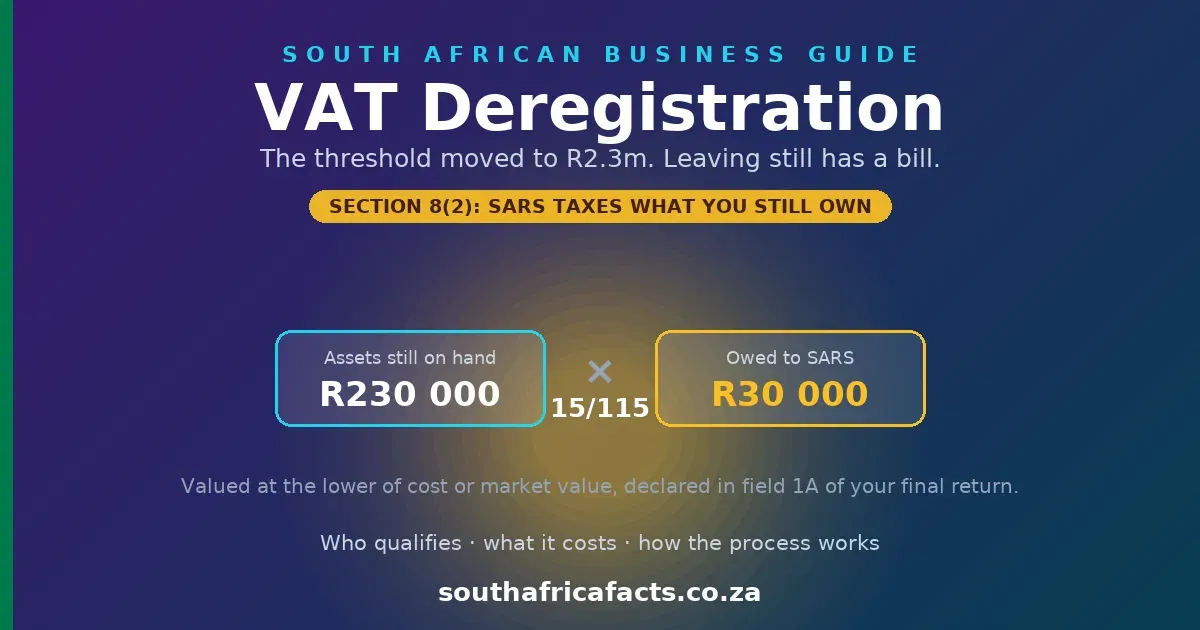
Section 8(2) of the VAT Act deems the goods and rights forming part of your enterprise's assets to have been supplied by you immediately before you cease to be a vendor. You did not sell anything, no money changed hands, but for VAT purposes a sale is treated as having happened. Section 10(5) then sets the value of that deemed supply at the lesser of what the goods cost you or their open market value, and you account for output tax on that amount using the tax fraction of 15/115. It goes into your final VAT return, in field 1A.
A worked example makes the size of it obvious. Say you are a small contractor leaving the VAT net, and on your last day as a vendor you still hold R230,000 of stock, tools and equipment, valued at the lower of cost or current market value. Your exit bill is R230,000 multiplied by 15/115, which is R30,000, payable in your final tax period. That is real money, due at exactly the moment you were expecting your VAT obligations to end.
The logic behind it is fair enough once you see it. While you were registered you claimed back the VAT on those assets when you bought them. If you could simply walk out still owning them, you would have permanently pocketed input VAT on goods that ended up outside the VAT system. The deemed supply claws that back. Notice that it is the same 15/115 fraction you used to claim the VAT in the first place, which is why the two broadly cancel out.
Two things reduce the bill. First, the valuation is the lesser of cost or open market value, so genuinely depreciated equipment is valued at what it is actually worth now, not what you paid years ago. Keep evidence of that valuation. Second, assets on which input tax was denied in the first place are excluded, which most importantly means motor cars, and also entertainment. You never claimed the VAT on the company bakkie's replacement sedan, so you are not taxed on it now.
One further point worth raising with SARS rather than assuming: when the threshold last rose in 2009, taxpayers deregistering as a result were permitted to pay the deemed output tax in instalments over six months. Whether an equivalent concession applies to the 2026 increase was still unresolved at the time of writing, so if the exit bill is large enough to hurt, ask about payment terms rather than treating the full amount as immediately due.
How to deregister, step by step
1. Check you actually qualify. Your taxable supplies must be heading below R2.3 million over a consecutive twelve-month period. Base this on realistic expectations, not a single quiet quarter.
2. Work out the exit bill before you apply, not after. Total up the enterprise assets you will still hold, at the lower of cost or market value, exclude anything where input tax was denied, and multiply by 15/115. If that number changes your mind, you have lost nothing by checking.
3. Submit the right form. Use a VAT123e to cancel the registration across all your enterprises. Use a VAT123T if you are only cancelling one separately registered enterprise, branch or division. The circumstances giving rise to the cancellation must be stated clearly on the form or in a letter attached to it. You can submit it to the SARS branch where you are registered, by email, or through a virtual appointment booked on eBooking.
4. Keep charging VAT until SARS says stop. This is where people go wrong. Cancellation does not take effect when you post the form. For a voluntary deregistration the Commissioner decides the date and tells you which tax period is your final one. Until the last day of that period you must carry on charging VAT on your supplies, declaring output tax, and claiming the input tax you are entitled to, exactly as before. Stopping early means you have undercharged your customers and understated your returns.
5. File the final return, including field 1A. Your last VAT201 carries the deemed supply on assets on hand. SARS normally wants that final return in before it will approve the cancellation.
6. Settle everything outstanding. SARS cannot finalise a cancellation while any VAT liability or obligation is unresolved. Outstanding returns, unpaid assessments and unfiled periods will all hold it up. SARS does not publish a processing timeframe for cancellations, and the informal estimates floating around vary so wildly that none of them is worth relying on. A clean compliance record is the only thing you control that makes it faster.
Should you deregister, or stay registered voluntarily?
Qualifying to leave and being better off leaving are different questions. The economics come down to four things.
What you reclaim on costs. As a vendor you get back 15/115 of everything you spend that carries VAT. Give that up and it comes straight off your bottom line. How much it matters depends heavily on your cost base: a retailer or manufacturer buying stock and materials recovers a great deal, while a consultancy whose costs are mostly salaries recovers almost nothing, because wages carry no VAT at all. The same is true of interest, petrol and diesel, municipal rates and residential rent.
Who your customers are. If you sell mainly to other VAT-registered businesses, charging VAT costs them nothing, because they claim it straight back. Deregistering wins you no competitive advantage with those customers and may actively cost you: some larger companies and government departments will not deal with a supplier who cannot issue a valid tax invoice, since it costs them the input VAT on everything they buy from you. If you sell mainly to consumers, the opposite holds. Your prices effectively drop about 13% the day you stop charging VAT, or your margin improves by the same amount, which is a genuine competitive gain.
What the admin is actually costing you. Six VAT201 returns a year, the record keeping behind them, and either your own time or a bookkeeper's fee. For a small business with a simple cost base this can be the largest single item in the calculation.
The exit bill, spread over time. A saving of R40,000 a year against a R30,000 exit bill pays for itself in about nine months. The same R30,000 against a R5,000 annual saving takes six years, which is far too long to be confident nothing changes. Our Should I Register for VAT? calculator does this in its deregistration mode: enter your turnover, customer mix, cost base and the assets you hold, and it gives you both the annual figure and how many months the exit bill takes to earn back.
The mistakes that make deregistration expensive
Forgetting the assets entirely. By far the most common and most costly. Owners think of deregistration as paperwork and are then presented with a five-figure liability in the final return.
Stopping charging VAT on the day you apply. You remain a vendor until the last day of the final tax period SARS specifies. Everything invoiced before then must still carry VAT.
Valuing assets at original cost when market value is lower. The rule is the lesser of the two. Using cost for a five-year-old set of equipment can materially overstate what you owe.
Leaving when your customers are all VAT vendors. If nobody in your customer base feels the 15%, the only thing deregistering buys you is a smaller admin load, paid for with the input VAT you no longer reclaim and the exit bill on the way out.
Not thinking about growing back. If you deregister and later cross R2.3 million again, registration becomes compulsory and you must apply within 21 business days. You start the admin over, and the input VAT you gave up in between is gone for good. If you are growing steadily toward the threshold anyway, the case for leaving is weak.
Assuming a low turnover means low assets. A business can turn over R1.5 million and still hold R400,000 of equipment. The exit bill scales with what you own, not what you sell.
Where these figures come from
Last checked 26 July 2026. The R2.3 million threshold, the VAT123e and VAT123T forms, the field 1A treatment of assets on hand and the requirement that outstanding liabilities be settled first all come from SARS's Cancellation of VAT registration page, with the registration side on Register for VAT.
The mechanics, meaning when the Commissioner may cancel a registration, the obligation to keep charging VAT until the last day of the final tax period, the denial of input tax on motor cars and entertainment, and the deemed supply of assets on ceasing to be a vendor, come from the SARS VAT 404 Guide for Vendors, currently Issue 15, chapters 2, 3 and 8. Section numbers are cited rather than page numbers, since SARS reissues the guide and the pagination moves while the numbering does not. The exit VAT itself rests on sections 8(2) and 10(5) of the VAT Act.
Expect one discrepancy if you open the guide. Issue 15 still quotes the old R1 million compulsory and R50,000 voluntary thresholds throughout, because it predates the April 2026 Budget change. That is the guide waiting to be reissued rather than an error here. Use the SARS web pages for the numbers and the guide for how the rules work.
Frequently asked questions
Can I deregister for VAT now that the threshold is R2.3 million?
Yes, if the value of your taxable supplies will be less than R2.3 million in any consecutive twelve-month period. The threshold rose from R1 million on 1 April 2026, so every vendor between those two figures became free to apply. You are not obliged to leave, though. You may also elect to stay registered on a voluntary basis, and if you do nothing at all you simply remain a vendor with all the usual obligations.
What does it cost to deregister from VAT in South Africa?
The form itself costs nothing, but section 8(2) of the VAT Act deems all the enterprise assets you still hold to have been supplied immediately before you cease to be a vendor. Section 10(5) values that deemed supply at the lesser of what the assets cost you or their open market value, and you account for output tax at the tax fraction of 15/115 in your final return, in field 1A. On R230,000 of stock and equipment that is R30,000. Assets on which input tax was denied to begin with, most importantly motor cars and entertainment, are excluded.
Which form do I use to cancel a VAT registration?
Form VAT123e cancels your registration across all your enterprises. Form VAT123T is used where you are cancelling only one separately registered enterprise, branch or division. Either way you must clearly state the circumstances giving rise to the cancellation, on the form itself or in a letter attached to it. You can submit it at the SARS branch where you are registered, by email, or via a virtual appointment booked through eBooking.
When do I stop charging VAT to my customers?
Not when you submit the form. For a voluntary deregistration the Commissioner decides the date of cancellation and tells you which tax period is your final one. Until the last day of that period you must keep charging VAT on your supplies, keep declaring output tax, and keep claiming the input tax you are entitled to. Stopping early means you have undercharged customers and understated your returns, which is a far more expensive problem than waiting.
How long does VAT deregistration take?
SARS does not publish a processing timeframe, and the estimates circulating from various service providers contradict each other so heavily that none is worth relying on. What SARS does state is that it cannot finalise a cancellation until every outstanding VAT liability and obligation has been resolved or settled. Outstanding returns, unpaid assessments and unfiled periods will all hold things up, so the single most useful thing you can do is make sure your compliance record is clean before you apply.
Is it better to deregister or stay VAT registered voluntarily?
It depends on your cost base and your customer mix far more than on your turnover. If a large share of your costs carries VAT, you lose real money by giving up the input claim. If your customers are mostly VAT-registered businesses, they never felt the 15% anyway, so deregistering wins you nothing with them and may lose you those who require a valid tax invoice. If your customers are consumers and your costs are mostly salaries, leaving is usually the better call. Our Should I Register for VAT? calculator works this out in rand, including how long the exit bill takes to pay back.
What happens if I deregister and my turnover grows past R2.3 million again?
Registration becomes compulsory again and you must apply within 21 business days of crossing the threshold. You would go through the registration process from scratch, and the input VAT you gave up during the period you were deregistered is not recoverable. If your business is growing steadily toward R2.3 million, that alone is a strong argument for staying registered rather than leaving and returning.
Do I pay VAT on my company car when I deregister?
No. Input tax on a motor car is denied when you buy it, unless you are a motor dealer or a car rental business, so a motor car is excluded from the deemed supply on deregistration. The same logic applies to entertainment. You are only taxed on the way out for assets you were allowed to claim the VAT on in the first place, which is precisely why the deemed supply exists.
Is this tax advice?
No, it is general information to help South African business owners understand what deregistration involves and what it costs. VAT is a technical tax and the consequences of getting registration or deregistration timing wrong are real. Confirm your own position with SARS or a registered tax practitioner before submitting anything, particularly the valuation of assets on hand, which is the figure most likely to be queried.
To put a rand figure on your own decision, including the exit bill and how many months it takes to earn back, use the Should I Register for VAT? calculator and switch it to deregistration mode. If you are weighing up your business structure more broadly, the Sole Proprietor vs Company calculator compares the tax positions, the Working Capital & Cash Gap Calculator shows what your debtor and stock days are costing you, and the Business Compliance Calendar keeps SARS and CIPC deadlines from becoming a surprise. You can find every free tool on our tools and calculators page.
This article is general information about VAT deregistration in South Africa, not tax advice. Thresholds, forms and the deemed supply rules described here are as published by SARS and confirmed against the VAT 404 Guide for Vendors, current as of July 2026. Confirm your own position with SARS or a registered tax practitioner. Last reviewed July 2026.
What do you think?
Join the conversation on our South African community forum. Share your perspective, ask a question, or just say hello.