
Should I Register for VAT? The Economics, Not Just the Threshold (South Africa)
Not a threshold checker. Works out whether registering for VAT would actually leave your business better or worse off, and what deregistering would cost you.
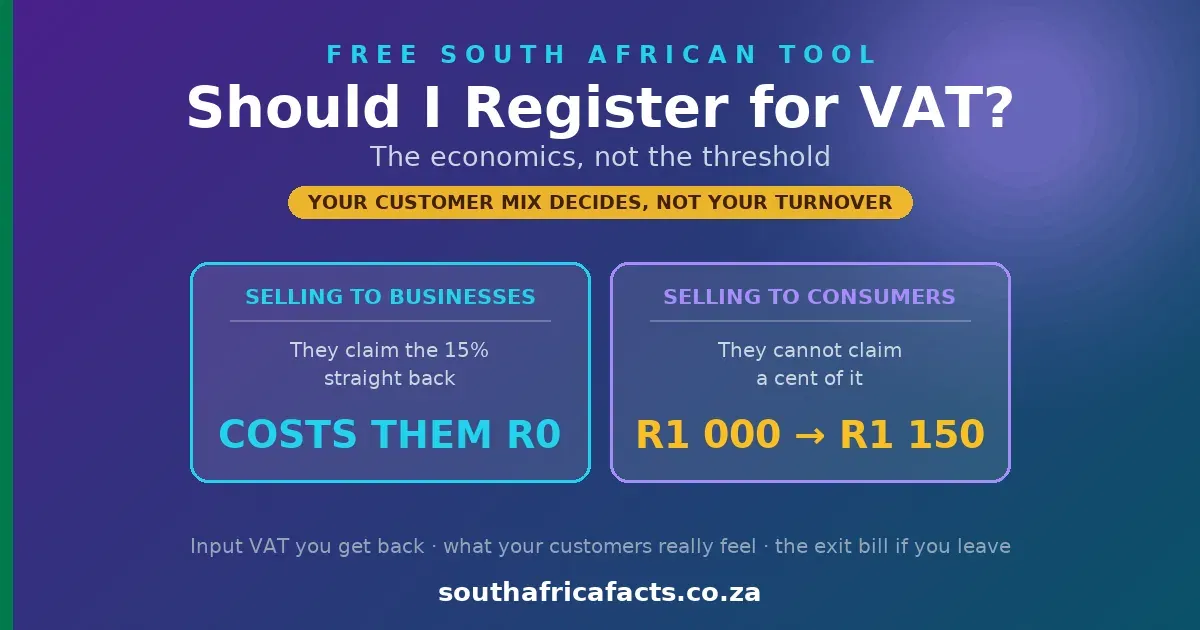
Should I register for VAT?
Should I Register for VAT?
Not the threshold, the economics. Below R2.3 million a year, registering is a business decision, not a legal duty. This works out what it would actually cost or save you, including the part most guides skip: whether your customers can claim the VAT back.
The compulsory threshold rose from R1 million to R2.3 million on 1 April 2026, so a lot of businesses that had to be registered are now free to leave. Leaving has a one-off cost most people do not see coming, which the second option works out for you.
Everything the business bills in a year, at the prices you charge today. You are not charging VAT yet, so this is simply your sales.
Customers who are themselves VAT vendors. They claim back any VAT you charge them, so to them your price with VAT added costs exactly what it costs today. This is usually the single most important number on this page.
Exports, basic foodstuffs (brown bread, maize meal, rice, fresh fruit and vegetables, dried beans, eggs and the rest of the zero-rated list) and fuel levy goods such as petrol and diesel. You charge 0% on these but still claim the VAT on what you bought, which is why exporters and fresh produce sellers are usually in a permanent refund position.
Whatever is left over is sales to private consumers and small businesses that are not registered. Those customers cannot claim your VAT back, so they are the only ones who genuinely feel it.
Everything the business spends in a year, at the prices you pay today. Because you are not registered, those prices already include VAT that you currently cannot claim back.
Carries VAT: stock and materials, equipment, commercial rent from a registered landlord, professional fees, electricity, phone and internet, short-term insurance, repairs. Carries none: salaries and wages, interest and bank charges on credit, petrol and diesel, municipal rates, residential rent, and anything bought from a supplier who is not registered. A consultancy that is mostly salaries might sit near 20%. A retailer buying stock might sit near 80%.
A one-off claim in your first year, often the very thing that makes voluntary registration pay. Leave it at 0 if you have nothing planned. Exclude motor cars, SARS denies the input VAT on a car outright, even a genuine business one, unless you are a car dealer or a rental fleet.
At 100% you add the full 15% to your price and the consumer pays more. At 0% you hold your price exactly where it is and the VAT comes out of your own margin. Anything in between splits it. This slider only affects consumers and non-registered customers, because registered businesses claim it back either way, so the model always passes the full 15% on to them.
Most vendors file a VAT201 every two months, so six returns a year, each needing proper tax invoices, reconciled records and an eFiling submission. This is the recurring cost of being a vendor, whether you do it yourself in time or pay a bookkeeper to do it.
This decides whether the payments basis is open to you, and it matters more than most people realise. See the cash flow result below.
The average time from invoice to money in the bank, not your stated terms. On the invoice basis you owe SARS the VAT on a sale once you have invoiced it, whether or not the customer has paid. Set this to 0 for a cash business paid on the spot.
💬 Weighing up VAT registration? Discuss this tool on the forum →
More Business tools: Sole Proprietor vs Company · Working Capital & Cash Gap · Employee Cost Calculator · Provisional Tax Calculator · Business Compliance Calendar · Employee or Independent Contractor?
Should you register for VAT in South Africa?
Below R2.3 million a year, registering for VAT is a business decision, not a legal duty, and it is a decision most free tools refuse to help with. Search for help and you find two things: threshold checkers that tell you whether you are allowed to register, and add-or-remove-15% calculators that do arithmetic you could do on your phone. Neither answers the question an owner actually asks, which is whether registering would leave them better or worse off. That depends on how much of your spending carries VAT you could reclaim, on whether your customers can claim your VAT back, and on what six VAT201 returns a year cost you in time or bookkeeping fees. This calculator models all three and gives you a rand answer.
The part almost every guide gets wrong
You reclaim 15/115 of your VATable costs, not 15% of them. Because you are not registered today, the prices you already pay include VAT, so the VAT sits inside the price rather than on top of it. R115,000 of VATable costs returns R15,000, not R17,250. Treating it as 15% overstates the case for registering by 15% every time, which is exactly the direction that pushes a business into a decision it should not have made. The same fraction reappears on the way out: the exit VAT you pay on assets still held when you deregister is also 15/115.
The second thing guides skip is that not all costs carry VAT at all. Salaries and wages are not a supply by a vendor, so they carry none. Neither do interest and bank charges on credit, petrol and diesel (which are zero-rated fuel levy goods), municipal rates, residential rent, or anything bought from a supplier who is not registered. A consultancy whose costs are mostly people recovers almost nothing, while a retailer buying stock recovers a great deal. That single difference decides the question more often than turnover does.
Roughly what share of costs carries VAT, by business type
Starting points for the slider only, not measured data. Your own management accounts will always beat a rule of thumb, and it is worth doing once properly: this number moves the answer more than almost any other input.
| Business type | VATable share of costs | Why |
|---|---|---|
| Consultancy or professional services | 15–30% | Mostly salaries, which carry no VAT at all |
| Trades and contracting | 40–60% | Materials carry VAT, own labour does not |
| Retail or e-commerce | 70–85% | Stock purchases dominate the cost base |
| Manufacturing | 60–80% | Raw materials and plant, less the wage bill |
| Restaurant or food service | 50–70% | Ingredients and rent, less a large staff cost |
| Transport and delivery | 30–50% | Fuel is zero-rated, so it recovers nothing |
Who your customers are matters more than your turnover
If your customers are VAT-registered businesses, they claim back every rand of VAT you charge them. Your price with 15% added costs them exactly what it costs them today, so the VAT is invisible to them and you can pass it on in full, keep your revenue intact, and still reclaim the VAT on your own costs. That is close to a free gain. If your customers are private consumers or small unregistered businesses, none of that holds: they cannot reclaim anything, so you either raise prices about 15% and lose ground to an unregistered competitor, or hold your price and give up roughly 13% of your revenue on those sales. Most businesses are somewhere in between, which is why the calculator asks for the split and works out your break-even pass-through, the exact share of the VAT you could absorb and still be no worse off.
Voluntary VAT registration: the advantages and disadvantages
Voluntary VAT registration is open from R120,000 of taxable supplies, and whether it is worth it comes down to a short list on each side. The advantages: you reclaim the VAT on everything you buy, which is real money if your cost base is stock, materials or equipment rather than salaries; a one-off claim on equipment you were going to buy anyway; some larger customers and government departments will not deal with a supplier who cannot issue a valid tax invoice, because it costs them the input VAT on everything they buy from you; and if your supplies are zero-rated you end up in a permanent refund position. The disadvantages: six VAT201 returns a year with the record keeping behind them; a 15% price increase to any customer who cannot reclaim it, or the same amount out of your margin; and on the invoice basis you owe SARS the VAT when you invoice, not when you get paid, which bites if your customers are slow. The honest summary is that a consumer-facing business with a mostly wage cost base should usually wait until the law forces the issue, and a business selling to other VAT vendors with real VATable costs should usually register early. The calculator above tells you which one you are, in rand.
A worked example, line by line
Take a business billing R1.5 million a year today, 40% of it to VAT-registered businesses and 60% to consumers, with R900,000 of annual costs of which 55% carries VAT, and R9,600 a year of extra bookkeeping. Read that R1.5 million as the prices it charges right now, while unregistered. There is no VAT inside it, because an unregistered business cannot charge any. That matters for what follows: registering does not re-slice an existing number, it changes what the business charges and what it keeps.
The whole decision then turns on one choice, what to do about the 60% of sales going to consumers who cannot reclaim VAT. Add the 15% on top and they pay more, or hold the price and absorb it. Business customers are not part of that choice, they reclaim whatever you charge them, so the full 15% always goes on to them and it costs neither side anything. Here is the same business under both options:
| Line item | Add 15% on top | Absorb the 15% |
|---|---|---|
| What you bill today | R1 500 000 | R1 500 000 |
| VAT on business sales (40%) | R90 000 | R90 000 |
| VAT on consumer sales (60%) | R135 000 | R117 391 |
| Revenue you keep | R1 500 000 | R1 382 609 |
| Revenue given up | R0 | −R117 391 |
| Input VAT reclaimed | +R64 565 | +R64 565 |
| Compliance cost | −R9 600 | −R9 600 |
| Change in annual profit | +R54 965 | −R62 426 |
The R90,000 of VAT on business customers appears in both columns and changes nothing, which is the point: you collect it, you hand it to SARS, and your customer claims it back. It never touches your profit. Everything that actually moves sits in the consumer column. Note also that the two figures in the absorbing column, the R117,391 of VAT you must hand over on consumer sales and the R117,391 of revenue you give up, are the same number. That is not a coincidence, it is what absorbing means: holding your price while owing SARS 15/115 of it. At any pass-through between the two extremes they stop being equal, because part of the VAT is then coming from the customer rather than your margin.
So the same business, on the same turnover, is either R54,965 a year better off or R62,426 a year worse off, decided entirely by a pricing question a threshold checker never asks. In practice you would not sit at either extreme: this business breaks even at 53% pass-through, meaning it could absorb up to about 47% of the VAT on consumer sales, softening the increase they see, and still be no worse off than staying unregistered. And if it buys R80,000 of equipment in its first year, a further R10,435 comes back once off, making year one about R65,400 rather than R54,965.
Deregistering after the 2026 threshold increase
On 1 April 2026 the compulsory threshold rose from R1 million to R2.3 million, which left a large number of vendors registered by obligation who are now free to leave. Whether they should is the same calculation run backwards, with one extra cost that catches people out. Under section 8(2) of the VAT Act, on the day you cease to be a vendor every enterprise asset you still hold is deemed to have been supplied, valued under section 10(5) at the lower of what it cost you or its open market value, and you account for output VAT of 15/115 on that amount in your final tax period. On R230,000 of stock and equipment that is R30,000, payable on the way out. Assets on which the input tax was denied to begin with, motor cars and entertainment, are excluded. Switch the calculator above into deregistration mode and it works out both the annual saving and how many months that exit bill takes to earn back.
For the full process, who qualifies, how the exit bill is valued, the VAT123e and VAT123T forms, when you must actually stop charging VAT, and the mistakes that make leaving expensive, read VAT Deregistration in South Africa: The Exit Bill Nobody Mentions.
Where these figures come from
Last checked 26 July 2026. Two different kinds of source are used here, and the distinction matters if you go and check.
Thresholds and the VAT rate come from the SARS website, because they changed on 1 April 2026 and the printed guide has not caught up. See Value-Added Tax and Register for VAT for the R2.3 million compulsory and R120,000 voluntary thresholds, the sub-R120,000 qualifying routes and the 21 business day application window, and Cancellation of VAT registration for the VAT123e and VAT123T forms and the field 1A treatment of assets on hand. Filing categories A to E are set out in Tax periods for VAT vendors.
The mechanics come from the SARS VAT 404 Guide for Vendors, currently Issue 15. The rules that do most of the work in this calculator are: the payments basis and exactly who may use it, in section 4.3, which is where the statement that juristic persons and trust funds do not qualify comes from; the denial of input tax on motor cars, entertainment and club subscriptions, in section 8.5; zero-rated fuel levy goods including petrol and diesel, in section 6.3.2; exempt supplies such as salaries, interest and residential rent, in chapter 7; and the deemed supply of assets when a vendor ceases to be registered, in chapter 3. Section numbers are cited rather than page numbers because SARS reissues the guide and the pagination shifts, while the numbering is stable.
One thing to expect if you open the guide. Issue 15 still states the old R1 million compulsory and R50,000 voluntary thresholds throughout, because it predates the April 2026 Budget change. That is not an error on this page, it is the guide waiting to be reissued. Trust the SARS web pages above for the numbers and the guide for how the rules work. The exit VAT on deregistration rests on sections 8(2) and 10(5) of the VAT Act itself, which the guide explains but does not replace.
Frequently asked questions
Should I register for VAT if I am below the R2.3 million threshold?
It depends on three things, and turnover is not really one of them. First, how much of what you spend carries VAT: you get that back once registered, so a retailer buying stock recovers far more than a consultancy whose costs are mostly salaries. Second, and usually decisive, who your customers are: if they are VAT-registered businesses they claim your VAT straight back and never feel it, but if they are private consumers your prices effectively rise 15% or your margin absorbs it. Third, the compliance cost of six VAT201 returns a year. The calculator on this page puts a rand figure on all three and tells you whether registering leaves you better or worse off.
How much VAT do I actually get back on my expenses?
15/115 of what you spend on VATable costs, not 15% of it. This trips up almost everyone. Because you are not registered, the prices you pay today already include VAT, so the VAT is inside the price rather than added on top. R115,000 of VATable costs returns R15,000, not R17,250. Getting this backwards overstates the case for registering by 15% every single time. Note too that not all costs carry VAT at all: salaries and wages, interest and bank charges on credit, petrol and diesel, municipal rates and residential rent carry none, so a business whose costs are mostly staff recovers very little.
Is it better to register for VAT if my customers are businesses?
Almost always, yes, and this is the single most decision-relevant fact about VAT registration. A VAT-registered business customer claims back every rand of VAT you charge them, so your price with 15% added costs them exactly what it costs them today. The 15% is invisible to them. That means you can pass the full amount on, keep your own revenue completely intact, and still reclaim the VAT on your own costs, which is pure gain. If instead you sell to private consumers or to small businesses that are not registered, they cannot reclaim anything, so you either raise your prices 15% and become less competitive against an unregistered rival, or you hold your price and take the hit on margin.
What does VAT registration cost me if I sell to the public?
Either your customers pay about 15% more, or you absorb it and lose 15/115 of your revenue on those sales, roughly 13%, or some split of the two. On R900,000 of consumer sales, absorbing the whole amount costs about R117,400 a year in revenue you simply stop receiving. That is why a consumer-facing business with few VATable costs is usually better off staying unregistered until the law forces the issue. The calculator works out your break-even pass-through, the exact share of the VAT you could absorb while still being no worse off than staying unregistered.
What are the VAT registration thresholds in South Africa for 2026?
From 1 April 2026, registration is compulsory once your taxable supplies exceed R2.3 million in any consecutive 12-month period, raised from the long-standing R1 million. You must apply within 21 business days of crossing it. Voluntary registration is open from R120,000 of taxable supplies in the preceding 12 months, raised from R50,000. Below R120,000 you can still qualify in specific cases, for example if you have already made more than R4,200 in a single month, or averaged more than R4,200 a month over the months you have traded, or hold written contracts, finance or funding that will take you past R120,000 within 12 months. The VAT rate itself remains 15%, the increases to 15.5% and 16% announced in 2025 were reversed.
I am registered but now fall below the new R2.3 million threshold. Should I deregister?
You may, but check the exit bill first. When the threshold rose from R1 million to R2.3 million on 1 April 2026, a large number of vendors became free to cancel their registration by submitting a VAT123e to SARS. The catch is section 8(2): on the day you stop being a vendor, every enterprise asset you still hold is deemed to have been supplied back to you, valued under section 10(5) at the lower of what it cost you or its open market value, and you account for output VAT of 15/115 on that amount. On R230,000 of stock and equipment that is a R30,000 bill in your final tax period. Assets on which input tax was denied in the first place, motor cars and entertainment, are excluded. Switch this page's calculator to deregistration mode and it works out both the annual saving and how many months the exit VAT takes to earn back.
Can I account for VAT only when my customers actually pay me?
Only if you are a natural person. This is the most under-explained rule in South African VAT. On the default invoice basis you owe SARS the VAT as soon as you raise an invoice, whether or not you have been paid, so a slow-paying debtor book means you finance SARS as well as your customer. The payments basis removes that entirely, but SARS restricts it to sole proprietors and partnerships made up only of natural persons, with taxable supplies under R2.5 million on both a backward and forward-looking test, plus a short list of public authorities, municipalities and welfare organisations. The VAT 404 guide states it plainly: juristic persons, meaning companies and close corporations, and trust funds do not qualify. If you trade through a Pty Ltd, the invoice basis is your only option at any turnover. Note the trade-off is symmetric: on the payments basis you also only claim input VAT once you have actually paid your own suppliers.
Does being VAT registered hurt my cash flow?
Less than people assume, and sometimes it helps. The VAT cycle has real float built into it: with a two-month tax period and payment due by the 25th of the following month, a sale made at an average point in the period gives you roughly 55 days before the VAT has to reach SARS. If your customers pay faster than that, you are holding their VAT in your account in the meantime, which is a genuine if temporary benefit. The drag only starts when your debtor days run past that float. On R1 million of standard-rated sales, which carries R150,000 of output VAT, customers who take 90 days to pay leave roughly R14,000 of your cash permanently out funding SARS ahead of your own debtors.
What can I not claim VAT back on?
Input tax is denied outright on several things even when they are genuine business expenses. Motor cars are the big one: you cannot claim the VAT on buying a car, no matter how business-critical, unless you are a motor dealer or a car rental business. Entertainment is the other, and it is broader than people expect, covering client lunches, year-end functions, venue hire, staff refreshments and free or subsidised staff meals. Also denied are club, sporting and social society subscriptions, and goods or services acquired by medical schemes for benefit cover. Leave all of these out when you estimate what share of your costs carries recoverable VAT.
Should an exporter or a business selling zero-rated goods register for VAT?
Yes, essentially always, and this is the clearest case in the whole decision. Zero-rated supplies carry no output VAT, so you charge your customers nothing extra, but you still reclaim all the VAT on what you bought. That puts you in a permanent refund position where SARS pays you rather than the other way round. Zero-rated supplies include exports, basic foodstuffs such as brown bread, maize meal, rice, fresh fruit and vegetables, dried beans and eggs, and fuel levy goods such as petrol and diesel. Two practical notes: SARS must pay a valid refund within 21 business days or owe you interest, but refund returns are also the most likely to be selected for verification, so keep your tax invoices in order.
How often do I have to file VAT returns?
Most vendors are placed in Category A or Category B and file a VAT201 every two months, so six returns a year, differing only in which months the periods end. Category C is monthly and is compulsory once taxable supplies exceed R30 million in any 12 months, or where a vendor asks for it or SARS imposes it for repeated non-compliance. Category D is six-monthly and is mainly for farming operations with taxable supplies under R1.5 million. Category E is annual and applies to certain companies and trusts letting property or renting goods to connected persons. Payment is due by the 25th of the month following the period, or the last business day of that month if you file and pay through eFiling.
Is registering for VAT worth it just to look bigger or to win contracts?
Sometimes, and this is the one thing the calculator on this page deliberately cannot price for you. Many larger companies and government departments will not deal with a supplier who cannot issue a valid tax invoice, because it costs them the input VAT on everything they buy from you. If a specific contract or customer relationship depends on it, that can justify registering even when the pure arithmetic says otherwise. Treat that as a commercial decision made with your eyes open about the annual cost, which the calculator does give you, rather than a vague belief that being registered makes a business look more credible.
What are the advantages and disadvantages of VAT registration?
The advantages: you reclaim the VAT on your purchases, which matters most when your costs are stock, materials or equipment rather than salaries; you can claim a one-off amount on equipment bought after registering; some larger clients and government departments will only deal with suppliers who can issue a valid tax invoice, since otherwise they lose the input VAT on everything they buy from you; and a zero-rated supplier ends up receiving refunds rather than paying. The disadvantages: six VAT201 returns a year plus the record keeping; an effective 15% price rise for any customer who cannot reclaim it, or the same amount off your margin if you absorb it; and on the invoice basis you owe SARS the VAT when you invoice rather than when you are paid. Which side wins is not a matter of opinion, it depends on your cost base and your customer mix, which is what the calculator on this page works out.
How do I actually register for VAT with SARS?
Registration is done on eFiling using a VAT101 application, and you need an income tax reference number for the business first. SARS asks for supporting documents including proof of business address, a bank confirmation letter or recent statements in the business's name, ID copies for the directors or members, the CIPC registration certificate for a company or close corporation, and proof of the taxable supplies you are relying on, meaning invoices, contracts or projections. Because of a rise in fraudulent applications SARS now validates registrations before issuing a VAT number, so watch your eFiling correspondence for a Registration Application Review Notice, which gives you 21 days to supply what it asks for. If registration is compulsory you must apply within 21 business days of crossing R2.3 million. Check the current requirements on the SARS website before applying, as the document list does change.
How do I deregister from VAT, and what does SARS require?
You apply in writing using form VAT123e to cancel all your enterprises, or VAT123T to cancel a separately registered branch or enterprise, stating the circumstances for the cancellation. You can qualify once your taxable supplies will be under R2.3 million in any consecutive 12 months. Two things matter more than the form. First, you must keep charging and declaring VAT, and keep claiming input tax, right up to the last day of the final tax period SARS specifies, not from the day you send the form. Second, the output tax on assets you still hold is declared in your final return, in field 1A. SARS does not publish a processing time, and it cannot finalise a cancellation until every outstanding VAT liability and obligation has been settled, so leaving is not instant and a clean compliance record makes it faster.
Is this tax advice?
No. This is a free planning tool using simplified assumptions: one blended VATable share across all your costs, an estimated pass-through decision, and an average debtor-days figure rather than your actual ledgers. It does not model mixed taxable and exempt supplies needing apportionment, second-hand goods notional input tax, imports, or the once-off input claim on stock you already hold at registration. VAT is one of the more technical taxes and the penalties for getting registration timing wrong are real, so confirm your own position with SARS or a registered tax practitioner before acting. Last reviewed July 2026.
This calculator gives estimates using simplified assumptions: one blended VATable share across all costs, an estimated pass-through decision, and average debtor days rather than your actual ledgers. Thresholds, the VAT rate and the payments basis rules are as published by SARS and confirmed against the VAT 404 Guide for Vendors. It is general information, not tax advice, and does not model apportionment for mixed taxable and exempt supplies, second-hand goods notional input tax, imports, or the once-off input claim on stock held at registration. Confirm your own position with SARS or a registered tax practitioner. Figures last verified against SARS's published sources on 26 July 2026.