
Why Profitable Businesses Run Out of Cash in South Africa
Cash flow, not a lack of profit, is the leading reason SA small businesses fail. Here's why it happens and what actually fixes it.
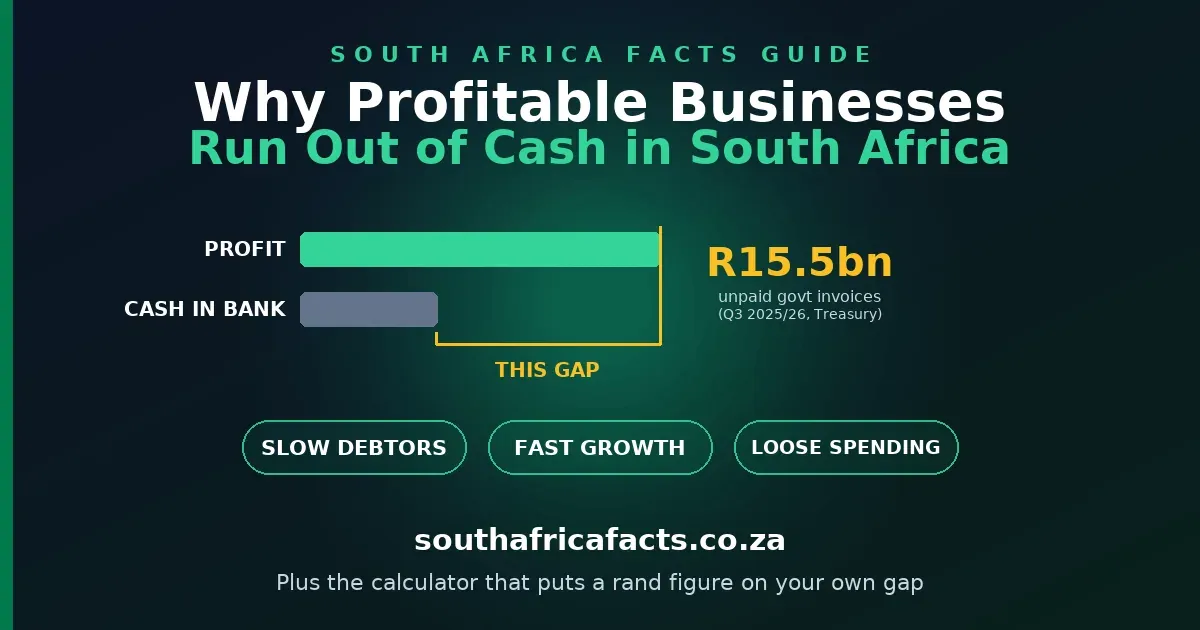
National Treasury's own figures show government departments were sitting on R15.5 billion in invoices unpaid beyond 30 days by the third quarter of the 2025/26 financial year, up from R12.4 billion the quarter before. That's not a struggling economy story, it's a cash flow story, and it's the same story playing out one size down at almost every small business in South Africa. Cash flow, not a lack of profit, is consistently cited as the leading reason small businesses here fail. If you want to see exactly how much cash your own business has tied up right now, our Working Capital & Cash Gap Calculator turns your own debtor, stock and supplier days into an actual rand figure. This article is the explanation behind that number, why it happens, how bad it really is in South Africa specifically, and what actually fixes it.
Why a profitable business can still run out of cash
Profit and cash are not the same thing, and confusing the two is one of the most common ways an otherwise healthy small business ends up in trouble. Profit is an accounting figure, revenue less expenses, recognised the moment you invoice a sale. Cash is what's actually sitting in your bank account, and it only shows up once the customer has paid you, which might be 30, 60 or 90 days later, or never at all. In between, you've usually already paid for the stock or materials that went into that sale, and you may still owe your own suppliers for it too. That gap, between money earned on paper and money in the bank, is what a cash flow problem actually is. A business can have a full order book, healthy margins and a growing customer list, and still not be able to pay its own staff and suppliers on time, because all of that profit is sitting unpaid in someone else's accounts payable.
How bad is South Africa's cash flow problem, really?
Worse than most owners assume, and the direction of travel isn't good either. On the government side alone, National Treasury's figures show invoices older than 30 days reached R15.5 billion, 90,856 invoices, by the third quarter of the 2025/26 financial year, up 17% from R12.4 billion the quarter before. Provincial departments account for 98% of both that invoice count and the rand value, national departments like Home Affairs, Land Reform and Rural Development, and Public Works and Infrastructure show up repeatedly among the worst offenders. A Public Service Commissioner put it plainly: non-payment by government departments is a direct contributing factor to the lack of sustainability in the small business sector, forcing suppliers to borrow, cut staff, or close entirely.
And that's only the public sector. Private-sector payment cycles of 90 to 120 days are commonly cited as standard in South African supplier relationships, well beyond what most invoices actually state as terms. Stack the full order-to-cash cycle for an SME supplying a large corporate, the time to fulfil the order, deliver it, invoice it, and then wait out the payment terms, and the whole cycle can run past 150 days before a rand actually lands in the business's account. If your customer base leans toward large corporates or government, budget for real payment behaviour, not the number printed on your invoice.
The three ways this actually shows up in a South African small business
Slow debtors, especially large corporate and government ones. This is the most direct version: work is done, the invoice is out, and the money simply takes far longer to arrive than the stated terms promise. Many owners also avoid chasing a slow-paying client too hard for fear of damaging the relationship, which quietly makes the problem worse over time.
Growth that outruns the cash to fund it. A business that's winning more work needs to pay for more stock, more staff and more overheads immediately, while the revenue from that growth only arrives weeks or months later. The faster the growth, the bigger this gap gets, and it's entirely possible to grow your way into a cash crisis while every other number in the business looks great.
Spending that creeps up with confidence. When business is good, it's tempting to hire ahead of need, upgrade equipment, or loosen cost discipline. Cash doesn't arrive at the same steady pace optimism does, so when a quieter month follows a strong one, the higher cost base is already locked in and the cash cushion that used to absorb it is gone.
The trap: growing broke
Here's the part that catches even careful business owners off guard. If your debtor days, stock days and supplier days stay roughly the same as your business grows, the cash tied up in the business grows right along with it, proportionally, before any of that extra profit shows up as spendable cash. A business growing turnover 20% a year with a 60-day cash conversion cycle needs roughly 20% more cash locked up in debtors and stock, net of extra supplier credit, just to keep operating at the new, bigger scale. That cash has to come from somewhere: retained profit, an owner's own top-up, or a facility. If none of those show up in time, the growth itself is what breaks the business, not a downturn, not bad luck, just success arriving faster than the cash to fund it. Our calculator models this directly, enter your own expected growth rate and it shows the extra rand you'd need to find, on top of what's already tied up.
How to actually fix a cash flow problem
Most of the fix is about timing, not turnover. A few levers actually move the number:
Shorten how long customers take to pay. Shorter invoice terms, upfront deposits, and a genuine habit of following up on overdue invoices without waiting for them to become embarrassing all help. If a chunk of your book is large corporates or government, know their real payment behaviour going in and price or plan around it rather than hoping the stated terms hold.
Don't be afraid to lean on supplier terms, within reason. Extending how long you take to pay your own suppliers is free financing, worth exactly as much cash as cutting stock days by the same amount. Push it too far and you damage the relationship or lose favourable pricing, so this is a negotiation, not a policy of paying everyone as late as possible.
Keep less cash sitting in stock. Stock that hasn't sold yet is cash that's stopped moving. Tighter ordering, better demand forecasting, and clearing slow-moving stock all free up real rand, not just shelf space.
Watch spending discipline in the good months, not just the bad ones. The moment to control costs is when business feels easy, since that's when the higher cost base gets locked in for whenever it slows down again.
Know the real, honest cost of financing the gap if you need to. A bank overdraft is commonly priced as a margin over South Africa's prime lending rate. Invoice discounting and factoring against your debtors book are priced per facility, not off a posted rate, funders in that market are upfront that pricing genuinely varies deal to deal on your book size, customer concentration and payment history. Get an actual quote on your own numbers before treating any online benchmark as real pricing.
Work out your own cash gap
None of the above means much until it's your own number. Our Working Capital & Cash Gap Calculator takes your turnover, margin, and your debtor, stock and supplier days, and turns them into the actual rand figure your business has tied up right now, plus what a single day faster payment, a single day less stock, or a single day longer to pay suppliers is really worth to your bank account. It also runs the growth trap above on your own expected growth rate, and gives an honest, illustrative estimate of what it would cost to carry that gap on a facility priced against South Africa's own prime rate.
Frequently asked questions
Why does a profitable business run out of cash in South Africa?
Because profit is recognised the moment you invoice a sale, but cash only arrives once the customer actually pays, which can be 30, 60 or even 90-plus days later. In between, you've usually already paid for the stock or materials behind that sale. A business can be genuinely profitable on paper and still be unable to pay its own staff and suppliers on time, because that profit is sitting unpaid in someone else's accounts.
How bad is South Africa's cash flow problem, really?
On the government side alone, National Treasury's figures show invoices unpaid beyond 30 days reached R15.5 billion (90,856 invoices) by the third quarter of the 2025/26 financial year, up from R12.4 billion the quarter before, with provincial departments responsible for 98% of both figures. Private-sector payment cycles of 90 to 120 days are commonly cited as standard on top of that, well beyond most invoices' stated terms.
Does government really pay small businesses late?
Yes, and it's documented by National Treasury's own reporting, not just anecdote. Provincial departments account for the large majority of overdue invoices by both count and rand value, and specific national departments including Home Affairs, Land Reform and Rural Development, and Public Works and Infrastructure show up repeatedly among the worst offenders. A Public Service Commissioner has stated directly that this non-payment is a contributing factor to small business failure.
Why can a growing business run out of cash faster than a stagnant one?
Because more sales at the same debtor, stock and supplier days means proportionally more cash tied up in the business, before any of the extra profit becomes spendable cash. A business growing turnover 20% a year at a 60-day cash cycle needs roughly 20% more cash locked up just to operate at its new size. If that extra cash isn't funded from retained profit, an owner top-up or a facility, the growth itself is what breaks the business.
How do I fix cash flow problems in my small business?
The main levers are shortening how long customers actually take to pay (not just what the invoice says), carefully extending your own supplier terms, keeping less cash tied up in unsold stock, and watching spending discipline in good months rather than only reacting once things slow down. Each of these has a real rand value, our Working Capital & Cash Gap Calculator shows what a single day's change in any of them is actually worth to your business.
Should I chase slow-paying customers or just accept longer terms?
Chase them, tactfully. Many owners avoid following up on a slow-paying client for fear of damaging the relationship, but every day of delay is a real, quantifiable cash cost to your business. If a customer, especially a large corporate or government entity, consistently pays well beyond terms, plan your own cash flow around their real behaviour rather than their stated terms, and don't be afraid to ask for deposits or shorter terms on new work.
Is this financial advice?
No, it's general information to help South African business owners understand and quantify their own cash flow position. It's not financial, accounting or lending advice. For your specific situation, including any facility or financing decision, speak to a registered accountant or your bank's business banker.
To put a real rand figure on your own business's cash gap, including the growth trap and an illustrative financing cost, use the Working Capital & Cash Gap Calculator. If staffing costs are also part of your cash flow picture, the Employee Cost Calculator works out the true monthly cost of a hire, and the Business Compliance Calendar keeps SARS and CIPC deadlines from becoming a cash flow surprise of their own. You can find every free tool on our tools and calculators page.
This article is general information to help South African business owners understand cash flow problems, not financial or accounting advice. Figures cited are drawn from National Treasury's published reporting and general industry sources current as of July 2026, confirm your own facility pricing and financial position with a registered accountant or your bank. Last reviewed July 2026.
What do you think?
Join the conversation on our South African community forum. Share your perspective, ask a question, or just say hello.