Bloemfontein: Discover South Africa's City of Roses and Judicial Capital
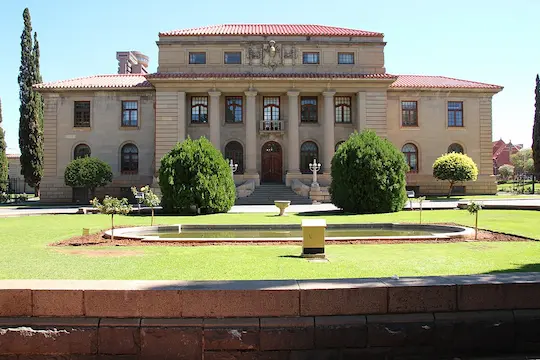
Bloemfontein, fondly known as the 'City of Roses', brings together legal gravity and easy natural charm in a way few South African cities manage. It is the country's judicial capital and the seat of the Supreme Court of Appeal,[1] one of three capitals that share national power alongside the legislative capital, Cape Town, and the administrative capital, Pretoria. Yet there is far more here than courtrooms. The seventh-largest city in the country,[1] Bloemfontein is also famous for its gardens, above all the roughly 4,000 rose bushes that fill King's Park, a garden first laid out in 1906.[2] Its Sesotho name, Mangaung, means 'place of cheetahs', a detail that explains a good deal about the city's sporting identity.[1]
The city sits on the high, dry grasslands of the Free State, part of South Africa's interior Highveld rather than the Karoo, which lies a couple of hundred kilometres to the south.[1] These plains are semi-arid and turn golden in winter, which makes the lush, well-watered greenery of the city's parks all the more striking. For the wider picture of how the country's climatic zones and the neighbouring Karoo fit together, it helps to remember that open grassland and true desert are not the same thing.
The name is usually translated from the Dutch as 'fountain of flowers', a fitting label for the City of Roses, though the real story may be less romantic. One well-supported theory holds that the spring here was named after Jan Bloem, a Griqua leader, which would make it 'Bloem's fountain' rather than anything floral.[1] Either way, the poetry has stuck.
Bloemfontein has its share of famous sons and daughters. J.R.R. Tolkien, author of The Hobbit and The Lord of the Rings, was born here in 1892, although his family left for England when he was only three, after his father's death, so the city can claim his birth certificate if not his imagination.[1]
Sport runs deep. The Cheetahs, the Free State's rugby side and another nod to Mangaung, are regulars in the Currie Cup and the wider South African rugby calendar, playing at the Toyota Stadium, still widely called the Free State Stadium, which seats more than 40,000 spectators.[3] Football carries a tinge of sadness here. Bloemfontein Celtic, the much-loved club known to its supporters as Siwelele, was sold and moved to KwaZulu-Natal in 2021, ending decades of local devotion.[4] Away from the big stadiums, the city is a respected centre for gliding, helped by its wide skies and dependable thermals, and motorsport has a loyal following too.
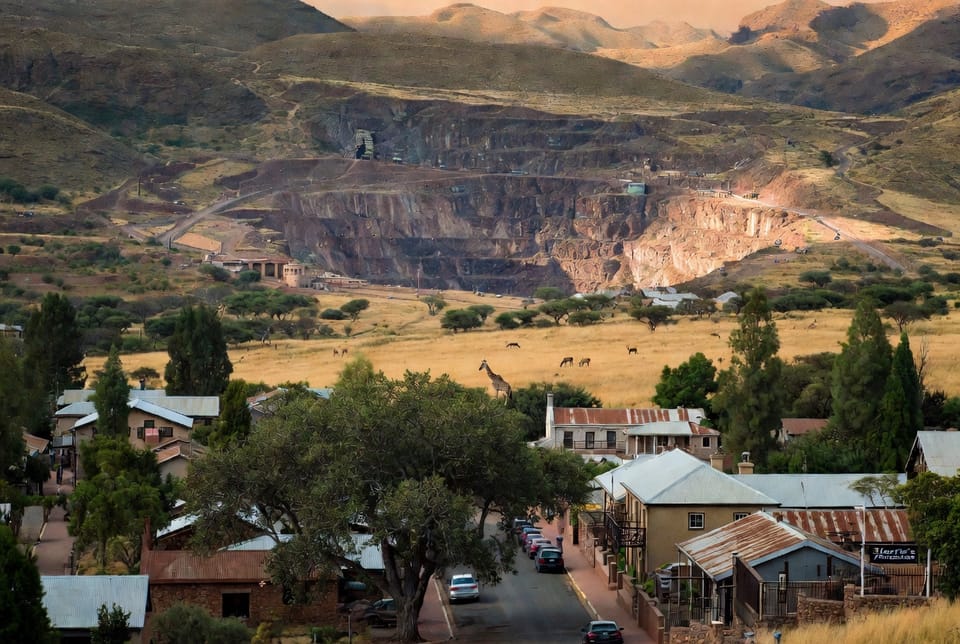
Naval Hill, a flat-topped rise right in the middle of the city, is one of Bloemfontein's quiet showstoppers. It carries a 6.5-metre bronze of Nelson Mandela, the tallest statue of him anywhere in the world, looking out over the city.[11] The hill is also home to the Naval Hill Planetarium, set in the old Lamont-Hussey Observatory; when it opened in 2013 it made Bloemfontein the first city in sub-Saharan Africa with a digital planetarium.[11] Add the Franklin Game Reserve, where giraffe and zebra graze within sight of the suburbs, and you have wildlife, art and the night sky on a single hilltop.[11] Visitors moved by Mandela's story can follow it further at Robben Island.
History is never far away. The town was founded in 1846 by Major Henry Douglas Warden as a British outpost, and handsome sandstone buildings still anchor the centre.[1] The University of the Free State, established in 1904, gives the city a lively student body and a strong research presence.[12] When you have had your fill of the past, the Loch Logan Waterfront covers shopping and dining, the Windmill Casino offers a flutter, and the Oliewenhuis Art Museum displays South African art in a gracious old residence with sculpture gardens. A short drive out, the Maselspoort Resort on the banks of the Modder River is a long-standing family favourite, and the Free State National Botanical Garden showcases the region's indigenous plants.[2]
Whether you come for the law, the history, the sport or simply the roses, Bloemfontein rewards a slower look. It is a working city with deep roots, where national memory and everyday warmth sit comfortably side by side.
Five interesting facts about Bloemfontein
- The African National Congress (ANC), today South Africa's governing party, was founded in Bloemfontein on 8 January 1912 at the Waaihoek Wesleyan Church.[5]
- During the Second Anglo-Boer War (the South African War), Bloemfontein held one of the first and largest British concentration camps. Across the camp system roughly 28,000 Boer women and children died, a tragedy commemorated by the National Women's Memorial just outside the city.[6][7] The ashes of Emily Hobhouse, the British humanitarian who exposed conditions in the camps, are interred at the memorial.[8]
- The Free State is South Africa's breadbasket and its leading maize producer, growing roughly 40% of the national crop, and the province is bordered to the south by the mighty Orange River.[9]
- The Mangaung Fire Station Museum at the Ehrlich Park fire station keeps vintage fire engines, cars and equipment dating back to 1926, and bills itself as the only fire station museum in the Southern Hemisphere.[10]
- Bloemfontein's municipal zoo, a city fixture for generations, closed in 2019 after welfare concerns, and its animals were rehomed to sanctuaries across the country, so it is no longer on the visitor map.[13]
Sources
- Bloemfontein, Wikipedia
- Bloemfontein, City of Roses, South African Tourism (southafrica.net)
- Toyota Stadium, Toyota Cheetahs official site
- PSL approves sale of Bloem Celtic, relocated and renamed Royal AM, News24
- African National Congress, Wikipedia
- The National Women's Memorial, Anglo-Boer War Museum
- Second Boer War concentration camps, Wikipedia
- Emily Hobhouse, Wikipedia
- Maize production in South Africa by province, Statista
- Fire Station Museum, Bloemfontein, WhereToStay
- Naval Hill, South African History Online
- University of the Free State, Wikipedia
- Animals relocated after Bloemfontein Zoo closes down, The Citizen
What do you think?
Join the conversation on our South African community forum. Share your perspective, ask a question, or just say hello.