Sutherland: South Africa's Astronomical Hub and Gateway to the Universe
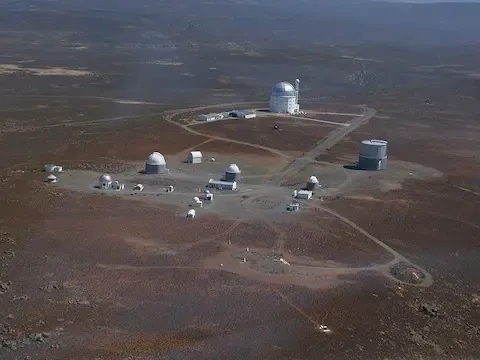
Sutherland sits high on the Roggeveld escarpment in South Africa’s Northern Cape, roughly 1,450 metres above sea level[1]. It lies about 350 km northeast of Cape Town[2]. The town is home to the South African Astronomical Observatory (SAAO) and its flagship instrument, the Southern African Large Telescope (SALT), the largest single optical telescope in the Southern Hemisphere[3]. The observatory chose this lonely stretch of the Karoo for its exceptionally clear, dark skies, and those same skies have earned Sutherland its nickname, the Gateway to the Universe.
Established in 1855, the town was named after Rev. Henry Sutherland, a Dutch Reformed Church minister who rode up from Worcester each year to hold services on the Roggeveld[1]. Its handsome sandstone Dutch Reformed Church, completed in 1899, was pressed into service as a fort by British troops during the Anglo-Boer War[1].
Today Sutherland still runs on sheep farming, and its lamb and mutton are prized around the country. The little commercial centre keeps an unhurried, old-fashioned rhythm, with most shops still pulling down the shutters for an hour over lunch.
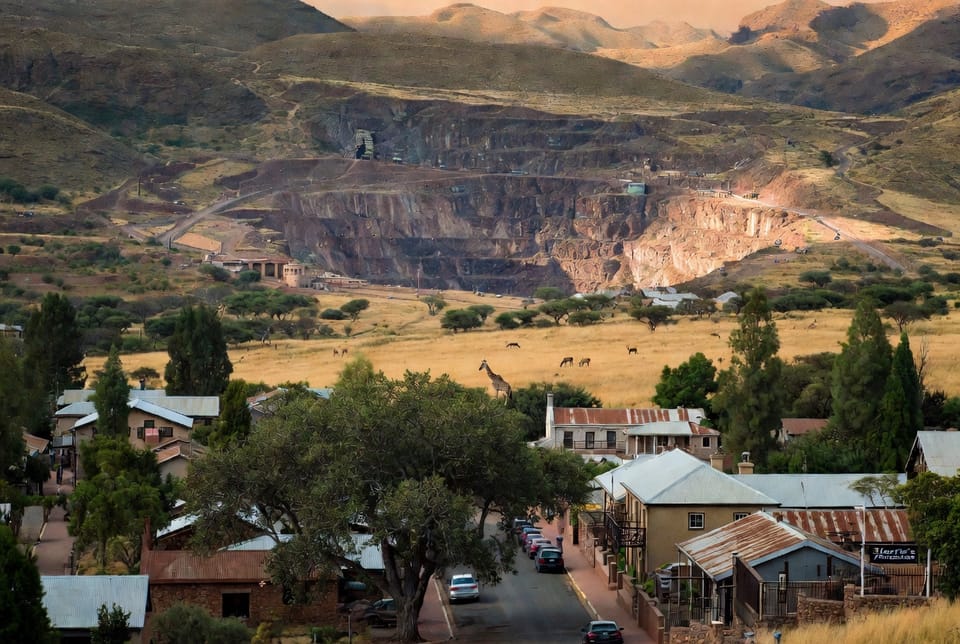
Set in the heart of the Karoo, the town makes a fine base for exploring the surrounding plains. Southeast of Sutherland lies Salpeterkop, an extinct volcano that last erupted in the Late Cretaceous, around 70 million years ago, and one of the best-preserved volcanic vents in the country[4]. The climb to its rim is a popular, lung-testing hike. For more Karoo scenery, both the Karoo National Park and the Victorian railway village of Matjiesfontein are within easy reach.
Sutherland is the birthplace of the Afrikaans writer brothers N.P. van Wyk Louw and W.E.G. van Wyk Louw, both towering figures of the language and both winners of the Hertzog Prize. Their family home, built in 1861, is now the Louwhuis museum and literary library[5]. Readers who enjoy South African verse may also like our piece on the poet Ingrid Jonker.
Sutherland is widely known as South Africa’s coldest town. Its average annual minimum temperature is around 2.8°C, frost settles on roughly a hundred nights a year, and snow falls most winters[6]. The lowest reading on record, −16.4°C, was logged on 12 July 2003, and it has even snowed here on Christmas Day[1]. For the wider picture, see our guide to South Africa’s climate.
Many local farmers keep two farms, one up on the cold Roggeveld and another in the warmer, lower-lying Karoo. Each winter they move their flocks down to the milder ground, a trek that can take up to four days, then reverse the journey in September when they head back to the high country for summer.
Sutherland is also the most southerly point in South Africa where diamonds were found, and the old diggings can still be seen around the district. The surrounding veld shelters the critically endangered riverine rabbit, one of the world’s rarest mammals[7], along with the curious sterboom (Star Tree), whose star-shaped foliage flowers in September.
Sources
- Sutherland, South Africa, Wikipedia
- About Our Town, Sutherland Info
- Southern African Large Telescope (SALT), official site
- The geology of the late-Cretaceous Salpeterkop volcano near Sutherland, ScienceDirect
- Louw House Museum, Sutherland, South African History Online
- Sutherland climate, SA Explorer
- Riverine rabbit, Wikipedia
What do you think?
Join the conversation on our South African community forum. Share your perspective, ask a question, or just say hello.