South Africa's Beaches: A Paradise for Beach Lovers
📅 Last updated: May 2026. Refreshed with the latest Blue Flag count, 2025 tourism figures and penguin conservation news, plus links to related guides.
South Africa is wrapped by the sea along almost the whole of its southern edge. From the Namibian border in the west, the coast runs down to the tip of the continent and then swings northeast towards Mozambique, roughly 2,850 kilometres of shoreline shared between two very different oceans, the Atlantic and the Indian.[1] Those two oceans meet at Cape Agulhas, the true southernmost point of Africa.[2] The result is a coastline with huge variety, from cold, kelp-fringed Atlantic bays in the west to warm subtropical water in KwaZulu-Natal, with a long, dramatic middle stretch where whales pass close to shore and surfers chase some of the best waves on the planet.
🇿🇦 Tourism note (2026): South Africa's beaches are busier than they have been in years. In 2025 the country welcomed about 10.5 million international visitors, finally edging past pre-pandemic levels for the first time, helped along by a weak rand that stretches a foreign holiday a long way.[5]
Two oceans, two completely different swims
The thing that catches most first-time visitors off guard is the water temperature. On the Atlantic side, the cold Benguela current sweeps up from the south, so beaches like Cape Town's Clifton and Camps Bay can look tropical yet take your breath away the moment you wade in, even in midsummer.[1] Round the corner on the Indian Ocean side, the warm Agulhas current keeps the KwaZulu-Natal coast comfortable for swimming almost all year. If you want to float about lazily in warm water, head east. If you want to cool off fast under a postcard mountain, the Cape is for you. The west coast itself stays quieter and wilder, with fishing villages such as Paternoster built around whitewashed cottages and crayfish dinners rather than crowds.
What the Blue Flag actually means
You will see the Blue Flag flying on many South African beaches over summer, and it is worth more than decoration. Blue Flag is an international eco-label run by the Foundation for Environmental Education and managed locally by WESSA, awarded only to beaches that meet strict standards for water quality, safety, facilities and environmental care.[4] For the 2025/26 season South Africa has 50 full Blue Flag beaches, the most it has ever had, in the programme's twenty-fifth year in the country.[3] The flags fly during the official bathing season, roughly December to the end of February. If you are ever unsure where to swim, a Blue Flag beach is a safe, well-run bet.
The Western Cape and the Cape Peninsula
Around Cape Town the beaches come with a mountain for a backdrop. Clifton's four sheltered coves and the wide sweep of Camps Bay are the glamorous, sundowner end of things, all granite boulders and bracing Atlantic water. For something more active, Muizenberg on the False Bay side is where most South Africans learn to surf, and its row of brightly painted Victorian bathing huts has become one of the most photographed sights in the country.[8]
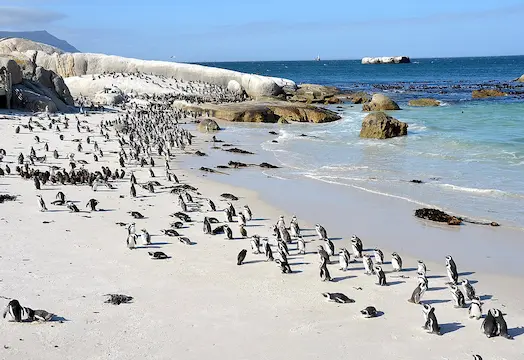
A short drive down the peninsula brings you to Boulders Beach near Simon's Town, home to a colony of African penguins that has grown from two breeding pairs in 1982 to a few thousand birds today.[7] It is a rare chance to share the sand with wild penguins, though it comes with a sober note. In 2024 the African penguin became the first penguin species in the world to be listed as Critically Endangered, just one step from extinct in the wild, after decades of steep decline.[6] Visiting gently, and keeping your distance, genuinely matters here.
East of the peninsula, Hermanus has earned a name as one of the best places on Earth to watch whales from dry land. Southern right whales come into Walker Bay to calve between about June and November, sometimes only metres from the cliff path, and the town even keeps a "whale crier" to announce the day's sightings.[9]
The Garden Route
The Garden Route strings together some of the country's prettiest coast, where forest, lagoon and beach sit almost on top of one another. Plettenberg Bay is the headline act, with long golden beaches and dolphins offshore, while tiny Noetzie near Knysna is famous for the storybook castles tucked among its dunes. The town of George makes a handy base for working your way along the whole stretch.
The Eastern Cape and the Wild Coast
The Eastern Cape is where South Africa's surfing legend really lives. Port Elizabeth, officially renamed Gqeberha in 2021, sits on the warm waters of Algoa Bay and makes a relaxed city-beach stop.[11] But the real pilgrimage is to Jeffreys Bay, where the right-hand point break known as Supertubes peels off long, fast, perfectly hollow waves that many surfers rate the finest in the world. The World Surf League brings its Championship Tour here each July.[10]
North of there the coast turns rugged and remote along the Wild Coast. Port St Johns and Coffee Bay are the main gateways, and the natural rock arch called Hole in the Wall is the area's signature sight, punched clean through a cliff by the pounding sea.[12] This is a coast for walking and rondavels, not high-rise resorts.
KwaZulu-Natal, the warm-water coast
Durban is South Africa's beach city, its Golden Mile a continuous run of promenade, piers and warm Indian Ocean surf right alongside the high-rises. Just up the coast, Umhlanga is the smarter lighthouse-and-boardwalk version, while Margate on the South Coast is the classic family-holiday town. For something wilder, Cape Vidal inside the iSimangaliso Wetland Park offers protected beaches where the bush runs down to the sea, and the diving offshore ranks among the best in South Africa.
Staying safe in the water
South Africa's seas are gorgeous, but they ask for respect. Rip currents are the biggest everyday danger, so swim between the flags at lifeguarded beaches and never on your own. Shark safety is taken seriously: KwaZulu-Natal beaches are protected by the KZN Sharks Board's nets and drumlines,[14] while in Cape Town the Shark Spotters programme posts lookouts on the mountainside to warn bathers when a white shark moves into the bay.[13] If you would rather meet a great white on purpose, cage diving in Gansbaai is the place to do it.
When to go
For classic beach weather in the Cape, aim for December to March, when the Western Cape is warm and dry. The KwaZulu-Natal coast is subtropical and pleasant almost year round, though its summers are humid and its winters are the driest, clearest time to visit. If whales are the goal, plan for the Cape between June and November. And if you are chasing waves, the Eastern Cape surf is at its best through the southern winter.
Few countries pack so much into a single coastline. You can swim near penguins in the morning, watch whales over lunch and take a surf lesson before sundown, often within a couple of hours' drive of each other. That is the real magic of South Africa's beaches.
Sources
- Geography of South Africa: coastline length and ocean currents (Wikipedia)
- Cape Agulhas, where the Atlantic and Indian Oceans meet (Wikipedia)
- WESSA: 2025/26 Blue Flag and Green Coast sites (50 Blue Flag beaches)
- WESSA: the Blue Flag programme in South Africa
- Statistics South Africa: tourism surpasses pre-pandemic levels in 2025
- African penguin: Critically Endangered status (Wikipedia)
- Boulders Beach penguin colony (Wikipedia)
- Muizenberg and its surfing beach (Wikipedia)
- Hermanus: land-based whale watching (Wikipedia)
- Jeffreys Bay and Supertubes (Wikipedia)
- Gqeberha, formerly Port Elizabeth (Wikipedia)
- Coffee Bay and Hole in the Wall, Wild Coast (Wikipedia)
- Shark Spotters, Cape Town
- KZN Sharks Board
What do you think?
Join the conversation on our South African community forum. Share your perspective, ask a question, or just say hello.