Explore Durban: A Subtropical Delight in South Africa
South Africa's sun-soaked port city pairs golden beaches and the Golden Mile with a rich Zulu and Indian heritage, world-class attractions and the birthplace of bunny chow.
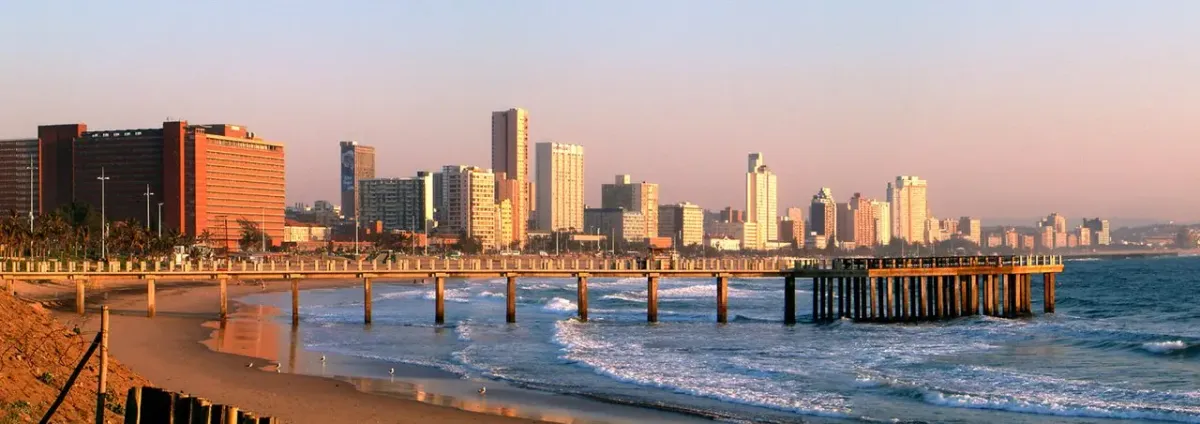
While Cape Town and Johannesburg tend to take the spotlight, Durban quietly makes the case that South Africa's warmest welcome waits on the east coast. This sun-soaked port city on the Indian Ocean has drawn a steady stream of international visitors since it hosted matches at the 2010 FIFA World Cup,[1] and it rewards them with a rich history, golden beaches, and a culture found nowhere else in the country. The Zulu know the city as eThekwini, a name drawn from itheku, meaning "the bay" or "lagoon", a nod to the natural harbour it grew around.[2]
A coastline first charted in 1497
European records of the area open on Christmas Day 1497, when the Portuguese navigator Vasco da Gama sailed past on his way to India and named the coast Natal, the Portuguese word for Christmas.[3] Long before that, the land belonged to Nguni and Zulu communities, and the wider region is still the heartland of the Zulu people today. British settlers arrived in the 1820s and left their stamp on the growing town, which blossomed into one of the country's favourite holiday destinations through the 1970s.
Stadiums, architecture and the Golden Mile
Durban's central business district wears its past openly, mixing colonial buildings with the kind of striking Art Deco facades that reward anyone curious about South Africa's architecture. The skyline's modern landmark is the Moses Mabhida Stadium, built for the 2010 World Cup with a football capacity of about 54,000 that expands for major events.[1] Its great white arch is an attraction in its own right, with a SkyCar that glides to a viewing platform at the top and the Big Rush swing that launches from the arch, recognised by Guinness World Records as the tallest swing of its kind on Earth.[5] The nearby King Shaka International Airport, opened just weeks before the 2010 tournament, gave the city a modern gateway to match.[4]
Down at the shore, the Golden Mile unfurls for kilometres of promenade, warm-water swimming and some of the country's best-loved surf breaks. It sits at the heart of South Africa's beach culture, alive with families, joggers, and the city's celebrated Zulu rickshaw pullers in their towering beaded headdresses.
The flavour of Durban
No South African city is shaped by its food quite like Durban. It is home to one of the largest populations of people of Indian descent anywhere outside India, a community rooted in the indentured labourers who began arriving in the 1860s, and that heritage gave the world bunny chow, a hollowed-out half-loaf of bread filled with curry that was invented here in the 1940s.[6] Spice markets, curry houses and the bustling Victoria Street Market make the city a highlight of any journey through South African cuisine. Mahatma Gandhi also lived in the Durban area for around two decades, where he shaped his philosophy of peaceful resistance.
Things to see and do
uShaka Marine World, at the southern end of the Golden Mile, is Africa's largest marine theme park and ranks among the five largest aquariums in the world.[7] Families can shrink the whole city to size at Mini Town, a detailed scale model of Durban, while the Port Natal Maritime Museum lets visitors clamber aboard a steam tug and a navy minesweeper moored beside the harbour. That harbour is no ornament: the Port of Durban is the busiest container port in sub-Saharan Africa.[8] For a green escape, the Durban Botanic Gardens is the oldest surviving botanic garden on the continent, first planted in 1849.[9]
When to visit
Durban's greatest draw is its climate. The city sits in a genuinely subtropical belt, which brings warm, humid summers, mild and sunny winters, and a sea that stays comfortable for swimming all year round. If you are planning a longer trip, it pairs naturally with the culture of Cape Town and the energy of Johannesburg to round out a portrait of the country. As South Africa's third-largest city,[2] Durban delivers history, architecture, food and beaches in one easy-going package, which is exactly why it earns its name as a subtropical delight.
Sources
- Moses Mabhida Stadium, Wikipedia
- Durban, Wikipedia
- Durban, Encyclopaedia Britannica
- King Shaka International Airport, Wikipedia
- Big Swing at Moses Mabhida Stadium, SA-Venues
- Bunny chow, Wikipedia
- The magic of uShaka Marine World, Brand South Africa
- Port of Durban, Wikipedia
- Durban Botanic Gardens, Africa's Oldest Surviving Botanic Garden
What do you think?
Join the conversation on our South African community forum. Share your perspective, ask a question, or just say hello.