
Provisional Tax Calculator (IRP6): Payments & Penalty Risk South Africa
Free 2026/27 provisional tax (IRP6) calculator for South Africa. Estimate your August and February payments and check your underestimation-penalty risk.
Provisional tax estimate
Provisional Tax Calculator
Work out your August and February IRP6 payments for the 2026/27 tax year, and check whether your estimate is safe from SARS's underestimation penalty.
All non-salary income (freelance, business, rental, interest) plus any salary, minus your business expenses and deductions. This is the figure you'll declare on your IRP6. Not sure? Start with last year's number and adjust.
If you also earn a salary and your employer deducts PAYE, enter your expected total for the full tax year. This reduces both provisional payments, since SARS only wants the balance. Leave at 0 if you have no salary.
If you're the main member who pays. Reduces your tax via the monthly medical scheme fees credit. Enter 0 if none.
The taxable income on your most recent SARS assessment (ITA34), from your last tax return, not this year's estimate. If your estimate is at least this much, SARS can't charge you an underestimation penalty on the February payment, even if your actual income turns out higher.
SARS requires you to increase an old basic amount by 8% for every year (compounded) since the assessment. This is an approximation, the exact 18-month cut-off is measured against the payment due date, check SARS's own guide or a tax practitioner if you're close to the line.
This is a private "just in case" figure, not what you declare to SARS. It powers the risk check below, showing whether the estimate you're about to declare would leave you exposed if income comes in higher than planned. Leave blank to skip the check.
💬 Questions about provisional tax? Discuss this tool on the forum →
Provisional tax calculator and IRP6 payment estimator, South Africa 2026/27
Freelancers, sole proprietors and anyone with rental or investment income don't pay tax through PAYE, so SARS asks for it in two instalments a year instead, an August payment and a February payment, using estimates you file on an IRP6 return. Every provisional tax calculator will split that estimate in half for you. This one goes further, it checks whether the estimate you're about to declare would actually protect you from SARS's 20% underestimation penalty if your real income comes in higher than planned, and shows the exact rand exposure if it wouldn't.
The safe harbour has two independent tests, hitting either one is enough, but they behave very differently depending on how big your actual income turns out to be. Enter your basic amount (last year's assessed taxable income) and, privately, what you think your actual income might realistically be, and the calculator shows both the Fourth Schedule tests side by side.
Provisional tax deadlines, 2026/27 tax year
For the tax year running 1 March 2026 to 28 February 2027. Dates shift to the prior business day if they land on a weekend or public holiday, always confirm the exact date on SARS eFiling.
| Payment | How it's worked out | Due |
|---|---|---|
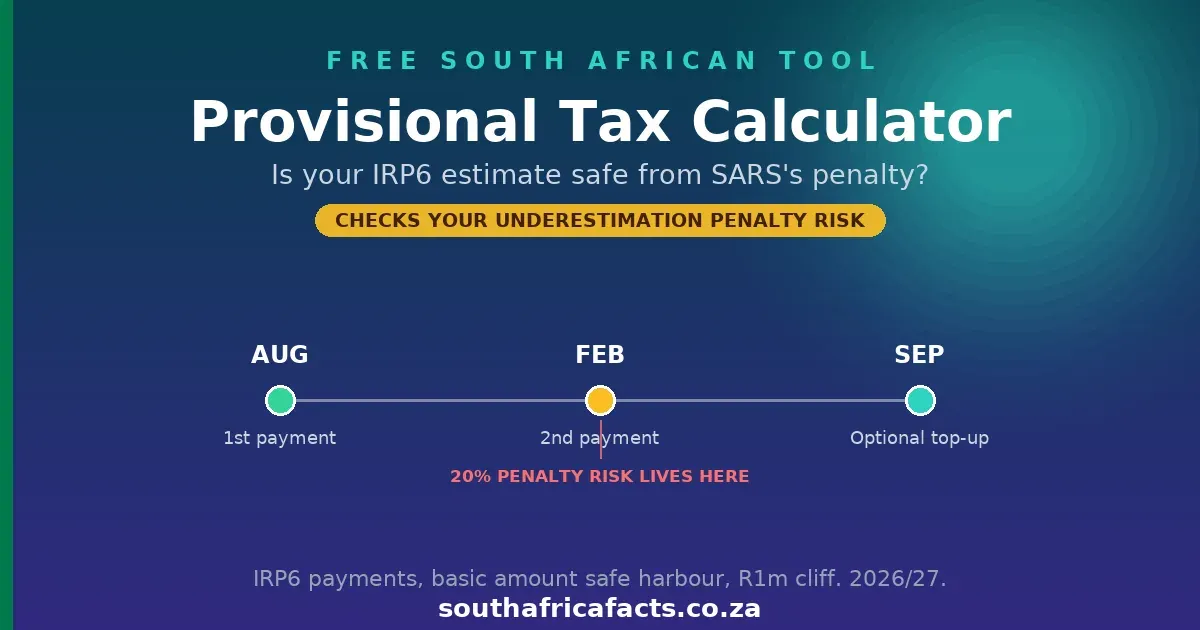
| 1st payment | Half your estimated full-year tax, less PAYE for the first 6 months | End of August |
| 2nd payment | Full estimated tax for the year, less PAYE and the 1st payment | Last business day of February |
| Optional top-up | Closes any remaining gap, stops interest, doesn't undo a penalty already triggered | 30 September |
Underestimation penalty thresholds
Fourth Schedule paragraph 20 of the Income Tax Act. These only apply to the February payment, not the August one.
| Situation | Rule |
|---|---|
| Actual taxable income R1,000,000 or less | Estimate must reach 90% of actual income, or your basic amount (either is enough) |
| Actual taxable income above R1,000,000 | Estimate must reach 80% of actual income. The basic amount no longer helps |
| Underestimation penalty, if triggered | 20% of the extra tax you should have paid on the shortfall |
| Late payment of either instalment | 10% of the amount paid late, separate from the underestimation penalty |
| Interest on any shortfall | 10.25% a year, from 1 October until your assessment is issued |
A worked example
Thabo runs a small consulting business. His last SARS assessment showed R500,000 in taxable income, his basic amount, but this year has been quieter, so he estimates R350,000 on his IRP6. Privately, he thinks it will probably land closer to R700,000 once a couple of outstanding invoices come in. His R350,000 estimate is below both his R500,000 basic amount and 90% of his likely R700,000 actual income (R630,000), so neither safe-harbour test is met. If his income does come in around R700,000, SARS could charge an underestimation penalty of roughly R8,969 on assessment, on top of the extra tax itself. Declaring at least his R500,000 basic amount instead would raise his August and February payments now, but remove that penalty risk entirely, regardless of how the rest of the year turns out. Try both numbers in the calculator above to see the trade-off for your own figures.
Frequently asked questions
Who has to pay provisional tax?
Anyone who earns income other than a normal salary that already has PAYE deducted. In practice that covers freelancers, sole proprietors and other small business owners, landlords, anyone with meaningful interest or investment income, company directors, and companies themselves. You can also be a provisional taxpayer while holding down a salaried job, if you earn other income on the side. You're excluded if you don't run a business and your taxable income stays under the tax threshold for your age, or if your only other income is interest, foreign dividends or rental and it totals R30,000 or less for the year.
When are the provisional tax payments due?
The first payment is due six months into the tax year, at the end of August. The second is due at the end of the tax year, the last business day of February. A third, voluntary top-up payment can be made up to seven months after the tax year ends, by 30 September, to close any remaining gap before SARS issues your assessment. Deadlines shift to the prior business day when the date falls on a weekend or public holiday, so check the exact date on eFiling rather than assuming a fixed day of the month.
How is the first (August) payment worked out?
SARS wants half of the tax on your estimated taxable income for the full year, less any PAYE already deducted from a salary during those first six months. You declare your estimated full-year taxable income on an IRP6 return, SARS calculates the tax on it using the normal tax tables and your rebates, and you pay half of that figure, minus PAYE credited for the period. If PAYE alone already covers half the tax, nothing is due, but you still need to submit the return.
How is the second (February) payment worked out?
This one settles the full year. SARS wants the total tax on your estimated full-year taxable income, less all the PAYE deducted during the year, less whatever you already paid in August. You can revise your income estimate for this return, most people know their year's income more accurately by February than they did in August, and a lot rides on getting this estimate right, since it's the one the underestimation penalty is measured against.
What is a 'basic amount' and why does it matter?
Your basic amount is the taxable income on your most recently assessed SARS return, the ITA34 from your last completed tax year, not this year's estimate. If your February estimate is at least your basic amount, SARS cannot charge you the underestimation penalty, no matter how much higher your actual income turns out to be, provided your actual income doesn't exceed R1 million. If that assessment is more than 18 months old by the time your second payment is due, SARS requires you to increase it by roughly 8% for every year since, compounded, before you can rely on it.
What happens if I underestimate my income?
If your February estimate turns out too low, SARS can charge an underestimation penalty once your return is assessed. For actual taxable income of R1 million or less, the penalty applies if your estimate was both below your basic amount and below 90% of your actual income. It's calculated as 20% of the extra tax you should have paid, on the lower of the tax on 90% of actual income or the tax on your basic amount, after subtracting what you actually paid across PAYE and both provisional payments. This is separate from any interest charged on the shortfall itself.
Is there a different rule if my income is over R1 million?
Yes, and it's a hard cliff, not a gradual scale. Once your actual taxable income for the year exceeds R1 million, the basic amount stops offering any protection at all, and your February estimate must reach at least 80% of actual income instead of 90%. Someone with a very large basic amount who assumed it would keep them safe can still be penalised heavily if their income crosses that line and their estimate doesn't keep pace. If you're anywhere near R1 million, estimate on the cautious side.
What's the difference between the underestimation penalty and interest?
They're two separate charges. The 20% underestimation penalty is only about the accuracy of your February estimate, and the basic-amount safe harbour can eliminate it entirely. Interest is different, it's simply the cost of paying tax late, and it accrues on any shortfall from 1 October (seven months after the tax year ends) until SARS issues your assessment, currently at 10.25% a year. Being penalty-safe through the basic amount does not stop this interest clock, only actually paying the money does, whether through your provisional payments or the optional top-up.
Should I make the optional third (top-up) payment in September?
It's worth considering if you paid less than your actual tax liability by February, whether because you used the basic amount and it turned out too low, or because your real income only became clear after your second IRP6 was filed. Paying the shortfall by 30 September stops interest from accruing on it, even though the underestimation penalty (if any) has already been determined by your February estimate and can't be undone by a later payment. There's no penalty for not making a top-up payment, it exists purely to save you interest.
Does this calculator account for medical expenses, foreign tax credits or late payment penalties?
Partially. It uses the standard monthly medical scheme fees credit (section 6A), but not the additional credit for large out-of-pocket medical costs (section 6B), which can only be claimed on assessment, not on an IRP6. It doesn't model foreign tax credits or a separate 10% late-payment penalty, which applies if a payment misses its deadline regardless of whether the estimate was accurate. These are stated simplifications, not oversights, add them by hand if they apply to you.
Is this calculator tax advice?
No, it's a free independent tool using the 2026/27 SARS tax tables and the Fourth Schedule's underestimation penalty rules to give you a reliable estimate. The 8% basic-amount escalation shown is an approximation of the exact 18-month rule. It doesn't replace SARS's own Guide for Provisional Tax or advice from a registered tax practitioner, especially if your income is close to the R1 million cliff or you're unsure which basic amount applies to you.
This calculator gives estimates using the 2026/27 SARS tax tables and the Fourth Schedule's underestimation penalty rules. It is general information, not tax advice, and doesn't model the section 6B additional medical expenses credit, foreign tax credits, or the separate 10% late-payment penalty. Confirm your own position with SARS's Guide for Provisional Tax or a registered tax practitioner, especially near the R1 million threshold. Last reviewed July 2026.