
Employee or Independent Contractor? SARS & Labour Law Checker (South Africa)
Free tool: run the SARS statutory tests, SARS's own dominant impression grid and the labour law presumption over the same facts, and see the cost of getting it wrong.
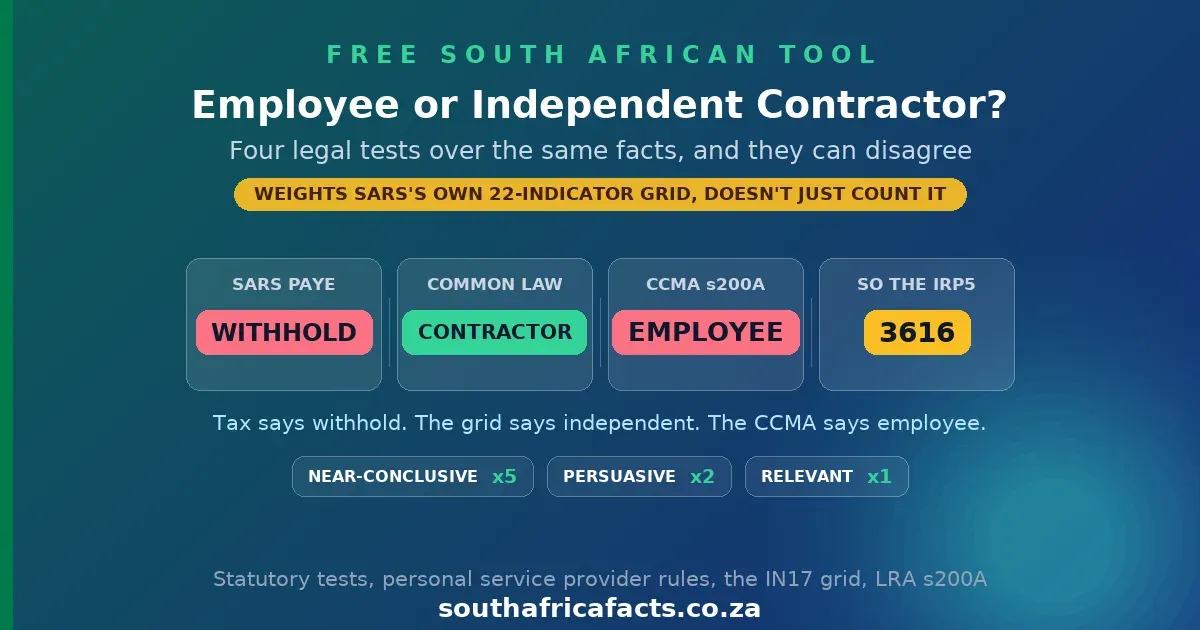
Employee or Independent Contractor?
Three different laws ask this question and they can give three different answers. This checker runs all three: the SARS statutory tests that decide PAYE, SARS's own dominant impression grid, and the labour law presumption that decides CCMA rights.
Invoicing through a company or trust changes the test completely. It brings the personal service provider rules into play, which most people trading through a one-person company have never heard of.
The Fourth Schedule's independent trade exclusion is only available to residents. A non-resident cannot use it at all.
These are conclusive, and they run before anything else. The second one overrides the first.
They must be genuinely full-time, engaged in the business of rendering this kind of service, for the whole year of assessment, and none of them may be a connected person (a spouse, or a relative within the third degree, or a trust they benefit from). Hitting this test settles the PAYE question outright.
"Mainly" means more than 50% of the work. It counts the premises of whoever pays, or whoever receives the service, which are not always the same party.
Either control or supervision is enough, and either the manner of work or the hours. It only has to exist as a contractual right. It does not have to be used in practice.
A company or trust is a personal service provider if a connected person renders the service personally and any one of the three triggers below is met, unless the three-employee exclusion applies.
In a one-person consultancy this is almost always true, it is the owner doing the work. If the company sends staff who are unconnected to the owner, the personal service provider definition does not get started at all.
This sends you to the common law grid in the next tab. Answer that tab and this trigger is decided for you.
Count the client's associated institutions with it. This is the trigger that catches most one-client contractors.
Paragraph 2(1A) lets a client stop withholding where trigger (c) is the only thing caught, if it holds that affidavit and relies on it in good faith. It does nothing for triggers (a) or (b).
Stricter than the version for individuals: these employees may not be shareholders, or the settlor or a beneficiary of the trust, or connected persons in relation to any of them. Meeting it takes the entity out of the personal service provider definition entirely.
Used to size the PAYE that should have been withheld if the classification turns out to be wrong.
SARS can go back over the whole period, not just the current tax year.
Answered 0 of 22 indicators.
This is a completely separate question from tax. Section 200A of the Labour Relations Act says that if any one of these seven factors is present, the worker is presumed to be an employee until the employer proves otherwise, whatever the contract calls them. It only applies to workers earning at or below the BCEA earnings threshold.
The presumption switches off above the BCEA earnings threshold of R269,600.90 a year, set on 1 May 2026. Confirm annually The Minister re-announces this figure roughly every year.
💬 Not sure which side of the line you are on? Discuss this tool on the forum →
Employee or independent contractor, South Africa
This is the question that quietly costs South African small businesses the most money, because it looks like one question and it is actually four. SARS has two conclusive statutory tests that decide whether PAYE must come off. It has a separate common law grid that decides whether the worker is really an employee in substance, which in turn decides the IRP5 code and whether the worker keeps their tax deductions. If the worker invoices through their own company or trust, the personal service provider rules apply instead, and they are harsher. And running alongside all of that, completely independently, the Labour Relations Act decides whether the person can take you to the CCMA.
These four can disagree with each other, and it is normal and legally correct when they do. Most articles on this topic pick one of them and treat it as the whole answer. This tool runs all of them over the same facts and shows you where they land separately, which combination you are in, and what it costs if the classification is wrong.
The tests this tool runs
| Test | The question it answers | Where it comes from |
|---|---|---|
| SARS statutory tests | Must the client withhold PAYE? | Fourth Schedule, exclusion (ii). Conclusive. The three-employee test overrides the premises-and-control test. |
| Personal service provider rules | Must the client withhold from a company or trust, and at what rate? | Fourth Schedule paragraph 1. 27% for a company, 45% for a trust, and the entity loses most deductions. |
| Common law dominant impression | Is the worker really an employee in substance? | Interpretation Note 17 Annexure C. Decides the IRP5 code, and so whether section 23(m) kills the worker's deductions. |
| LRA section 200A presumption | Can the worker go to the CCMA as an employee? | Any one of seven factors triggers it. Only available at or below the BCEA earnings threshold. |
Do independent contractors pay PAYE in South Africa?
Usually not, and that is the whole appeal of the arrangement. A genuine independent contractor invoices for the work, is paid in full, and settles their own tax as a provisional taxpayer twice a year on an IRP6 rather than having anything deducted monthly. If that is you, the provisional tax calculator works out both payments and checks your underestimation penalty risk.
The exception is the one that costs people money. If either SARS statutory test applies, the client has to deduct employees' tax from every payment even though the worker genuinely runs their own business. They do not become an employee, they simply have PAYE withheld, and the IRP5 then has to be coded 3616 rather than 3601 so their deductions survive. A worker who has been quietly coded 3601 for two years has usually lost far more in disallowed expenses than the withholding itself ever cost them.
Contract of service vs contract for services
This is the old distinction underneath all of it, and it is still the clearest way to think about the question. A contract of service is employment: the client buys your time and your capacity to work, directs how the work is done, and carries the risk if the work is slow or poor. A contract for services is an independent contract: the client buys a defined result, can say what must be delivered and by when but not how you go about it, and you carry the risk if it takes longer or costs more than you priced. Everything in SARS's near-conclusive tier, who picks the tools, whether you are paid for effort or for output, whether you can send someone else, whether you can take other clients, and who bears the loss, is really just asking which of those two contracts you actually have, whatever the document is titled.
Why weighting matters more than counting
SARS sorts the dominant impression indicators into three tiers, and it does that because they do not carry equal weight. The near-conclusive tier asks whether the client bought the worker's productive capacity or bought a result, and that is close to decisive. The persuasive tier measures how much control was acquired and why. The bottom tier is labels, clauses, compliance and economic circumstances, and SARS explicitly warns that those are the easiest to dress up, which is exactly why a contract can look independent while the relationship is not.
So a tool that counts ticks gives you the wrong answer. This one counts a near-conclusive indicator five times as heavily as a bottom-tier one, shows you the tally in each tier separately, and raises a warning when your near-conclusive answers point the opposite way to your overall score. That combination, a case that only holds together on the lower tiers, is the one most likely to fall over under an audit.
Related tools
- Provisional tax (IRP6) calculator, if you came out independent, this is how you actually pay your tax, and it checks your penalty risk.
- Business structure and tax calculator, whether to trade as a sole proprietor, on Turnover Tax, or through a company, and what each actually leaves you.
- Employee cost calculator, if the answer is employee, this is what the hire really costs once UIF, SDL, COIDA and the Employment Tax Incentive are counted.
- Small business compliance calendar, the EMP201, EMP501 and UIF deadlines that start applying the moment you have an employee.
- Income tax and PAYE calculator, the underlying tax on any given income, at the same 2027 tax year rates this tool uses.
Frequently asked questions
Can someone be an independent contractor for tax but an employee for labour law?
Yes, and it happens constantly. They are different statutes asking different questions. The Fourth Schedule to the Income Tax Act decides whether PAYE comes off. The Labour Relations Act decides whether the person can take you to the CCMA for unfair dismissal. A worker can be genuinely independent at common law, still have employees' tax withheld because a statutory test catches them, and still be presumed an employee under section 200A. Winning the tax argument does not protect you from the labour one.
Do independent contractors pay PAYE in South Africa?
Normally no. A genuine independent contractor invoices the client, receives the full amount, registers as a provisional taxpayer and pays tax twice a year on an IRP6 instead. But there is a large exception that catches a lot of people: if either of the SARS statutory tests applies, the client must deduct employees' tax from the payments even though the person is running their own business. That is the single most common surprise in this area. The worker is still an independent contractor, they simply have PAYE withheld, and the IRP5 must then be coded 3616 so their deductions survive.
Is it the 50% rule or the 80% rule? They get mixed up constantly
They are two different rules and they are widely confused, including in articles that should know better. The 50% figure is about PREMISES: the first statutory test asks whether the services are required to be performed mainly, meaning more than 50% of the time, at the client's premises. It has nothing to do with how much of your income comes from that client. The 80% figure is about INCOME CONCENTRATION, and it only applies to a company or trust under the personal service provider rules (and to a labour broker seeking an exemption certificate), where more than 80% of service income coming from one client is a trigger on its own. If you are an individual invoicing in your own name, there is no 80% income rule that makes you an employee. Getting this backwards is one of the most common mistakes on this topic.
I have several clients. Does the test apply to all of them at once?
No, and this catches people out. The tests are applied per engagement, not to you as a person. You assess each client relationship separately, so you can genuinely be an independent contractor to one client and an employee of another at the same time. One client having the right to control your hours does not contaminate your other contracts, and equally, having five other clients does not automatically rescue a sixth relationship that looks like employment on its own facts. Run this checker once per client.
Can an independent contractor claim business expenses?
It depends entirely on section 23(m), which is driven by the IRP5 code. If you are independent at common law, whether or not PAYE was withheld, the code should be 3616 and you may deduct the genuine expenses you incurred in producing your income, so equipment, a home office, travel, data, professional fees. If you are an employee at common law, the code is 3601 and section 23(m) limits you to a short list, essentially pension and retirement annuity contributions and a few specific items, with ordinary business expenses disallowed entirely. This is why the code matters so much and why it is worth checking the IRP5 you are handed rather than assuming it is right.
Can a misclassified contractor take an employer to the CCMA for unfair dismissal?
Yes, and this is the risk most employers underestimate. If the CCMA or a court finds the person was really an employee, they get the full suite of protections: unfair dismissal, notice, leave, and the right to bring unfair labour practice claims. The contract calling them a contractor does not settle it, since the CCMA looks at the real relationship using the control, integration and dominant impression tests. Where the worker earns at or below the BCEA earnings threshold, section 200A goes further and puts the onus on the employer to disprove employment. Terminating a long-running contractor by simply not renewing them is exactly the moment this tends to get tested.
What are the two SARS statutory tests?
The first deems a person NOT to be carrying on a trade independently if both parts are true: the services are required to be performed mainly (more than 50%) at the client's premises, AND the worker is subject to anyone's control or supervision as to the manner of the work or the hours. Either control or supervision is enough, and it only has to exist as a contractual right, it does not have to be used. The second test deems a person TO be carrying on a trade independently if they employ three or more full-time employees, all year, none of them connected persons. The second test overrides the first, and it overrides the common law position too.
What is the difference between IRP5 code 3601 and code 3616?
It is one of the most expensive small differences in South African payroll. Code 3601 is ordinary remuneration for an employee. Code 3616 is remuneration paid to someone who is an independent contractor at common law but who still had employees' tax withheld because a statutory test caught them. The code decides whether section 23(m) applies. Under 3601 it does, and it limits the worker's deductions to essentially nothing beyond pension, retirement annuity and a few specific items. Under 3616 it does not, and the worker keeps the right to deduct genuine business expenses. SARS's own Interpretation Note 17 works through exactly this case.
I invoice through my own Pty Ltd. Does that solve the problem?
Usually it makes it worse. A company or trust whose service is rendered personally by a connected person is a personal service provider if any one of three triggers is met: that person would be an employee if they contracted directly, or the duties are performed mainly at the client's premises under its control, or more than 80% of the entity's service income comes from one client. A personal service provider has employees' tax withheld from every invoice at 27% (a company) or 45% (a trust), loses almost all its ordinary business deductions, and cannot use the small business corporation rates. The only clean way out is the three-employee exclusion, which is stricter here than for individuals: those employees may not be shareholders, or the settlor or a beneficiary of the trust, or connected persons in relation to any of them.
What is the 80% affidavit?
Paragraph 2(1A) of the Fourth Schedule lets a client stop withholding where the 80% one-client rule is the ONLY reason the entity is a personal service provider, if the entity gives the client an affidavit or solemn declaration to that effect and the client relies on it in good faith. It is narrow relief. It does nothing if the person would also be an employee if they contracted directly, or if they work mainly at the client's premises under its control, and it does not change the entity's own tax position. It also needs to be current, relying on a stale affidavit is not good faith.
What is the dominant impression test?
It is the common law test that applies once the statutory tests fall away. SARS publishes a grid in Annexure C of Interpretation Note 17 setting out the indicators in three weight tiers: near-conclusive (which go to whether the client bought the worker's productive capacity or bought a result), persuasive (which measure the degree and purpose of control), and relevant (labels, clauses, compliance and economic circumstances, which SARS warns are the easiest to dress up). You weigh them all and form an overall impression. SARS is explicit that it is not a checklist and no single indicator decides it.
Why does this tool weight the indicators instead of just counting them?
Because counting them gives the wrong answer. SARS groups the indicators into tiers precisely because they do not carry equal weight. A relationship where all the near-conclusive indicators point to employment can still show more contractor-looking answers on the lower tiers, since those are the ones a contract can be written to look good on. This tool counts a near-conclusive indicator five times as heavily as a relevant one, and it flags it explicitly when your near-conclusive answers point the opposite way to your overall score, because that is the pattern a naive checklist scores wrongly.
What is the section 200A presumption?
Section 200A of the Labour Relations Act says that if any ONE of seven factors is present, the worker is presumed to be an employee until the employer proves otherwise, whatever the contract calls them. The factors are control over the manner of work, control over hours, forming part of the organisation, averaging at least 40 hours a month over the last three months, economic dependence, being given tools of trade, and working for only that one person. The practical effect is that the onus shifts to the employer at the CCMA.
Does the section 200A presumption apply to everyone?
No. It is only available to workers earning at or below the BCEA earnings threshold, which is R269,600.90 a year from 1 May 2026. Above that the presumption cannot be used, but that is not a finding that the person is a contractor. It just means the worker has to prove employment the ordinary way, on the same common law factors, rather than the employer having to disprove it. The Minister re-announces this threshold roughly every year, so confirm the current figure.
What does it cost an employer to get this wrong?
The employer is liable for the employees' tax it should have deducted and never did, plus a flat 10% late payment penalty under paragraph 6(1) of the Fourth Schedule, plus interest at SARS's prescribed rate from each date the money should have been paid, plus unpaid UIF on both sides. Understatement penalties can be added where SARS finds the classification was not a bona fide error. The employer has a right to recover the tax itself from the worker, but the penalty and the interest are the employer's own, and in practice recovering from a worker who has already left is difficult. Separately, a misclassified worker who is found to be an employee at the CCMA gets unfair dismissal protection, notice, leave and UIF.
Is a contract that says 'independent contractor' enough?
No. Every one of these tests looks at the substance of the relationship, not its label. SARS's grid puts labels and clauses in its lowest weight tier and warns that they are the easiest to dress up. Section 200A applies 'regardless of the form of the contract'. A well-drafted contract helps only to the extent that it reflects, and the parties actually follow, a genuinely independent arrangement.
Is this legal or tax advice?
No. It is a structured way to work through the same tests SARS and the CCMA use, built from the published sources, so you can see where you stand and what specifically is driving the answer. It cannot weigh your facts in context the way an auditor, a tax practitioner or a commissioner will, and it deliberately does not ask about everything that could matter. Treat a borderline result as a reason to get advice, not as a clearance.
Built from SARS Interpretation Note 17 (the statutory tests and the Annexure C dominant impression grid), Interpretation Note 35 (personal service providers and labour brokers), the Fourth Schedule to the Income Tax Act, and section 200A of the Labour Relations Act. Tax figures use the 2027 tax year (1 March 2026 to 28 February 2027). The BCEA earnings threshold of R269,600.90 applies from 1 May 2026 and is re-announced roughly annually, always confirm the current figure. This is a planning aid, not tax or legal advice. Nothing you enter leaves your browser. Last reviewed July 2026.