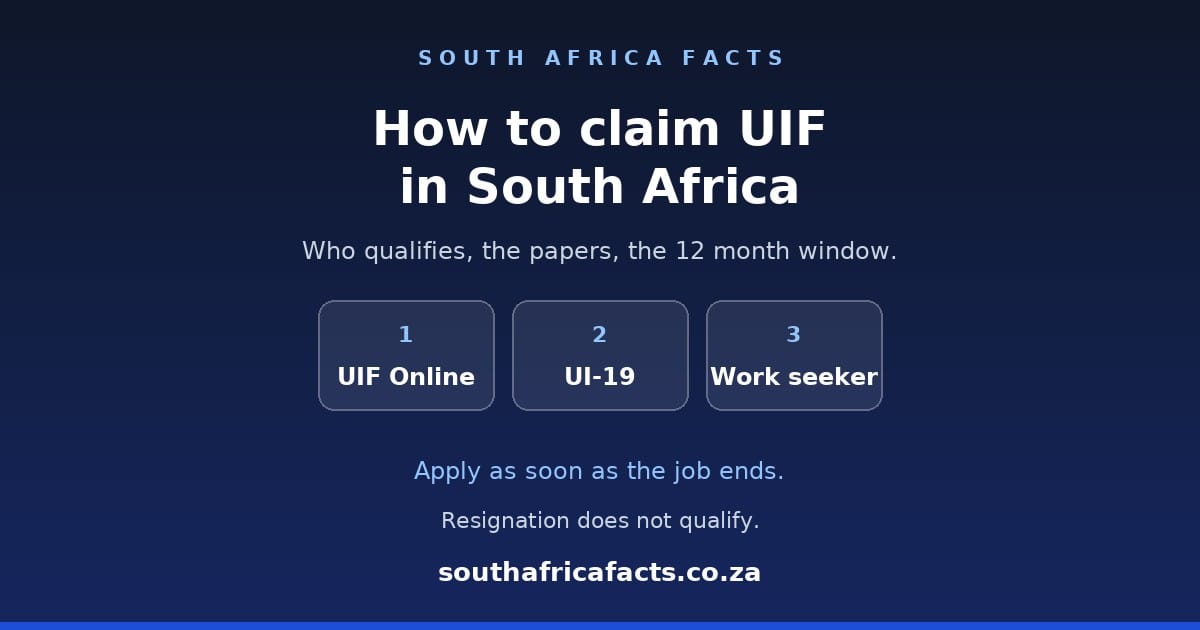
How to Claim UIF in South Africa (2026)
Who can claim UIF, where to apply in 2026, the papers the Fund actually wants, and the traps that stop a payout.
The 1% that comes off your payslip every month is not a tax. It is a ticket. When the job ends, that ticket is supposed to buy you a few months of breathing room while you look for the next one. A lot of people only find out, on the worst week of their working life, that the Fund will not pay them, or that the employer never declared them, or that the website they were told to use has a different name from the one a colleague used last year.
This is the process as it stands in August 2026, and the traps that actually stop claims. For the rand figure, daily rate and credit days, use the UIF benefits calculator. This page is the rest of it: who qualifies, where to apply, which papers the Fund wants, and why a claim comes back refused.
Daily rate, credit days and the 238 day split, from the formula the Fund publishes. Tax free, paid by the UIF, not your employer.
Open the UIF calculator →What UIF actually is
The Unemployment Insurance Fund is a short term relief scheme run by the Department of Employment and Labour. You and your employer each pay 1% of your remuneration, 2% in total, up to a monthly ceiling of R17,712. That ceiling has not moved since 1 June 2021. Earn R25,000 and you still only contribute, and later claim, as if you earned R17,712.
You contribute if you work 24 hours or more in a month. Domestic workers have been inside the Fund since April 2003. Foreign nationals who contribute can claim, unless the work permit requires them to be sent home when the job ends. You do not contribute, and you cannot claim, if you work fewer than 24 hours a month, or if you work for national or provincial government. Municipal staff are in. Commission on its own is not UIF remuneration; a mixed salary still contributes on the salary part. A registered learnership stipend is usually left out of UIF contributions, so there may be nothing to claim when that contract ends. A contributing worker who later goes on learnership training can still claim, subject to the normal rules.
The 1% deduction is worked out in the Cost to Hire Calculator for a firm, and in the Domestic Worker Wage Calculator for a household. This page is the claim.
What you get, in one paragraph
Ordinary unemployment benefits replace between 38% and 60% of your daily income for the first 238 credit days, then 20% after that, up to 365 days in a four year cycle. You earn one credit day for every four days you worked as a contributor. Four continuous contributing years fills the tank. At the ceiling the official worked example is R221.28 a day, then R116.46 once you pass day 238. The money is tax free. It is paid by the Fund, not your last employer, so it does not sit inside a retrenchment package. For the employer money, severance, notice and leave, use the retrenchment calculator.
Who can claim, and who cannot
You can claim ordinary unemployment benefits if the employer ended the job, a fixed term contract ran out, the employer went insolvent, or, for a domestic worker, the employer died. You must be capable of work, available for work, and registered as a work seeker with the Department. The spell of unemployment has to last more than 14 days. That is a qualification rule in the Act, not 14 days taken off your credits.
You cannot claim ordinary unemployment benefits if you resigned or absconded. The only exception is a resignation the CCMA treated as a constructive dismissal. Absconding stays out. If the employer ended it, including a dismissal for misconduct, you can still claim. That distinction is the trap that generates the angriest labour centre queues. Unused credits sit in the rolling four year cycle before the job ends. Days already paid in that cycle come off. They are not a lifetime pot.
Illness, maternity, parental, adoption and dependants benefits are different claims with different papers and different clocks. They are sketched at the bottom of this page. For the unemployment rand figure, use the UIF benefits calculator.
How to claim in 2026
Apply as soon as the job ends. The Act gives you twelve months from the last day at work. Some government service pages still say six. Treat twelve as the deadline, not a target. The Commissioner can accept a late claim if you show just cause. The benefit period is worked from the date of unemployment, not from the day you queued, so a delay does not automatically wipe the days before you applied. Do not wait on that.
Employees apply on UIF Online. The Department still labels that portal "Ufiling" on its own online tools page, which is why the two names keep circulating as if they were different systems. If you land on the older uFiling login at ufiling.labour.gov.za, look for the UIF Online link rather than opening a second account. A labour centre will still take a paper claim, and you will need one if the online record shows no employer data, if the company no longer exists, or if you are claiming parental or dependants benefits, which the booklet still sends to a labour centre rather than the portal.
Register as a work seeker on ESSA, or at the labour centre, at the same time. The Fund will not pay ordinary unemployment benefits to someone who has not registered. Keep looking for work. Collecting while you are back in a job, or sitting on a claim you are no longer entitled to, is how accounts get suspended.
The call centre is 0800 030 007. Have the labour centre name and, if you have it, the official who helped you. A reference number without a place is a slow conversation.
The papers the Fund actually wants
Most refused claims are not a legal argument. They are a missing stamp.
| Paper | Who fills it in | What goes wrong |
|---|---|---|
| 13 digit ID, or a valid foreign passport, asylum or refugee document | You | An expired foreign document, or a photocopy the centre will not take |
| UI-19 | The last employer | Wrong termination reason, or the employer never sent it in |
| Salary schedule | The last employer, if asked | Often requested with the UI-19. Not always on the short official checklist |
| UI-2.8 banking form | The bank or Post Office stamps the top. You complete and sign the bottom | The bank section is blank, or someone wrote over a correction. The form does not accept corrections |
| Work seeker registration | You, on ESSA or at a labour centre | Skipped, so the claim sits |
| UI-6A continuation | You, on the dates the Fund gives you | Missed, and the next payment stops. Monthly is typical, not a line in the Act |
| UI-2.11 | You, only for a voluntary severance or early retirement | Omitted, so a genuine package is treated as a resignation |
The UI-19 is the document that tells the Fund you existed, what you earned, and why the job ended. If the employer will not issue it, or the company has vanished, take what you have to a labour centre: payslips, a contract, a termination letter. The claims officer can work from other proof when the declaration is missing. That is slower, and it is still better than waiting for an email that will not come.
If you apply online and no employer data shows up, do not keep resubmitting. That usually means a previous employer never terminated you on the database, or never declared you at all. Take a completed UI-19 and salary schedule to a labour centre and get the record fixed. Paying 1% for years does not help if the Fund's database still thinks you work there.
How long it takes
The Department's Know Your UIF Rights booklet has said a normal unemployment claim should be decided, approve or reject, in 15 working days. That is a processing target, not a 2026 service charter, and incomplete papers restart it. Benefits run from the date of unemployment once you qualify, not from the day you queued. Apply inside twelve months anyway. A late claim needs just cause, and the Fund still has to find the contribution record.
After the first payment you complete whatever continuation or reporting the claims officer sets, often form UI-6A. Miss that date and the next payment does not land. If someone else has to sign for you, they need a signed power of attorney.
Why claims get refused
Resignation and absconding are the clean legal no. Everything else is usually a file problem.
- The bank left its section of UI-2.8 blank, or someone wrote over a correction.
- The UI-19 says "resigned" when you were retrenched, or a salary schedule the Fund asked for is missing.
- A previous employer never terminated you, so the database still shows you as employed.
- The company no longer exists and nobody took the papers to a labour centre.
- You applied after the twelve month window.
- You were already suspended for working and collecting, or for a fraud related to the Fund.
A rejection is not the end of it. Form UI-12 is a written appeal to the Regional Appeals Committee, through the provincial executive manager, within 90 days of the refusal or suspension notice. Lodge it at the labour centre that refused the claim, or as the form directs.
The other UIF claims, briefly
Unemployment is the claim this page is for. The Fund also pays these, on different clocks. Maternity, parental and adoption are delinked from unemployment credits. Illness and reduced work time are not.
| Claim | Clock | What is different |
|---|---|---|
| Illness | Apply within 6 months of stopping work because of the illness | Not payable for an illness of less than seven days. Uses the same credit pool as unemployment |
| Maternity | Before the birth, or within 12 months after | Flat 66% of daily income, up to 121 days, including a third trimester miscarriage or a stillbirth. You must have been employed for at least 13 weeks before you apply. Delinked from unemployment credits |
| Parental | 10 consecutive days, labour centre | Also 66%. One contributor of the parents. Full birth certificate with both parents. Delinked from unemployment credits. Historic duration still applies during the Van Wyk suspension, confirm with UIF. Commissioning parental leave is 10 weeks and is not covered here |
| Adoption | 10 consecutive weeks, within 12 months of the court order | Child younger than two. Only one of the adopting parents. 66%. Delinked from unemployment credits. Historic duration still applies during the Van Wyk suspension, confirm with UIF |
| Dependants | 18 months from the contributor's death | Spouse or life partner first. A child can apply if there is no surviving spouse or life partner, or if they have not applied within 18 months. The Department booklet has asked for a South African burial order; confirm current practice if the death was abroad |
| Reduced work time | While you are still employed | A top up when hours are cut and your pay falls below the benefit you would have got if you had lost the job, in any sector if you have the credits. A domestic worker with more than one employer has a specific route if one of those jobs ends. Uses the same credit pool as unemployment |
If you are about to have a child and you later expect to lose the job, that delink is the whole game. A maternity, parental or adoption claim does not spend the unemployment balance this page is about. In October 2025 the Constitutional Court declared the UIF parental, adoption and commissioning parental framework unconstitutional, then suspended that order for 36 months so Parliament can rewrite it. There is no interim change to the UIF money. The historic day and week limits still run until a new law or a UIF notice says otherwise. Confirm the current process with the Fund before you apply.
Work out the rand figure, then apply
The calculator will not file the claim for you, and the portal will not explain the 238 day split. Put in your last six months' pay and how long you contributed, or the remaining days the Fund already shows, and you will know whether you are looking at three weeks or ten months before you sit in the queue.
If the job is ending, take the employer package seriously as well. The legal floor on severance, notice and leave is the retrenchment calculator. Leave balances on the way out sit in the BCEA Leave and Pay Calculator.
This is general information about ordinary UIF unemployment benefits, drawn from the Unemployment Insurance Act 63 of 2001 as amended, the Unemployment Insurance Contributions Act, the Department of Employment and Labour's Know Your UIF Rights booklet, forms UI-2.8 and UI-12, and Van Wyk [2025] ZACC 20. The employee portal the Department lists in 2026 is UIF Online. Claim awards follow the contribution record the Fund holds, not this page. Confirm anything contentious at a labour centre or on 0800 030 007. Last reviewed 26 August 2026.
Frequently asked questions
How do I claim UIF in South Africa in 2026?
Apply on UIF Online as soon as the job ends, or at a labour centre if the online record has no employer data. Take your 13 digit ID, the employer's UI-19, and UI-2.8 with the bank section stamped and your section signed. Register as a work seeker. You have twelve months from the last day at work.
Can I claim UIF if I resign?
Not for ordinary unemployment benefits, unless the CCMA treated the resignation as a constructive dismissal. Unused credits sit in the rolling four year cycle and can still be used if a later job ends in a way that qualifies.
How long do I have to claim UIF after losing my job?
Twelve months from the last day at work. Some government pages still say six months. Apply as soon as you can. The Commissioner can accept a late claim on just cause. The benefit period is worked from the date of unemployment, not from the day you queued.
What documents do I need to claim UIF?
A 13 digit ID or valid foreign document, the employer's UI-19, UI-2.8 with the bank or Post Office stamp on top and your signature at the bottom, and proof you have registered as a work seeker. A salary schedule is often asked for with the UI-19. After the first payment, complete any continuation form on the dates the Fund gives you.
How long does a UIF claim take?
The Department booklet has said a normal unemployment claim should be decided in 15 working days. That is a processing target, not a guarantee, and incomplete papers restart it. Benefits run from the date of unemployment once you qualify.
What do you think?
Join the conversation on our South African community forum. Share your perspective, ask a question, or just say hello.