
Domestic Worker Wage Calculator South Africa: Cost, UIF and Minimum Wage (2026)
Enter days, hours and a wage. See take-home pay, what you actually pay, and whether the cash wage is legal.
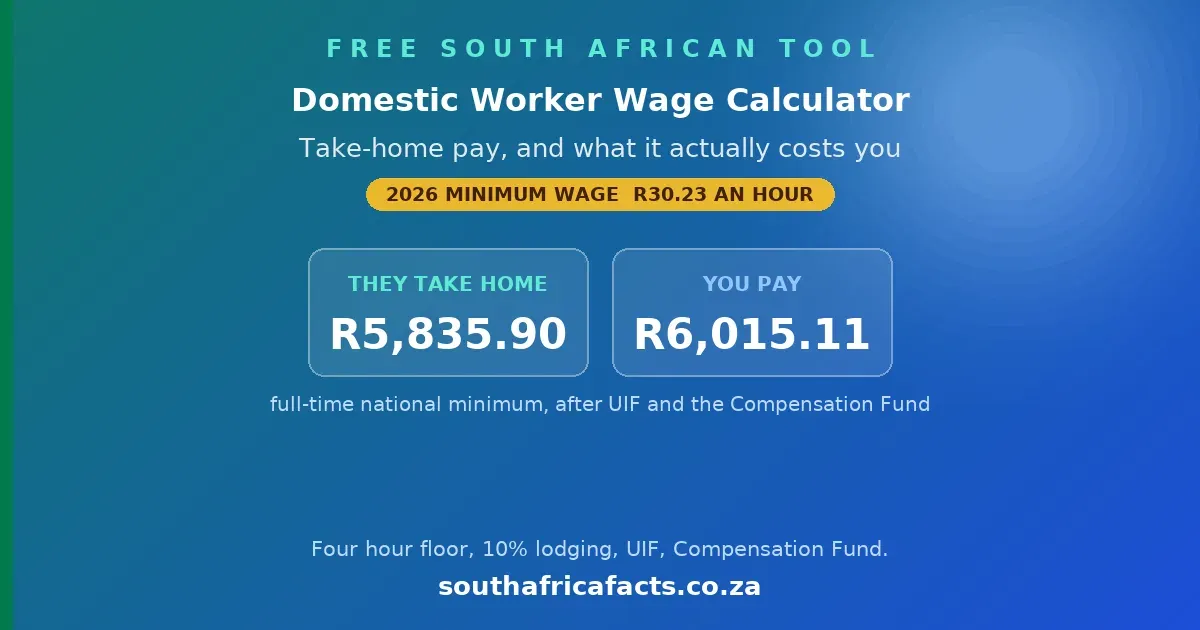
Domestic worker cost summary
Domestic Worker Wage and Cost Calculator
What it actually costs you, as a household, to employ a domestic worker in South Africa this month, and whether the cash wage is legal. If you are the worker, enter what you are paid and the tool will tell you whether it is legal.
Goes on the payslip as the employee. Nothing is sent anywhere, it stays in your browser.
Names and pay period for the payslip
Defaults to this calendar month. Sectoral Determination 7 clause 6 needs a period on the statement.
On five days or fewer the ordinary day is capped at 9 hours. On six days it is capped at 8, and the week is still capped at 45, so six days of 8 hours is 48 and is a breach.
A day of under four hours is still billed as four hours. That is a pay rule, not a rule that they must stay four hours. It sits in Sectoral Determination 7's wage clauses, so it still binds below 24 hours a month.
Ordinary cash wage, before lodging. The national minimum from 1 March 2026 is R30.23 an hour. The tool will not fill that in for you, it checks what you type.
Enter the cash wage first. The payslip cannot be built without it.
Taxi fare or a cash allowance. Added to what it costs you. Not counted toward the national minimum, because the wage must be paid in money for ordinary hours. A fare reimbursement is not wages, so it is also left out of UIF and the Compensation Fund; a cash allowance might be remuneration, treat this as a cost line.
Used only for the notice display. One week at six months or under, four weeks after that. Leave pay on termination sits in the BCEA calculator.
The Compensation Fund’s R560 a year household minimum is a whole-payroll floor. Tick this only if you do not already pay that floor on another worker.
This month also had overtime, a Sunday, a public holiday, standby, lodging or a 13th cheque
Hours already agreed above ordinary time, paid at 1.5 times. Sectoral Determination 7 caps overtime at 15 hours a week (the BCEA default is 10). Ordinary plus overtime on a day may not exceed 12. The tool will flag a breach rather than silently cap what you typed.
Ordinary Sundays pay at 1.5 times, with a floor of one daily wage. Other Sundays pay at double, and those hours do not count toward the 45 ordinary hours.
If they had the day off and you pay a monthly wage, that ordinary day is already in the salary. If you only pay on days they come in, you still owe the daily wage; use the BCEA calculator to see it.
R30 a shift, 20:00 to 06:00, and more than five shifts in a month is flagged. A written agreement is assumed if you enter any. That R30 figure has not been increased since the 2008 amendment.
Since the 2008 amendment, every hour actually worked on standby is overtime. There is no three hour free period.
Food is never a legal deduction. Lodging of up to 10% of the ordinary cash wage is only legal if the room meets the three conditions below.
Weatherproof and kept in good condition, at least one window and a lockable door, and a toilet and bath or shower if they have no other bathroom. If any of those fail, the 10% is illegal and the cash floor snaps back to the full national minimum.
One extra ordinary monthly wage a year, spread across twelve months in the cost, and included in the Compensation Fund year base. Not a legal minimum.
💬 Questions about a domestic worker's wage? Discuss this tool on the forum →
More on this: Employing a Domestic Worker · BCEA Leave and Pay Calculator · Cost to Hire Calculator · Retrenchment and Severance Calculator
What does it actually cost to employ a domestic worker?
Most search results will tell you the hourly minimum. That is the start of the answer, not the end of it. A household also pays 1% UIF on top of the cash, a Compensation Fund assessment from the first hour, and, if you offer one, a 13th cheque. The worker takes home the cash after a legal lodging deduction and their own 1% UIF. This calculator puts those two numbers next to each other, and then checks whether the cash wage is legal against the national minimum, the four hour daily floor, and Sectoral Determination 7's hours caps. If you are the worker, enter what you are paid and the tool will tell you whether it is legal.
It is built for a household, not a business. The Cost to Hire Calculator is the sibling for a firm that has ETI and the Skills Development Levy to think about. Leave balances, sick leave and the pay-out on termination sit in the BCEA Leave and Pay Calculator. The law in prose, including immigration, is on Employing a Domestic Worker in South Africa.
The legal floors this page actually uses
| Rule | The 2026 figure | The detail that catches households |
|---|---|---|
| National minimum wage | R30.23 an hour from 1 March 2026 | No separate domestic rate. Old metro versus area 2 tables are not the floor. |
| Four hour daily floor | A day they work is billed as at least four hours | Sectoral Determination 7 clause 2(4), a wage clause, so it binds below the 24 hour line. |
| UIF 1% + 1% | Applies once billed ordinary hours exceed 24 a month | Ceiling R17,712 a month, so R177.12 each at most. Their 1% comes out of cash. Tested on billed hours. |
| Compensation Fund, Class M | 1.04% of ordinary cash for the year, from the first hour | Accrual, not a monthly debit. Ceiling R668,000 a year. Household minimum R560 a year if this is your only domestic employee. |
| Lodging | Not more than 10% of ordinary cash, and only if the room qualifies | Food is never a legal deduction. A failed room snaps the cash floor back to 100% of the minimum. |
| Notice | 1 week, then 4 weeks after 6 months | Legally compelled above 24 hours a month. Leave on termination is the BCEA calculator. |
What R30.23 an hour is per day, per week and per month
The legal floor is hourly and there is no official daily or monthly gazette rate. The old Sectoral Determination 7 metro and area 2 tables are not the current minimum. Everything below is R30.23 multiplied out, using the determination's own 13/3 weeks in a month, which is the same fraction as 52/12 and not a rounded 4.33.
| A day of | Ordinary cash at R30.23 | Why this day length matters |
|---|---|---|
| 4 hours or less | R120.92 | The four hour floor. A one hour pop-in is billed as four hours. |
| 5 hours | R151.15 | Still below the 24 hour month gate on one day a week, so UIF is off. |
| 6 hours | R181.38 | Two of these a week is 52 billed hours a month and UIF is on. |
| 7.5 hours | R226.73 | Six of these is a 45 hour week, the legal full-time six day pattern. |
| 8 hours | R241.84 | The daily cap once someone works six days a week. |
| 9 hours | R272.07 | The daily cap on five days a week or fewer. |
By the week, a 45 hour week is R1,360.35 and a 40 hour week is R1,209.20. By the month, it depends on the pattern rather than on a flat number of hours, because the determination converts the week you actually work. Six days of 8 hours is 48 ordinary hours and breaches the 45 hour week, so it is not in the table below; 6 days of 7.5 hours sits on the 45 hour line and matches the full-time 5 × 9 month.
| Pattern | Billed hours a month | Ordinary cash at R30.23 |
|---|---|---|
| 5 days × 9 hours | 195 | R5,894.85 |
| 5 days × 8 hours | 173.33 | R5,239.87 |
| 6 days × 7.5 hours | 195 | R5,894.85 |
| 5 days × 6 hours | 130 | R3,929.90 |
| 3 days × 8 hours | 104 | R3,143.92 |
| 2 days × 8 hours | 69.33 | R2,095.95 |
| 1 day × 8 hours | 34.67 | R1,047.97 |
| 1 day × 6 hours | 26 | R785.98 |
| 1 day of 4 hours or less | 17.33 | R523.99 |
You may have seen about R4,837 a month or R121 a day quoted for 2026. Those come from multiplying R30.23 by a flat 160 hour month, and from rounding the four hour floor of R120.92. They are useful headlines, not the amount you owe. The determination converts the pattern you actually work, so five days of nine hours is 195 billed hours and R5,894.85, not 160 hours and R4,836.80. If your worker genuinely works 160 hours a month the two agree. The rate itself is R30.23 an hour from 1 March 2026, up 5% from R28.79, which moved a four hour day from R115.16 to R120.92 and a 45 hour week from R1,295.55 to R1,360.35.
Print a domestic worker payslip
Every payment needs a written statement. Sectoral Determination 7 clause 6 lists what goes on it: your name and address, the worker's name and occupation, the pay period, the wage and the overtime rate, ordinary hours, overtime hours, Sunday and public holiday hours, the wage, any other pay, every deduction, and the amount paid. The Department of Employment and Labour publishes Form BCEA4 as its own pay slip template. This page fills the same fields from the figures you have already entered and prints them straight from the browser, with no template to download, no spreadsheet, and no email address to hand over. Save it as a PDF and keep a copy for three years. Below 24 billed hours a month the determination does not compel written particulars, and handing over a statement is still the clean way to pay.
A worked example
Take a full-time domestic worker on the national minimum, five days a week, nine hours a day, no lodging, no extras. Billed ordinary hours are 45 a week and 195 a month, using Sectoral Determination 7's 13/3 conversion rather than a rounded 4.33. Ordinary cash is R5,894.85. UIF is on, R58.95 each side. The Compensation Fund at 1.04% of that ordinary cash for the year is R735.68, which is above the R560 household minimum, so the rate binds: R61.31 a month. They take home R5,835.90. What it costs you is R6,015.11.
Now a one-morning-a-week worker, three hours, still at the minimum, and they are your only domestic employee. The four hour floor bills that morning as four hours, 17.33 hours a month, which is not more than 24, so UIF is off. Ordinary cash is R523.99. The Compensation Fund 1.04% of that year is R65.39, under R560, so the household minimum binds: R46.67 a month. What it costs you is R570.66. That is about R43.90 per hour actually worked, against a R30.23 minimum. Paying the three hours you actually used would have been R392.99; the floor is the whole difference. If this is not your only domestic employee, the R560 year floor is already being paid on the other worker and this page applies the rate instead, about R5.45 a month.
Lodging is the third trap. Ten percent of R5,894.85 is R589.485. Rounding that up to R589.49 would exceed 10% and is illegal, so the cap floors to the cent at R589.48, leaving ordinary cash of R5,305.37, which still meets the national minimum. Untick the room conditions and that same R5,305.37 fails, because the cash floor snaps back to the full R5,894.85.
Where this sits against the rest of the law
Sectoral Determination 7 still governs hours, lodging, standby, Sunday, public holidays and notice for domestic work. The National Minimum Wage Act replaced the old area wage tables, and section 5 of that Act is why food cannot be deducted while a qualifying room still can. Standby has been R30 a shift since the 2008 amendment, and that amendment also deleted the three hour free period, so every hour actually worked on standby is overtime. The four hour daily floor is clause 2(4) of the determination, a wage clause, which is why it still binds below 24 hours a month; section 9A of the Basic Conditions of Employment Act is the Act-level twin and sits in a chapter that does not apply at that hours level. Ordinary hours may not exceed 45 a week, so 6 days of 8 hours is a breach even though the daily cap on six days is 8. This page does not score a CCMA case, does not advise on immigration, and the print-as-payslip button is a household statement of these figures for a typical month, not a Department of Labour form. It is the monthly rand arithmetic the compliance article cannot do.
Frequently asked questions
How much must I pay a domestic worker in South Africa in 2026?
From 1 March 2026 the national minimum wage is R30.23 an hour, and there is no separate domestic rate. For a full-time pattern of five days and nine hours, that is 195 billed ordinary hours a month and R5,894.85 in ordinary cash, before lodging. A day of under four hours is still billed as four hours, so a three hour morning at the minimum is R523.99 a month, not three-quarters of that. The calculator checks the cash wage you type against that floor; it will not bump a low figure up for you.
What is the minimum wage for a domestic worker per hour, per day and per month?
The legal floor is hourly: R30.23 from 1 March 2026. There is no official daily or monthly gazette rate any more. The old Sectoral Determination 7 metro versus area 2 tables are not the current floor. Convert with the determination's own fraction, 13/3 weeks in a month, which is the same as 52/12, not a rounded 4.33. A four hour day at the minimum is R120.92. A 45 hour week is R1,360.35. A 195 hour month is R5,894.85.
Must I pay UIF for my domestic worker?
Yes, once billed ordinary hours in the month are more than 24. Both sides pay 1%, and the monthly remuneration ceiling is R17,712, so the most either of you pays is R177.12. Their 1% comes out of the cash; yours sits on top. Under 24 hours, UIF is off. Written particulars, leave and notice are not legally compelled by Sectoral Determination 7 at that hours level either. The national minimum, the four hour daily floor and the Compensation Fund still apply, so this is not an unregulated household. The Contributions Act tests hours employed, not hours you are obliged to pay for. This page tests billed hours, the more protective reading. Two 2-hour mornings a week are 17.33 hours actually worked and 34.67 billed, so UIF is on here; if you register on that basis you cannot be wrong for having done so.
Do I have to register for the Compensation Fund if I employ a domestic worker?
Yes, from the first hour. After Mahlangu there is no 24 hour gate on COIDA. A household employer is Class M at 1.04%, with a per-employee earnings ceiling of R668,000 a year and a household minimum assessment of R560 a year (about R46.67 a month) when this is your only domestic employee. On a full-time national-minimum wage the 1.04% rate is about R735.68 a year, which is above the floor, so the rate binds. On a one-morning-a-week worker the floor binds. The figure shown is an accrual, not a monthly debit: you file a Return of Earnings between 1 April and 30 June for the March to February year, then pay the assessment within 30 days of the notice. This page's year base is ordinary cash times 12, plus a 13th if you offer one. Overtime, Sunday, public holiday and standby stay in this month's UIF and are not annualised, so a real Return of Earnings that includes them will be higher.
Can I deduct food or lodging from a domestic worker's wage?
Food, never. Sectoral Determination 7 refuses a food deduction. Lodging of not more than 10% of the ordinary cash wage is only legal if you provide a room that is weatherproof and kept in good condition, with at least one window and a lockable door, and a toilet and bath or shower if they have no other bathroom. The cap is floored to the cent so it cannot exceed 10%. Ten percent of R5,894.85 is R589.485; rounding that up to R589.49 would be more than 10% and is illegal. If the room fails any of the three conditions, the 10% is illegal and the cash floor snaps back to the full national minimum.
What is the four hour daily floor?
If they work at all on a day, Sectoral Determination 7 clause 2(4) says they must be paid for four hours. It is a pay rule, not a rule that they must stay four hours. A one hour pop-in is billed as four. That clause sits in the wage chapter, not the hours chapter, and clause 1(3) says only the wage clauses still apply below 24 hours a month. That is why a one morning a week pattern is still billed as four hours. The Basic Conditions of Employment Act has the same four hour pay rule at section 9A, but that section sits in Chapter 2, which does not apply below 24 hours a month. The floor in this calculator is the sector wage rule. There is no opt-out.
How do Sunday, public holiday and overtime pay work for a domestic worker?
Overtime is one and a half times, capped at 15 hours a week, and the ordinary day plus overtime may not exceed 12 hours. Sunday is double, or one and a half times if Sunday is part of the ordinary week, and a short Sunday shift still pays at least one daily wage. A public holiday that falls on a day they would otherwise have worked, and that they work, pays at least double the daily wage. If they work a public holiday that was not an ordinary working day, you owe the daily wage plus the hours worked. If you pay a monthly wage and they had the holiday off, that ordinary day is already in the salary. Leave balances sit in the BCEA Leave and Pay Calculator, not here.
Does my domestic worker pay PAYE?
Only once cash to the worker is above the 2026/27 under-65 tax threshold of R99,000 a year, which is R8,250 a month. Most live-out national-minimum patterns sit well below that. The calculator flags the threshold; it is not a PAYE engine and it will not produce an IRP5.
What notice must I give a domestic worker?
Sectoral Determination 7 follows the domestic rule: one week at six months of service or under, four weeks after that. Notice is legally compelled only once billed ordinary hours are more than 24 a month. The figure is still shown as good practice below that line. Leave pay on termination is in the BCEA calculator. If the departure is a retrenchment, the retrenchment calculator covers severance.
Is a 13th cheque required for a domestic worker?
No. It is a common practice, not a legal minimum. If you offer one, the calculator spreads one extra ordinary month across twelve in the monthly cost, and includes it in the Compensation Fund year base. UIF is shown for a non-bonus month. A 13th is remuneration in the month it is paid, so a December double-month on the full-time national minimum is R11,789.70 of cash, still under the R17,712 ceiling, and each side pays R117.90 that month rather than R58.95. Overtime, Sunday, public holiday and standby sit in this month's UIF and are left out of the Compensation Fund year base, so a real Return of Earnings that includes them will be higher.
How is this different from the Cost to Hire Calculator?
The Cost to Hire Calculator is for a business: ETI, the Skills Development Levy, and a seven-industry Compensation Fund table. Domestic workers are excluded from ETI, and a household is almost never over the R500,000 SDL threshold. This page is the household tool. It owns the four hour floor, the 10% lodging rule, standby at R30 a shift, and the Class M household Compensation Fund figures. Hiring in a business, not a home, still belongs on Cost to Hire.
Does taxi fare or a transport allowance count toward the national minimum?
No, and this page leaves it out of the cash-floor check, because the National Minimum Wage Act says the wage is the amount payable in money for ordinary hours of work. It is not out of everything, though. Travel between home and work is private travel under section 8(1)(b)(i) of the Income Tax Act, so transport money is not a reimbursement of expenditure incurred in the course of employment, which is the carve-out that would have kept it out of remuneration. This page therefore counts it as remuneration for UIF and as earnings for the Compensation Fund, on both input modes, and out of the national minimum. Money you hand over for a work errand, a taxi to the shops on your instruction with the fare proved, is a true reimbursement and does not belong in this field.
Why is a short morning so expensive?
Because of the four hour floor. A three hour morning at R30.23 is billed as four hours, R523.99 a month, and if they are your only domestic employee the Compensation Fund household minimum adds R46.67. What it costs you is R570.66 for 13 hours actually worked, about R43.90 an hour all-in, against a R30.23 minimum. Consolidating two 3-hour mornings into one 6-hour day drops the floor top-up and is cheaper for you and a fuller day for them.
Does Print as a payslip make a legal payslip?
It fills the fields Sectoral Determination 7 clause 6 requires: employer name and address, worker name and occupation, the pay period, the wage and overtime rates, ordinary hours, overtime hours, Sunday and public holiday hours, the wage, other pay, deductions, and the amount paid. It is a household statement of the figures on this page for a typical month of 52/12 weeks, not a clocked timesheet and not a Department of Labour form. Keep a copy for three years. Under 24 billed hours a month the determination does not compel written particulars, but handing over a statement is still the clean way to pay.
Where can I get a domestic worker payslip template?
You do not need one. The Print or save as PDF button on this page builds a Sectoral Determination 7 clause 6 statement from the figures you entered, in the browser, with no download, no spreadsheet and no email address. If you would rather use the official form, the Department of Employment and Labour publishes Form BCEA4 as a pay slip template, and you fill the same fields in by hand. Either way, keep a copy for three years.
Did the domestic worker minimum wage go up in 2026?
Yes. The national minimum wage went from R28.79 to R30.23 an hour on 1 March 2026, an increase of 5%. In rands that is a four hour day going from R115.16 to R120.92, a 45 hour week from R1,295.55 to R1,360.35, and a full-time 195 hour month from R5,614.05 to R5,894.85. Domestic workers have been on the full national minimum since 1 March 2022, when the 88% exemption fell away, so there is no separate domestic rate to look up any more.
This calculator models one domestic worker in a household against Sectoral Determination 7 and the national minimum wage of R30.23 an hour from 1 March 2026, with UIF at a R17,712 monthly ceiling and the Compensation Fund at Class M 1.04% (ceiling R668,000, household minimum R560 a year). It is general information rather than legal advice, and it does not model a bargaining council, a written contract that is more generous, immigration status, or leave balances. Confirm anything contentious with a labour lawyer or the Department of Employment and Labour. Last reviewed 23 August 2026. Rates effective from 1 March 2026.