
Leave Days Calculator South Africa: BCEA Leave Balance and Premium Pay for Employers
Work out what one employee is owed under the BCEA: leave balances in days and in rand, notice, and overtime, Sunday and public holiday pay at the statutory rates.
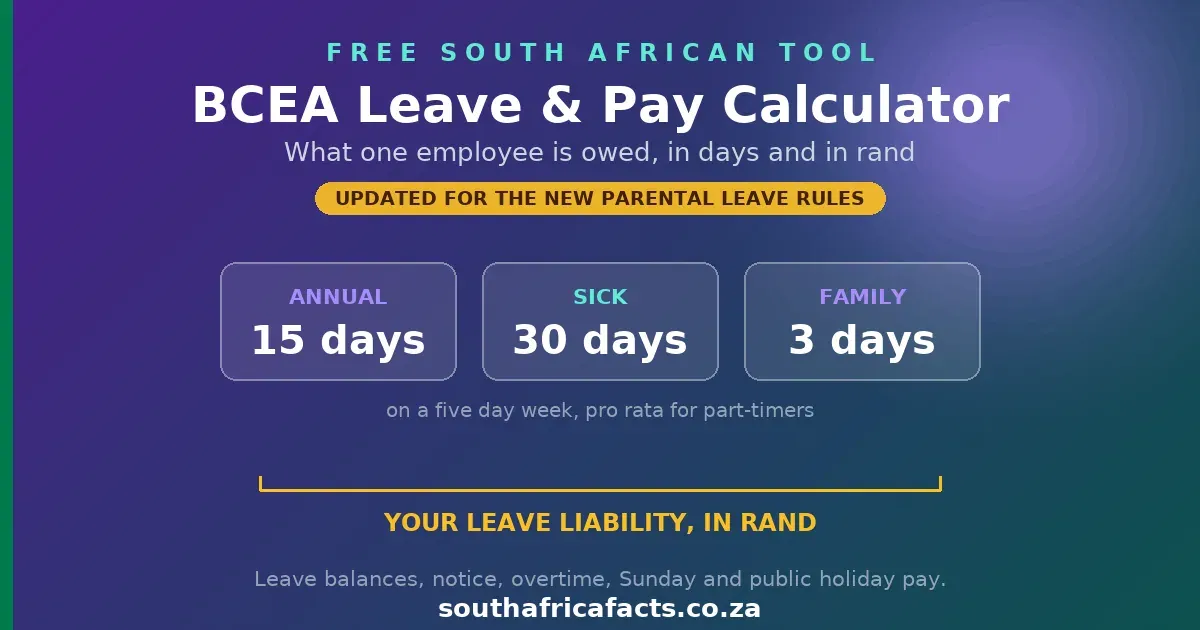
BCEA leave and pay summary
BCEA Leave & Pay Calculator
What one employee is actually owed under the Basic Conditions of Employment Act, the leave balance in days and in rand, plus overtime, Sunday and public holiday pay at the statutory rates.
Only used to label the printout, so a filed copy says who it is for. Nothing is sent anywhere, it stays in your browser.
Basic monthly pay before deductions. Every rand figure below is derived from this using the BCEA section 35(4) method, a month converts to a week at ×12÷52, not by dividing by four.
This drives both the leave entitlement and the daily rate. A part-time pattern is where most leave balances go wrong.
The BCEA maximum is 45 ordinary hours a week, before any overtime.
The date employment began, which sets the leave cycle anniversary.
Use today's date for a live balance, or a termination date to get the pay-out.
Farm and domestic workers get four weeks' notice once they pass six months' service, where other employees only reach four weeks after a full year.
Section 20(2) allows either. They are close but not identical, and the second one applies only by agreement, so it is a choice you must actually have made, not a better deal you can assume.
Days taken in the current leave cycle.
Out of three days per leave cycle.
Annual leave from completed cycles that was never taken. Section 40(b) requires this to be paid out in full on termination, on top of the current cycle, so it belongs in the liability figure. Section 20(4) says leave should be granted within six months of the cycle ending, which is why a large number here is worth looking at.
Only the days taken during the employee's first six months of service.
Days taken in the current 36 month sick leave cycle after the first six months.
Section 22(4) says an employer may do this, it does not happen automatically, and only in the first sick leave cycle. Tick it only if you are actually applying the reduction. It is worth exactly the number of days taken in that first six months.
Hours beyond ordinary hours. The BCEA caps overtime at 10 hours a week.
Hours actually worked on a Sunday.
If Sundays are part of the normal pattern the rate is one and a half times. If they are not, it is double.
Hours worked on a single public holiday. Leave it at zero to see what an unworked public holiday costs.
This changes the rule completely, from double the daily wage to the daily wage plus the time actually worked.
The BCEA requires an allowance for work between 18:00 and 06:00 but sets no percentage, so there is no statutory figure to calculate. Enter your own agreed rate and the hours below, or leave it at zero.
Hours worked between 18:00 and 06:00.
💬 Questions about a leave balance? Discuss this tool on the forum →
More Business tools: Cost to Hire Calculator · Employee or Independent Contractor? · Provisional Tax Calculator · Business Structure & Tax Calculator · Business Compliance Calendar · Working Capital & Cash Gap Calculator · Retrenchment & Severance Calculator
How many leave days does an employee actually have?
Most leave calculators answer that question for the employee. This one answers it for the employer, and it answers the part that actually costs money. Enter a salary, a working pattern and a start date, and it works out the annual leave balance in days and in rand, which is both your leave pay provision and the section 40 pay-out if the person resigns tomorrow. It handles the 36 month sick leave cycle including the one day per 26 days worked rule that applies in an employee's first six months, the two eligibility gates on family responsibility leave, the section 37 notice period, and the statutory rates for overtime, Sunday and public holiday work. It is built around the cases that go wrong in practice, a mid-cycle hire and a part-timer, rather than restating the Act at somebody on a standard five day week.
Three things here that most free leave calculators get wrong. The first is the earnings threshold. An employee earning above R269,600.90 a year is excluded from the overtime and Sunday pay sections altogether, but not from a single leave entitlement, and a tool that ignores the threshold will quietly overstate what you owe a manager. The second is the section 40(c) pay-out floor, which means the amount you owe on termination for the current cycle can legally exceed the balance your accrual method shows, because one day per 17 days worked is a statutory minimum rather than a method you choose. The third is parental leave, which changed on 3 October 2025 and is still widely published in its old form of four months for the mother and ten days for the father. All three are handled below.
What each type of leave is worth
| Type of leave | The statutory minimum | What that means in practice | Paid out on termination? |
|---|---|---|---|
| Annual leave | 21 consecutive days per 12 month cycle | 15 working days on a 5 day week, 18 on a 6 day week, 9 on a 3 day week | Yes. Completed cycles in full under s40(b), the incomplete cycle at a floor of one day per 17 days worked under s40(c), and only past 4 months' service |
| Sick leave | Days worked in a 6 week period, per 36 month cycle | 30 days on a 5 day week, 36 on a 6 day week. One day per 26 days worked in the first 6 months | No, it lapses |
| Family responsibility leave | 3 days per annual leave cycle | Only after 4 months' service and only if the employee works 4 or more days a week | No, it lapses |
| Parental leave | 4 months, or 4 months and 10 days shared where both parents are employed | Unpaid by the employer, the employee claims from the UIF | Not applicable |
What the premium pay rates are
The right-hand column is the one to watch. An employee earning over the section 6(3) earnings threshold is excluded from most of these, so the statutory obligation falls away even though a contractual promise to pay them would still stand.
| When the work happens | The statutory rate | The detail that catches people | Switched off above the threshold? |
|---|---|---|---|
| Overtime | 1.5 × the hourly rate | Max 10 hours a week, and only by agreement | Yes, section 10 |
| Sunday, not ordinarily worked | 2 × the hourly rate | Floored at one ordinary daily wage for a short shift, section 16(2) | Yes, section 16 |
| Sunday, ordinarily worked | 1.5 × the hourly rate | Same daily wage floor applies | Yes, section 16 |
| Public holiday, an ordinary working day, worked | 2 × the daily wage | Or the daily wage plus time worked, if greater | No, section 18(2) still applies |
| Public holiday, not an ordinary working day, worked | Daily wage plus the time worked | This is the case the threshold switches off | Yes, section 18(3) |
| Night work, 18:00 to 06:00 | No statutory percentage | An allowance or reduced hours is required, the amount is not prescribed | Yes, section 17(2) |
A worked example
Take an employee on R18,000 a month, a five day week of 45 ordinary hours, who started eight months ago and has taken three days of annual leave. Section 35(4) makes that R4,153.85 a week, R92.31 an hour and R830.77 a day. Eight months into a cycle they have accrued exactly 10 of their 15 days on the 21 consecutive day method, so the balance you manage is seven days. The figure you would actually pay out is higher, because section 40(c) floors the incomplete cycle at one day per 17 days worked, and they have worked about 174 days, giving 10.23 days rather than 10. Net of the three days taken, the statutory pay-out is 7.23 days, or R6,007.37, about R190 more than the accrued balance would suggest. Their notice period is two weeks, worth R8,307.69 if paid in lieu. On sick leave they are past the six month mark, so the full 30 day cycle allowance applies, and if they took four sick days in those first six months you may reduce that to 26 under section 22(4), though you do not have to.
Now the premium pay traps. Call that employee in for a three hour Sunday shift and double time comes to R553.85, which is less than their R830.77 daily wage, so section 16(2) means you owe the full R830.77 anyway. Have them work a nine hour public holiday that falls on a normal working day and the statutory figure is R1,661.54, double the daily wage, but because a monthly salary already covers that day the amount you actually add to payroll is R830.77. Raise the same employee's salary to R30,000 a month and they cross the earnings threshold, at which point the R1,846.15 of overtime you would have owed on eight hours is no longer a statutory requirement at all, while every one of their leave entitlements stays exactly where it was.
A part-timer shows why the working pattern matters more than the salary. Somebody on three days a week gets nine working days of annual leave a cycle rather than 15, 18 days of sick leave rather than 30, and no family responsibility leave at all, because section 27 requires four days a week however long they have been with you.
Where this sits against the rest of the Act
This tool covers leave, premium pay and notice for one employee against the statutory minimum. For the full cost of that employee to the business, including UIF, SDL, COIDA and the Employment Tax Incentive, use the Cost to Hire Calculator. If you are working out a retrenchment package, the Retrenchment and Severance Calculator covers severance, notice and leave pay from the employee's side. If you are not certain the person is an employee at all, and therefore whether any of this applies, start with the Employee or Independent Contractor checker.
Frequently asked questions
How much annual leave does an employee get under the BCEA?
Section 20 gives an employee 21 consecutive days of paid annual leave for every completed annual leave cycle of 12 months. The catch is that 21 consecutive days counts calendar days, weekends included, so it works out to three weeks of the employee's own working pattern. For somebody on a five day week that is 15 working days, and for somebody on a six day week it is 18 working days. For a part-timer on three days a week it is nine working days, not 15. Section 20(2) allows an alternative of one day for every 17 days worked, which comes to about 15.29 days a year on a five day week, but that method applies only by agreement, so it is a choice you must actually have made with the employee rather than a better deal either side can assume.
Does 21 consecutive days mean 21 working days off?
No, and this is probably the single most common annual leave mistake employers make. The Act says 21 consecutive days, which includes the weekends that fall inside that stretch. Three calendar weeks contains 15 working days for a five day week employee, so granting 21 working days is granting about 40% more leave than the statutory minimum. That is entirely lawful, the BCEA is a floor and you may always be more generous, but you should know you are doing it rather than discover it later in a leave balance you cannot explain.
How does the 36 month sick leave cycle actually work?
Section 22(2) gives an employee the number of days they would ordinarily work in a six week period, as paid sick leave, per 36 month cycle. That is 30 days on a five day week and 36 days on a six day week, and it is a cycle allowance rather than an annual one, so an employee who uses all 30 days in year one has none left for the following two years. During the employee's first six months a different rule applies under section 22(3): they earn one day of paid sick leave for every 26 days worked, which comes to roughly five days by the end of the six months on a five day week. The calculator above works out which of the two rules applies from the start date you enter.
Can I deduct sick days taken in the first six months from the full cycle entitlement?
You may, but only if you choose to, and only in the first sick leave cycle. Section 22(4) says an employer may reduce the section 22(2) entitlement by the number of days of sick leave taken under section 22(3) during the first six months. The important word is may. It is an employer election, not something that happens automatically, and it is worth exactly the number of days taken in that first six months. If an employee took four sick days in their first six months and you apply the reduction, they have 26 days for the rest of the cycle rather than 30, so 30 days in total across the cycle. If you do not apply it they end up with 34 in total. The calculator has this as a tick box precisely because both answers are lawful and the difference is yours to make.
Who qualifies for family responsibility leave?
Section 27 puts three days per annual leave cycle behind two separate gates, and an employee has to clear both. They must have been employed for longer than four months, and they must work at least four days a week for you. An employee on a three day week never qualifies, however many years they have been with you, which surprises a lot of employers. It also covers only the specific events the section lists, the birth or illness of the employee's child and the death of certain named family members, so it is not a general compassionate or emergency leave allowance.
What is the BCEA earnings threshold and what does it change?
From 1 May 2026 the threshold is R269,600.90 a year, which is R22,466.74 a month. An employee earning above it is excluded from sections 9, 10, 11, 12, 14, 15, 16, 17(2) and 18(3) of the Act, which is to say ordinary hours, overtime, compressed weeks, averaging, meal intervals, rest periods, Sunday pay, the night work allowance and the public holiday rule for a day the employee would not ordinarily work. In plain terms you are not statutorily required to pay a high earner overtime or Sunday premiums. What the threshold does not touch matters just as much: every leave entitlement in Chapter Three, so annual, sick, family responsibility and parental leave, applies to all employees whatever they earn, and so does the section 37 notice period. Note also that a contract or company policy promising overtime pay to a high earner is still enforceable as a contractual term, the threshold only removes the statutory obligation. One detail worth getting right: earnings for this purpose means regular annual remuneration before deductions such as tax, pension and medical, but it excludes the employer's own contributions, subsistence and transport allowances, achievement awards and overtime pay. An employee on R21,000 basic plus a R3,000 travel allowance sits on either side of the R22,466.74 monthly figure depending on whether you apply that definition, and the answer changes every premium you owe them, so it is worth doing properly.
How do I work out an hourly or daily rate from a monthly salary?
Section 35(4) sets the method and it is not the obvious one. A monthly remuneration converts to a weekly figure by multiplying by 12 and dividing by 52, not by dividing by four. From that weekly figure, the hourly rate divides by the employee's ordinary hours a week and the daily rate divides by the days they work a week. So R18,000 a month is R4,153.85 a week, R92.31 an hour on a 45 hour week, and R830.77 a day on a five day week. Dividing the monthly salary by 30 instead would give R600 a day and understate every single premium and leave pay-out you calculate from it.
What must I pay for work on a Sunday?
Section 16 sets double the wage for each hour worked if the employee does not ordinarily work Sundays, and one and a half times if Sundays are part of their normal pattern. There is a trap in section 16(2) that catches a lot of employers: if the amount that calculation produces is less than the employee's ordinary daily wage, you must pay the ordinary daily wage instead. So a three hour Sunday shift for somebody on R18,000 a month works out to R553.85 at double time, which is below their R830.77 daily wage, and the correct payment is therefore R830.77. Calling in an employee for a short Sunday shift costs you a full day either way.
What must I pay for work on a public holiday?
Section 18 splits into three genuinely different cases. If the public holiday falls on a day the employee would ordinarily work and they do not work, they are simply paid as normal. If it falls on such a day and they do work, you owe at least double the daily wage, or the daily wage plus what they earned for the time worked if that is more. If it falls on a day they would not ordinarily work and they work it, you owe the ordinary daily wage plus what they earned for the time worked. One practical point the calculator handles for you: for a monthly paid employee the salary already covers the ordinary wage for their normal pattern, so an unworked public holiday adds nothing to payroll, and a worked one on an ordinary working day adds one extra day's wage rather than two.
Is there a statutory night work allowance percentage?
No, and any figure you see quoted as the statutory rate is somebody's market practice, not the Act. Section 17 requires an employer to pay an allowance, which may be a shift allowance, or to reduce working hours, for work performed between 18:00 and 06:00, but it deliberately sets no percentage. Work after 23:00 brings further obligations around transport and health assessments. The calculator therefore takes your own agreed allowance as an input rather than inventing a rate, and says so on the page.
What is the parental leave position after the Van Wyk judgment?
On 3 October 2025 the Constitutional Court confirmed in Van Wyk v Minister of Employment and Labour [2025] ZACC 20 that the old maternity and parental leave sections unfairly discriminate between classes of parents. The declaration of invalidity is suspended for 36 months so Parliament can fix the Act, but paragraph 5 of the order reads replacement wording into the BCEA in the meantime, so this is the law now and not a pending proposal. Section 25A, the old ten days for the non-birth parent, is deleted. A single parent, or the only employed party in a parental relationship, gets at least four consecutive months. Where both parties are employed they are entitled in the aggregate to four months and ten days, split by agreement or, failing agreement, as close to half each as possible. Two details are widely reported wrongly: the four months and ten days applies where both parents are employed, a single parent gets four months rather than four months and ten days, and although the Court did declare the under-two age limit on adoption leave invalid, that declaration is suspended as well and the read-in wording keeps the limit, so the age limit still stands for now.
What has to be paid out when an employee leaves?
Accrued annual leave, always, and section 40 splits it into two parts that are calculated differently. Untaken leave from cycles the employee has already completed is paid out in full under section 40(b). The current, incomplete cycle is paid under section 40(c), and only if the employee has been employed longer than four months. Unused sick leave and family responsibility leave are entitlements rather than savings and simply lapse, so nothing is paid out for those. Notice under section 37 is separate again, either worked or paid in lieu. If the departure is a retrenchment there is severance pay on top, and our retrenchment calculator covers that from the employee's side.
Why is the leave pay-out sometimes more than the leave balance?
Because section 40(c) sets a floor for the incomplete cycle that is independent of however you accrue leave during the year. It requires one day's remuneration for every 17 days on which the employee worked or was entitled to be paid, or remuneration on any basis that is at least as favourable to the employee. That last phrase is the key one: the one day per 17 days figure is a minimum, not an alternative method you get to elect, so if your accrual method produces less you must pay the higher figure. It matters in practice. An employee on a five day week who is eight months into a cycle has accrued exactly 10 of their 15 days on the 21 consecutive day method, but has worked about 174 days, which puts the section 40(c) floor at 10.23 days. On R18,000 a month that gap is worth about R190, and it is the sort of difference that turns up in a CCMA referral rather than in a payroll report. The calculator shows the balance and the pay-out separately for exactly this reason.
Does the BCEA override my bargaining council agreement or sectoral determination?
It is the other way around. The BCEA sets a floor, and a bargaining council agreement or a sectoral determination for your industry can and frequently does require more than the statutory minimum. There are separate sectoral determinations covering domestic work, farm work, contract cleaning, hospitality, wholesale and retail and others, and where one applies to you its terms are what you owe. The same goes for the employee's own contract or your company policy where these are more generous. Check those first, then use this calculator to confirm you are at least clearing the statutory minimum underneath them.
This calculator models one employee against the BCEA statutory minimum, using the section 6(3) earnings threshold of R269,600.90 set on 1 May 2026 and the national minimum wage of R30.23 an hour set on 1 March 2026. The BCEA is a floor, so a bargaining council agreement, a sectoral determination or the employee's own contract may require more, and where it does that is what you owe. It is general information rather than legal advice, and it does not model bargaining council terms, sectoral determinations, collective agreements, or leave granted above the statutory minimum by company policy. Confirm anything contentious with a labour lawyer or the Department of Employment and Labour. Last reviewed July 2026.