
Tractor Fuel Consumption & Farm Diesel Cost Calculator (South Africa)
Tractor fuel consumption and diesel cost per hour, day, month and hectare at South African prices, net of the SARS on-land diesel refund, with a whole season built pass by pass.
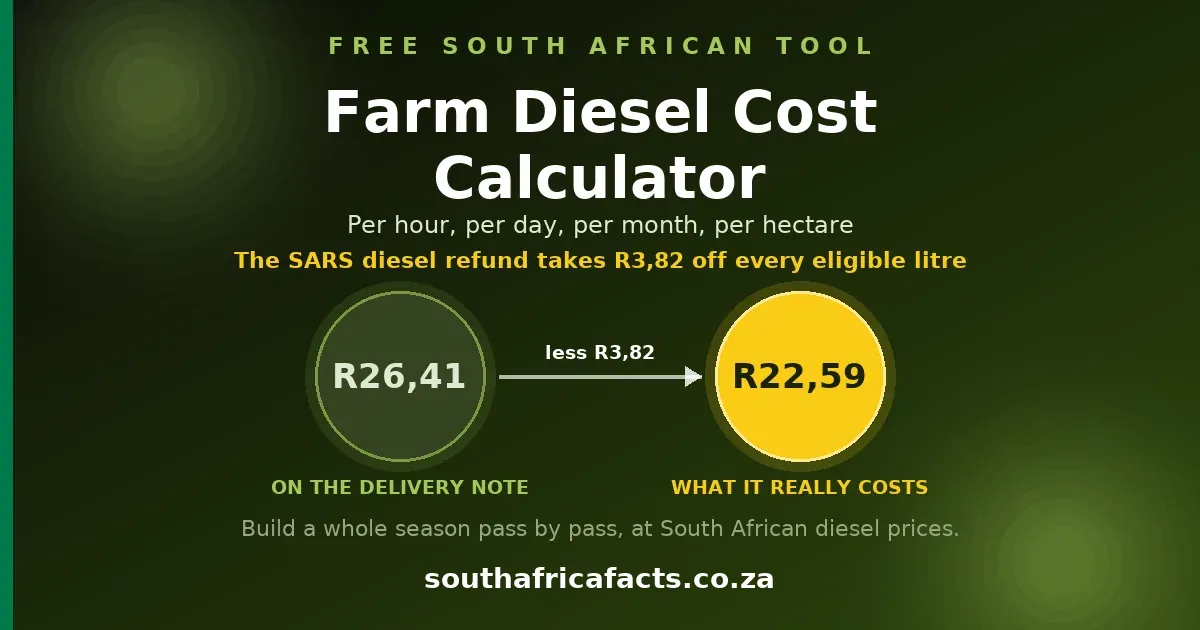
Works out what the diesel in your tractors actually costs, per hour, per day, per month and per hectare, at South African diesel prices. Two things separate this from a generic tractor fuel calculator. It works in litres, hectares and rands rather than gallons and acres, and it knows about the SARS diesel refund, which gives a registered farmer 382.2 cents back on every eligible litre, roughly a seventh of the pump price. Every rand figure on this page tells you which side of that refund it sits on.
Type the price on your own bulk delivery note if you have one, that is the number this tool wants. The buttons load the published wholesale list price as a starting point. Diesel is not price controlled at the pump in South Africa, so what you actually pay depends on your supplier, your zone and your delivery.
- You are registered as a VAT vendor and registered for the diesel refund on eFiling.
- The diesel is used on land in farming, forestry or mining, off the public road.
- You keep purchase, storage and usage logbooks.
- You are both the buyer and the user of the diesel.
Source, SARS external policy SE-DSL-02, effective 20 April 2026, section 3(a). In practice the storage logbook means bulk diesel into your own on-farm tank.
Litres burnt in a bakkie on a public road are not eligible. If a fifth of your diesel goes on road use, enter 80.
Two figures on different sides of the refund are not comparable, so this switches all of them at once rather than mixing them.
The most reliable number you can put in here. Fill the tank, work a measured number of hours, fill it again, divide.
The kilowatt rating on the tractor, which in South Africa is the engine rating. A 90 kW tractor goes in as 90.
The fuel equation works off PTO power, so an engine rating has to be stepped down to it. There is no single correct number: it runs from about 0.83 to 0.90 depending on the transmission and whether the engine has a power bulge, so it is shown here rather than applied behind your back. Use your own spec sheet if it gives both figures.
Set by the operation you picked. Override it if you know your own tractor sits heavier or lighter.
Leave it at zero if you do not want a per hectare figure, or work it out from your implement below.
Field capacity is speed times width times field efficiency, the formula in the Department of Agriculture guide to machinery costs. Field efficiency is the share of the hour actually spent working rather than turning on the headlands, refuelling or filling the planter, and 83% is the figure that guide uses for a field cultivator.
On the Highveld, altitude costs you power. The same guide notes a naturally aspirated engine at Highveld altitude delivers only about 80% of the power it is rated for at sea level, so it covers correspondingly less ground per hour. A turbocharged engine is taken to lose nothing. If your tractor is naturally aspirated and you farm high, drop your work rate accordingly.
Build the season one pass at a time. This is how a fuel budget is actually put together, because ploughing and spraying are nowhere near the same number, and the answer you want is litres and rands per hectare for the whole programme.
Optional. Turns the answer into rands of diesel per ton produced, which is the figure that travels with a grain price.
Each button loads a sequence of passes you can then edit. The litres come from the per operation table, not from the tillage trial, so the totals will not match the benchmark table lower down exactly.
| Pass | L/ha | Ha | Litres | Cost |
|---|
Diesel used to establish a maize crop under four tillage systems, measured at Cedara in KwaZulu-Natal. These cover land preparation and planting only, not harvesting or later spraying, so they are lower than a full season programme. Enter your land area to see what each system would cost you.
| Tillage system | L/ha | Hours/ha | Diesel cost | Against conventional |
|---|
Read that last column carefully. The same trial found no-till did not come out cheaper overall, because it needed a glyphosate spray and an extra 40 kg of nitrogen per hectare that the ploughed treatments did not, which cancelled the diesel saving. The fuel is genuinely lower. The establishment cost was not. Diesel is one line in the budget, not the budget.
💬 Discuss this tool, or check it against your own fuel records, on the forum →
What farm diesel actually costs, once the refund is in
Diesel is one of the largest single line items on a South African crop farm, and it is also the one most often costed wrong, because the price on the delivery note is not what the diesel costs you. A farmer registered for the SARS diesel refund claims back the fuel levy and Road Accident Fund levy portions on every eligible litre, 382.2 cents a litre from 1 jul 2026, on 100 percent of eligible litres since 1 April 2026. On inland 50ppm diesel that is about 14 percent of the price. Cost a season at the delivery note price and every figure you produce is that much too high.
The calculator above keeps that explicit rather than burying it. A price ladder shows what you pay, what the refund takes off and what a litre really costs, and a single switch moves every rand figure on the page between those two footings at once, so you never end up comparing a cost per hectare worked out before the refund against one worked out after it. There is deliberately no step netting off VAT, because diesel is zero rated for VAT in South Africa and there is no input VAT on it to reclaim, a point covered in the questions below.
Two ways in. The first tab turns a burn rate into a cost per hour, per day, per month, per season and per hectare worked, either from litres an hour you have measured yourself, which is always the better number, or estimated from your tractor kilowatts and the job. The second builds a whole season pass by pass, ploughing through to combining, adjusts every tillage figure for your soil, and gives you litres and rands per hectare and per ton produced. Both sit alongside a South African trial showing what changing tillage system does to the fuel bill.
Working out your actual refund claim for a VAT period is a separate job, and a fiddly one when the period spans a rate change. Our SARS Diesel Rebate Calculator does that using SARS's own published method. If you are budgeting the rest of the season too, the Fertiliser Calculator works out bags, cost and cost per kilogram of nutrient, and the Borehole Pump Electricity Calculator does the same for what your pump costs to run. Browse all our free South African tools and calculators.
South African diesel prices, August 2026
Published wholesale list price per litre, from the Fuels Industry Association of South Africa, with what a litre actually costs a registered farmer once the 382.2 cents a litre on-land diesel refund is taken off. Diesel is not price controlled at the pump in South Africa, so your delivered bulk price will differ from the list price.
| Grade and zone | Wholesale list price | After the diesel refund |
|---|---|---|
| Inland, 50ppm | R26.41 | R22.59 |
| Inland, 500ppm | R26.17 | R22.35 |
| Coastal, 50ppm | R25.53 | R21.71 |
| Coastal, 500ppm | R25.30 | R21.48 |
Diesel by tillage system, measured in South Africa
Diesel and time to establish a maize crop under four tillage systems, measured at Cedara and published by the KwaZulu-Natal Department of Agriculture and Rural Development. Land preparation and planting only, so harvesting and later spraying are not in these figures.
| Tillage system | Litres per hectare | Hours per hectare |
|---|---|---|
| Conventional (disc, plough, disc) | 53.43 | 4.74 |
| Chisel plough and disc | 46.60 | 4.22 |
| Stubble mulch (chisel plough) | 30.83 | 3.02 |
| No-till | 20.34 | 2.38 |
Tractor fuel consumption per hectare, by operation
Litres of diesel for one pass over one hectare, on loam. On clay and clay loam add 35 to 45 percent for primary tillage and 15 to 20 percent for secondary tillage; on sand and sandy loam take 15 to 20 percent and 10 to 15 percent off. Haying operations are not affected by soil type. These are indicative planning figures, your own records beat them.
| Operation | Litres per hectare |
|---|---|
| Mouldboard ploughing | 20.95 |
| Chisel ploughing | 10.85 |
| Rotary bed forming | 12.81 |
| Disking | 7.02 |
| Field cultivating | 7.11 |
| Roller packing | 7.20 |
| Springtooth harrowing | 6.17 |
| Knifing in fertiliser | 5.52 |
| Till planting | 5.61 |
| Surface planting | 4.68 |
| Drilling (small grain) | 3.65 |
| Mechanical weeding | 4.02 |
| Rotary hoeing | 2.34 |
| Spraying | 1.96 |
| Chopping stalks | 4.86 |
| Combining | 11.41 |
| Chopping silage | 16.56 |
| Mowing (hay) | 5.33 |
| Windrowing (hay) | 5.52 |
| Raking (hay) | 3.09 |
| Baling (hay) | 4.40 |
| Stacking (hay) | 7.95 |
Frequently asked questions
How much diesel does a tractor use per hour?
It depends far more on how hard the tractor is working than on how big it is. As a rule of thumb, a tractor at full load burns about 0.32 litres for every rated PTO kilowatt-hour, so a 90 kW tractor pulling hard is in the region of 20 to 25 litres an hour, while the same tractor on a boom sprayer might use half that. The South African Department of Agriculture guide to machinery costs puts it a slightly different way, at 0.30 litres per kilowatt-hour on a high power demand job using 60 percent of the engine's kilowatts, 0.35 at medium demand on 45 percent, and 0.40 at low demand on 35 percent. The calculator above will work out a figure from your tractor's kilowatt rating and the job, but the number worth having is your own: fill the tank, work a measured number of hours, fill it again and divide.
How many litres of diesel does a tractor use per hectare?
Ploughing is the heavy one. Published figures put mouldboard ploughing near 21 litres a hectare, chisel ploughing near 11, disking near 7, planting between about 4 and 6, spraying under 2, and combining near 11. Soil matters enormously: on clay and clay loam, primary tillage can take 35 to 45 percent more diesel than the same job on loam, and on sand it takes 15 to 20 percent less. Add the passes up over a season and a conventional maize programme lands somewhere near 60 to 65 litres a hectare, which is close to the roughly 60 litres a hectare Grain SA gives as a typical grain farm's annual use. The second tab above builds this up pass by pass and adjusts for your soil.
How much is the SARS diesel refund worth per litre?
From 1 Jul 2026 the on-land rate for farming, forestry and mining is 382.2 cents a litre, which is R3.822 a litre, claimed on 100 percent of eligible litres since 1 April 2026. On inland 50ppm diesel at R26.41 a litre that is about 14 percent of what you pay, so a farm burning 20 000 litres a season gets back roughly R76 440. Be careful with figures you find elsewhere: several widely read articles still quote 366 cents a litre and describe the rate as unchanged since 2023, and others quote a saving of R5.80 to R6.20 a litre. Neither matches the Government Gazette. The rate moved five times between April and July 2026. The table below gives each rate with its own notice.
Can I claim the VAT back on my farm diesel as well?
No, and this is the question most farmers get wrong in the hopeful direction. Diesel is zero rated for VAT in South Africa under section 11(1)(h) of the VAT Act, as a fuel levy good, precisely so that it is not taxed twice on top of the fuel levy and Road Accident Fund levy already in the price. There is no VAT in the price of the diesel, so there is no input VAT to claim back on it. What can carry VAT is a separately charged delivery or call-out fee, and if your supplier bills that as its own line you claim the input VAT on that line in the ordinary way. This calculator therefore has no VAT step, and says so on the price ladder, because quietly dividing your diesel price by 1.15 would flatter every figure on the page by about 13 percent.
Who qualifies for the diesel refund, and what records does SARS want?
Under SARS external policy SE-DSL-02, you must be registered as a VAT vendor, be registered for the diesel refund itself by completing the RAV01 form on eFiling, be carrying on farming, forestry or mining on land, keep a detailed logbook of all diesel purchases, storage and usage, and be both the buyer and the user of the diesel. In practice the storage logbook requirement means bulk diesel delivered into your own tank, with a record for each receipt into storage and a separate usage record per vehicle or engine drawing from it. Diesel burnt on a public road is not eligible, and for those trips our Trip Fuel Cost Calculator is the right tool instead. Claims go through Part C of your ordinary VAT201 return and must be submitted within two years of the purchase date, and the records must be kept for five years.
What diesel price should I put in, the pump price or something else?
Whatever your own delivery note says, which for most farms is a bulk delivered price rather than a pump price. Diesel is not price controlled at the pump in South Africa, unlike petrol, so there is no single correct national figure to fall back on. What is published is a wholesale list price, by zone and by grade, and that is what the buttons in the calculator load as a starting point, August 2026 figures from the Fuels Industry Association of South Africa. Your delivered price will differ from it, usually upward for transport and downward for volume, and an emergency delivery can carry a premium of several rand a litre on top. Put in your real number and the whole page updates.
Does gearing up and throttling down really save diesel?
Yes, on the right jobs, and the effect is well documented. Changing up a gear and dropping the engine revs while holding the same ground speed keeps the work rate the same but moves the engine into a more efficient part of its map. Dropping revs about 20 percent typically cuts the burn by 11 to 14 percent on a lightly loaded tractor. The two conditions matter though. It only applies on light work, generally under about 65 percent of full power, so it does nothing for you while ploughing. And it cannot be used on anything driven off the power take off, a baler, a mower conditioner, a silage chopper, because those need the engine held at 540 or 1000 PTO rpm and slowing them down damages the job and the driveline. The calculator above works out the saving where it applies and tells you why it does not where it does not.
Why is my diesel bill so different from my neighbour's?
Soil, tillage system, implement matching and the operator, roughly in that order. The tillage system is the biggest lever a farmer actually controls: a South African trial at Cedara measured 53.4 litres a hectare to establish maize conventionally with a disc, plough and disc, against 20.3 litres a hectare under no-till, which is a two and a half times difference on the same crop. Read the rest of that trial before you reach for the ripper though. The no-till treatment needed a glyphosate spray and an extra 40 kg of nitrogen a hectare, and once those were counted its total establishment cost came out much the same. Diesel is one line in the budget, not the budget.
Does this calculator include labour, repairs and the tractor itself?
No, deliberately. It costs diesel and nothing else. A full machinery cost takes in ownership and depreciation, repairs and maintenance, tyres, oil and labour, and on a typical machinery budget fuel is only somewhere around a sixth of the total. Keeping fuel on its own makes it possible to answer fuel questions cleanly, what a pass costs, what a price rise costs, what the refund is worth, without those answers being swallowed by assumptions about the tractor's purchase price and your hours a year. For a full machinery cost, the Department of Agriculture publishes a Guide for Machinery Costs.
Is farm diesel different from road diesel in South Africa?
No, and this trips people up because a lot of what you read online is written for other countries. In the United Kingdom and the United States there is a physically different, dyed fuel, red diesel or off road diesel, sold at a lower price at the point of sale for agricultural use, and putting it in a road vehicle is an offence you can be caught for with a dipstick. South Africa does not work that way. You buy ordinary diesel at the ordinary price, the same fuel a truck buys, and you claim the fuel levy and Road Accident Fund levy portions back afterwards through Part C of your VAT201 return. That is why SARS policy SE-DSL-02 requires you to be the buyer and the user and to keep purchase, storage and usage logbooks: the whole scheme is a claim back on fuel you have already paid full price for, so the paperwork is what proves the diesel went into a tractor rather than a bakkie on the N1. If a page tells you to ask your supplier for dyed rebate diesel in South Africa, it is describing a system this country does not have.
What does it cost to plough a hectare in South Africa?
For diesel alone, mouldboard ploughing runs near 21 litres a hectare on loam, which at the current inland price is roughly R553 a hectare before the SARS refund and about R473 after it. On clay or clay loam add 35 to 45 percent, which is most of the Highveld. Two warnings about that number though. It is fuel only, so it excludes labour, repairs, tyres and the tractor itself, and on a typical machinery budget fuel is only around a sixth of the total cost of the pass. And a contractor quoting you a rate per hectare is quoting all of it plus margin, so their figure will be several times the diesel line. Use the second tab above to build your own pass by pass and the answer comes out for your soil, your hectares and your diesel price. For a full machinery cost including ownership, the Department of Agriculture publishes a Guide for Machinery Costs.
Are the litres per hectare figures South African?
Partly, and the page is explicit about which is which. The tillage system comparison is South African, measured at Cedara in KwaZulu-Natal and published by the provincial Department of Agriculture and Rural Development. The power demand bands, the field capacity formula and the Highveld altitude note come from the national Department of Agriculture guide to machinery costs. The per-operation litres a hectare table is published in a South African machinery management text but the underlying survey is a two year study of farmers in Nebraska, so it is indicative rather than local, and it is labelled that way. The soil adjustment exists precisely so those figures can be pulled toward your own conditions, and your own fuel records beat all of them.
This calculator produces planning estimates for diesel only, not a full machinery cost, and it is general information rather than tax or agronomic advice. Whether your diesel qualifies for the refund, and how much of it, is a question for your own logbook and your accountant. Diesel prices and refund rates change; figures on this page are August 2026. Last reviewed August 2026.