Is It Illegal to Collect Rainwater in South Africa? What the Law Actually Says
One camp says it is fully legal, another says the National Water Act technically bans it. Schedule 1 settles it in a single line.
Search for this and you will find two confident, contradictory answers. One camp says rainwater harvesting is completely legal and government actively encourages it. The other says that on a strict reading of the National Water Act it is technically illegal and you are quietly getting away with it. Both are repeated on South African plumbing and tank supplier sites, which is how the question ends up feeling murky when it is not.
The Act settles it in one line. Rainwater harvesting is not a loophole and it is not tolerated in a grey area. It is a named, permitted use.
The short answer
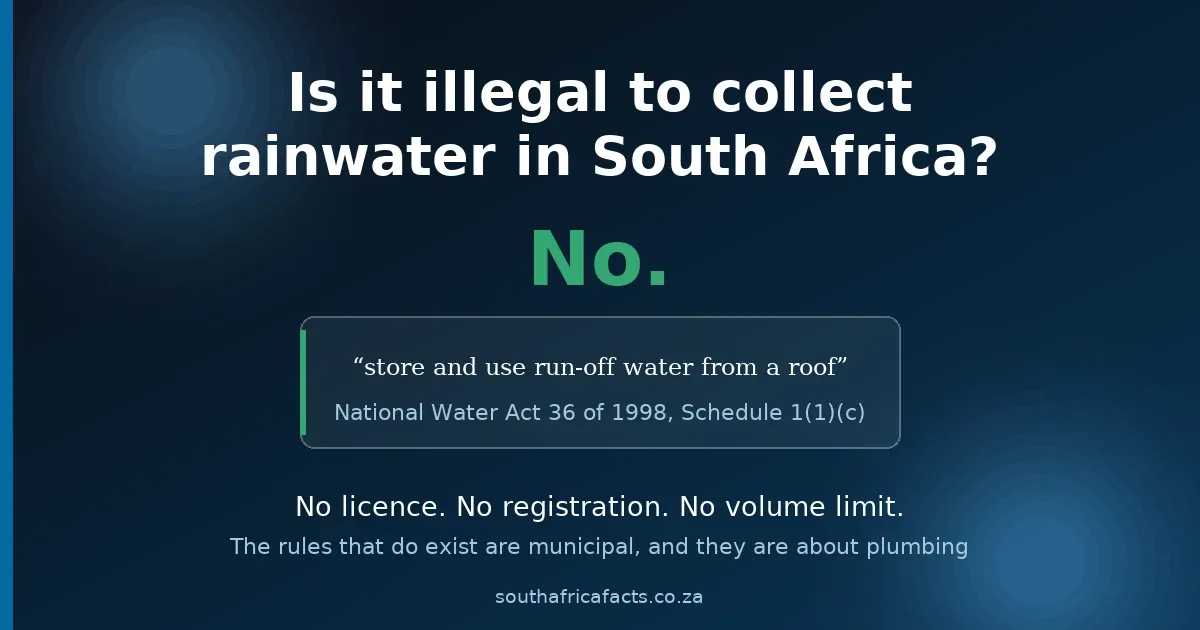
No, it is not illegal to collect rainwater in South Africa. Schedule 1 of the National Water Act 36 of 1998 lists the water uses you may make without a licence and without registering anything, and item (1)(c) reads, in full:
store and use run-off water from a roof
That is the whole clause. There is no volume limit attached to it, no permit, no form, and no fee. You may put a tank under your downpipe today.
Schedule 1 covers a handful of other everyday uses on the same no-permission basis, including taking water for reasonable domestic use in your household, small gardening not for commercial purposes, and watering animals grazing within the capacity of the land. Rainwater sits comfortably among them. The City of Cape Town, in its own guidelines for alternative water systems, puts it plainly: rainwater and greywater systems "do not require permission or licensing from DWS".
So where does the "technically illegal" claim come from?
From the clause immediately after the list, which almost nobody quotes. Schedule 1(2) says an entitlement under the Schedule:
does not override any other law, ordinance, bylaw or regulation, and is subject to any limitation or prohibition thereunder
That is the piece that reconciles the two camps. National law permits you to store and use your roof runoff. Your municipality can still regulate how you install it, and municipal water bylaws are real law with real fines behind them. So the people saying "it is legal" are right about collecting, and the people saying "there are rules" are right about plumbing. They are answering different questions and talking past each other.
What Schedule 1(2) does not do is make collection itself unlawful. A clause saying your entitlement is subject to other laws is not a clause taking the entitlement away. If someone tells you the National Water Act bans rainwater harvesting, they have this backwards: the Act is the document that expressly allows it.
What your municipality can actually control
This is where the real rules live, and they are narrower than people fear but stricter in one place than people expect. Cape Town publishes the most detailed guidance of the metros, so it makes a useful worked example. Three things stand out.
A standalone garden tank needs nothing. Filling a tank from a downpipe and running a hosepipe or a drip line off it is not something anyone asks you to register. It is the ordinary case and it is unregulated.
Plumbing it into the house does need approval. Cape Town's guidelines state that "all alternative water systems plumbed into a building (connected to a water installation) and used are subject to approval from the City". The concern is cross-connection: if tank water can find its way back into the municipal pipes, it stops being only your problem. That is why backflow prevention, typically an air gap, is the part installers are fussy about. Other municipalities have equivalent plumbing bylaws even where they publish less guidance, so if the tank is going anywhere near an indoor tap, ask your local building control first and use a plumber who does this work regularly.
You may not drink it, and this one surprises people. Cape Town's Water By-law goes further than most homeowners realise. The guidelines state that "according to national legislation and the City's Water By-law, no alternative water may be used for drinking, cooking (including food preparation) or body washing (ablution)". Not "should not". May not. Filtering it yourself does not create an exemption; the carve-outs are for large developments and businesses that contract with the City as a registered Water Services Intermediary and meet monitored treatment conditions. If you are in Cape Town and picturing rainwater at the kitchen tap, check your own municipality's bylaw before you spend anything, because the plan may simply not be permitted where you live.
None of that touches the garden, the pool top-up, washing the car, or flushing a toilet in most places. The overwhelmingly common use of a home rainwater tank in South Africa is entirely unrestricted.
Boreholes are the opposite case, and people mix them up
A lot of the confusion in this area comes from borehole rules leaking across into rainwater. They are not the same.
Groundwater is regulated because over-abstraction and contamination affect everyone drawing on the same aquifer. In Cape Town you are expected to notify the City before drilling a borehole or wellpoint, 14 days ahead, and register it afterwards, and registered users are issued signage they are legally required to display. None of that applies to a roof tank.
Even for boreholes the national picture is lighter than most people assume. In July 2026 the Department of Water and Sanitation confirmed, after OUTA raised it, that Schedule 1 covers low-impact domestic water uses without a licence or formal registration, and that there is no prescribed volume threshold for domestic groundwater use, the test being whether the use is reasonable and non-commercial. The list of Schedule 1 uses DWS pointed to includes harvesting rainwater. Commercial, agricultural and industrial users still register properly with their catchment management agency. That national position does not cancel a municipal notification requirement like Cape Town's, which is Schedule 1(2) doing its work again.
Where the line actually falls
The one thing that genuinely changes your legal position is selling the water or using it commercially. Schedule 1 is built around reasonable domestic use and small gardening not for commercial purposes. A tank supplying your own household and garden is squarely inside it. Trucking water off site or supplying other properties is a different activity under the Act and needs proper authorisation.
Size alone does not push you over that line. There is no litre threshold in Schedule 1(1)(c) at which a roof tank becomes unlawful, which is worth knowing if you have been told to keep a tank under some particular capacity to stay legal. What matters is what the water is for, not how much of it you store.
What you can do today without asking anyone
- Put a tank under a downpipe and water the garden from it.
- Use it for the pool, the car, the paving and outdoor cleaning.
- Store as much as your yard and budget allow, for your own household use.
- Fit a first-flush diverter and a leaf screen, which are good practice rather than legal requirements.
Check with your municipality before you:
- Connect the tank to your household plumbing in any way.
- Use rainwater for drinking, cooking or bathing, which is prohibited outright in Cape Town.
- Drill a borehole, which is a genuinely regulated activity with notification and registration steps.
The harder question is not whether you may, it is whether it will work
Since the legal answer turns out to be short, the useful question is the practical one: what size tank actually gets you through your dry season. That depends far less on your annual rainfall than on when that rain falls relative to when you use the water, which is why two towns with similar rainfall totals can need very different tanks. A summer rainfall garden in Johannesburg is topped up exactly when it is thirsty. A Cape Town garden has to carry winter water across to summer, and carrying water is what costs capacity.
This year adds a reason to size generously. A strengthening El Niño weather pattern is raising the odds of a hotter, drier summer over large parts of the country, which tends to stretch a dry season longer than an average year's rainfall record would suggest.
Our Rainwater Tank Calculator simulates a tank day by day against ten years of real daily rainfall for your town and tells you the smallest standard size that covers the share of your watering you want, or tells you honestly when your roof is the limiting factor and no tank will do it. If you are weighing a borehole instead, the Borehole Pump Electricity Cost Calculator prices the pumping against your actual Eskom tariff.
This article is general information about South African water law, not legal advice. Municipal water bylaws differ and are amended from time to time, so confirm the position with your own municipality before plumbing a tank into a building. Sources: National Water Act 36 of 1998, Schedule 1; City of Cape Town, Guidelines for the Installation of Alternative Water Systems; Department of Water and Sanitation clarification reported July 2026. Last reviewed July 2026.
Frequently asked questions
Is it illegal to collect rainwater in South Africa?
No. Schedule 1 of the National Water Act 36 of 1998 lists water uses permitted without a licence or registration, and item (1)(c) is to "store and use run-off water from a roof". There is no permit, no fee and no volume limit attached to it. The claim that a strict reading of the Act makes rainwater harvesting illegal, which does circulate on South African sites, has it backwards: the Act is the document that expressly allows it.
Do I need permission or a licence for a rainwater tank?
Not to collect. The City of Cape Town states in its guidelines for alternative water systems that rainwater and greywater systems do not require permission or licensing from the Department of Water and Sanitation. What can need approval is plumbing the tank into your house, which is a municipal matter, so check your local bylaw before connecting a tank to any indoor plumbing.
Can I drink rainwater from my tank in South Africa?
Legally that depends on your municipality, and in Cape Town the answer is no. The City's guidelines state that under national legislation and the City's Water By-law, no alternative water may be used for drinking, cooking including food preparation, or body washing. Treating or filtering it yourself does not create an exemption; the carve-outs are for large developments and businesses contracted with the City as Water Services Intermediaries under monitored conditions. Check your own municipality's water bylaw before planning rainwater for indoor use.
Is there a limit on how much rainwater I can store?
Schedule 1(1)(c) attaches no volume threshold to storing and using roof runoff, so tank size is not what determines whether you are within the law. What matters is the purpose. Schedule 1 is framed around reasonable domestic use and small gardening not for commercial purposes, so a tank supplying your own household and garden is inside it, while selling the water or supplying other properties is a different activity needing authorisation.
Do I need to register a borehole in South Africa?
Boreholes are treated quite differently from rainwater, which is where a lot of the confusion comes from. In July 2026 the Department of Water and Sanitation confirmed, after OUTA raised the question, that Schedule 1 covers low-impact domestic uses without a licence or formal registration, and that there is no prescribed volume threshold for domestic groundwater use, the test being whether the use is reasonable and non-commercial. Municipal requirements still apply on top: Cape Town expects notification 14 days before drilling and registration afterwards. Commercial, agricultural and industrial users register with their catchment management agency.
Why do some sources say rainwater harvesting is restricted?
Because of Schedule 1(2), which almost nobody quotes. It says an entitlement under the Schedule "does not override any other law, ordinance, bylaw or regulation, and is subject to any limitation or prohibition thereunder". National law permits you to store and use roof runoff; your municipality can still regulate how you install it. So people saying it is legal are right about collecting, and people saying there are rules are right about plumbing. A clause saying your entitlement is subject to other laws is not a clause removing the entitlement.
What do you think?
Join the conversation on our South African community forum. Share your perspective, ask a question, or just say hello.