
Rainwater Tank Calculator (South Africa)
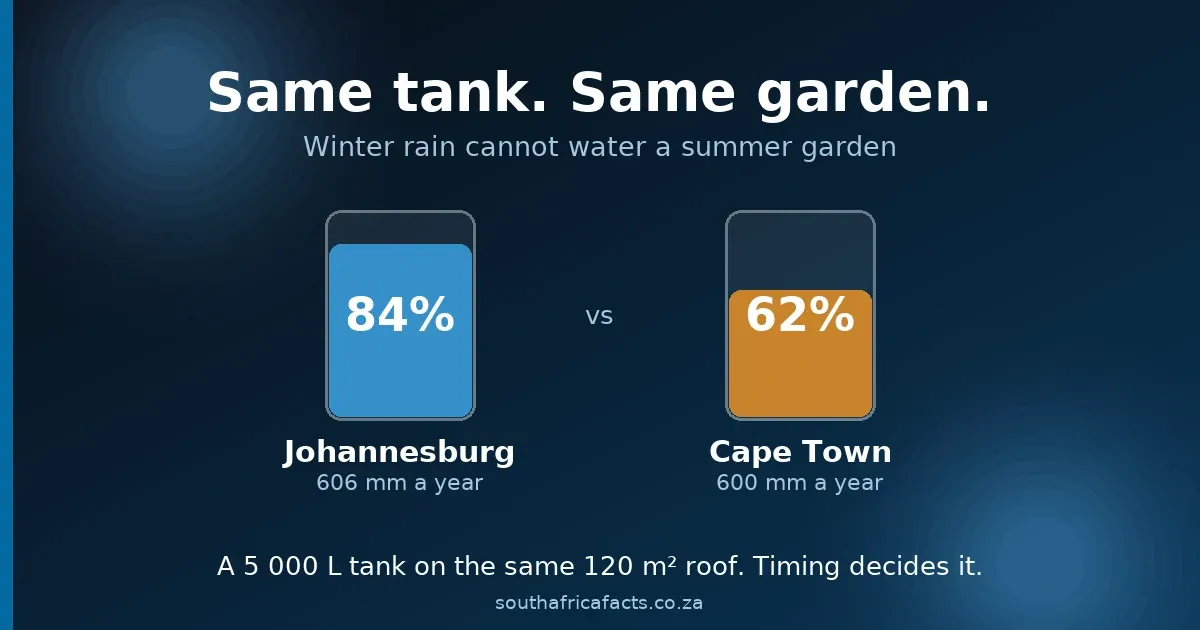
Same roof, same tank, same garden: 84% covered in Johannesburg, 62% in Cape Town. When the rain falls decides it. Size yours properly.
Rainwater Tank Calculator: sizing record
Most rainwater calculators multiply your roof area by one annual rainfall figure. That hides the thing that actually decides whether a tank works: when the rain falls relative to when you use it. This one runs a day by day tank simulation against ten years of real rainfall for your town, then tells you the smallest standard tank size that covers the share of your watering you want.
Where you are
Your roof
Only the part guttered to the tank, often about half a house.
Sets how much rain actually reaches the tank.
What you will use it for
A 100 m² garden on a hot Highveld day drinks roughly 300 to 500 L. Enter your peak, not your average, the calculator works the rest of the year out for you.
Costs, tariff and rainfall override
On a stepped tariff the water you stop buying comes off your top block, so a heavy user saves far more per kilolitre than a light one. Check a recent bill.
Recommended tank
Harvested per year
Overflowing to waste
Saved per year
What each tank size actually buys you
| Tank | Covers | Cost | Per extra % | Payback |
|---|
The same tank in other towns
Identical roof, tank and demand. The difference is purely when the rain arrives.
| Town | Rainfall | Covers |
|---|
💬 Discuss this tool, or share what your own tank actually delivers, on the forum →
Why annual rainfall is the wrong number
Nearly every rainwater calculator you will find does the same sum: roof area times annual rainfall times a loss factor. That tells you how much water lands on your roof over a year, which is worth knowing, but it does not tell you what a tank will actually deliver, because a tank is limited by timing rather than by totals. Rain that arrives while your tank is already full runs out of the overflow, and demand that arrives while the tank is empty is not met however much fell three months earlier.
Take one town, one roof and one 5 000 litre tank, and change nothing but the shape of the demand. Steady indoor use all year against summer peaked garden watering, at the same peak day figure. The garden pattern uses roughly 35% less water over the year, so on volume alone it ought to do better everywhere. In Johannesburg it does, by 27 percentage points. In Cape Town it gains under one point. The same 35% saving is worth almost nothing there, because the rain arrives in winter and the garden is thirsty in summer, and no 5 000 litre tank bridges six months. That is timing alone, with no comparison between towns and no rainfall totals involved.
Across towns the same effect shows up as very different answers to the same question. The same roof, tank and garden covers around 84% of the watering in Johannesburg and about 62% in Cape Town. A single annual rainfall figure cannot express any of this, which is why this calculator simulates every day instead.
What size rainwater tank do I need?
The rules of thumb you will find elsewhere, size it for ten to fifteen days of use, or the flat advice that most homes want somewhere between 2 500 and 5 000 litres, are not wrong so much as blind to where you live. The calculator above answers it properly: pick your town, tell it how much roof drains to the tank and how much water you want covered, and it returns the smallest standard size that gets you there. Sizes match what JoJo, Rototank and the other South African manufacturers actually sell, from 750 litres up to 30 000, so the answer is something you can walk into a store and buy.
In a dry town it will sometimes tell you no tank is big enough, and that is the useful answer rather than a failure. On roughly 150 mm of rain a year a 100 square metre roof in Upington cannot cover a normal garden however much storage you bolt on, so the tool reports the ceiling your roof can actually reach and leaves the decision to you.
How this one works
Behind the page sits ten years of daily rainfall, 2015 to 2024, for each of the towns in the list. For your roof, your tank and your pattern of use, the tank is filled and drawn down day by day across all ten years, and the result is the share of your demand the tank actually met. A monthly calculation is not good enough here, we tested it, and lumping a month of rain into one event misstates a small tank by up to 21 percentage points because in reality it refills between showers.
The money side matters as much as the water. Municipal water is sold in stepped blocks, so the litres you stop buying come off the top of your bill, not off the average. That single detail moves the effective saving in Johannesburg from about R27 to about R74 a kilolitre depending on how much you already use, which changes the payback on the same tank by years. Enter your real monthly consumption and the calculator prices the saving properly.
Watering a garden with what you catch? Our Vegetable, Herb & Fruit Planting Calendar shows what to plant this month in your region, and the Borehole Pump Electricity Calculator prices the alternative if you are weighing a borehole instead, and the Chance of Rain Calculator shows how many days a month actually see rain in your town, from the same rainfall record this sizing runs on. Want to know how this actual season compares to that long-run average before you size a tank against it? The Season Rainfall Tracker shows how much has fallen so far this season against normal, updated weekly. You can also browse all our free South African tools and calculators.
Frequently asked questions
What size rainwater tank do I need in South Africa?
There is no single answer, because it depends on three things the usual rules of thumb ignore: how much roof you can gutter into the tank, how much water you actually use, and crucially when your town's rain falls relative to when you need it. A 5 000 litre tank on a 120 square metre roof covers roughly 84% of a typical garden's watering in Johannesburg and about 62% of the same garden in Cape Town. The calculator above works your own figure out rather than guessing.
Why do Johannesburg and Cape Town need such different tanks?
Johannesburg is a summer rainfall region and Cape Town is a winter rainfall region. Gardens drink most in summer, so in Johannesburg the rain arrives exactly when you want it and a modest tank is topped up constantly. In Cape Town the rain falls in winter, when the garden barely needs it, so the tank has to carry water across four or five dry months to be useful. Carrying water is what costs capacity, which is why a Cape Town garden needs a far bigger tank for the same result.
How much does the timing of rain actually matter?
More than almost anything else you can change. Here is the cleanest way to see it, with no comparison between towns involved. Take one town, one roof and one 5 000 litre tank, and compare steady year round indoor use against summer peaked garden use at the same peak day figure. The garden pattern uses about 35% less water over a year, so on volume alone it should always score better. In Johannesburg it scores 27 percentage points better, exactly as you would expect. In Cape Town it scores less than one point better: the 35% saving buys you virtually nothing, because the water arrives six months before you need it and a tank that size cannot hold it that long. That gap between 27 points and one point is timing, and nothing else.
How much rainwater can I collect from my roof?
One millimetre of rain on one square metre of roof is one litre of water, before losses. So a 120 square metre roof in a 600 mm a year town sees about 72 000 litres land on it. You will not get all of it: some evaporates off a warm roof, some overshoots the gutter in a downpour, and some is lost to first flush. The calculator applies a runoff coefficient for your roof material, 0.90 for metal down to 0.75 for flat concrete, which is the standard way of allowing for this.
Is a rainwater tank worth it in South Africa?
It depends far more on your water tariff than on your rainfall. Municipal water is billed in stepped blocks, so the water you stop buying comes off your top block, not at an average rate. On Johannesburg's 2026/27 residential tariff a household using 12 kilolitres a month saves about R27 a kilolitre, while one using 35 kilolitres saves about R74. The same tank pays back nearly three times faster for the heavy user. Enter your actual monthly usage in the calculator to see your own figure rather than an average.
Does harvesting rainwater reduce my sanitation bill too?
In Johannesburg, on a conventional meter, no. This surprises people and it is worth checking on your own bill. Johannesburg charges residential sanitation as a flat monthly amount banded by erf size, from R397.85 for an erf up to 300 square metres to R1 688.12 above 2 000 square metres, and that charge does not move whatever your water consumption does. The fixed water demand management levy, R107.74 a month, does not move either. Only the water blocks fall. Households on a prepayment meter are different: their sanitation is charged by volume, so for them saving water does cut both bills.
Is it illegal to collect rainwater in South Africa?
No, and the law says so explicitly rather than by implication. Schedule 1 of the National Water Act 36 of 1998 lists the water uses you may make without a licence or registration, and item (1)(c) is, in full, to "store and use run-off water from a roof". Reasonable domestic use and small gardening not for commercial purposes are on the same list. You do not need permission and you do not need to register. If you have read that a strict reading of the National Water Act makes rainwater harvesting illegal, which does circulate online, that is simply wrong: the Act names it as a permitted use.
So why do people say rainwater harvesting is restricted?
Because of the very next clause, and it is the piece that reconciles the two camps arguing about this. Schedule 1(2) says an entitlement under the Schedule "does not override any other law, ordinance, bylaw or regulation, and is subject to any limitation or prohibition thereunder". So the National Water Act permits you to store and use your roof runoff, and your municipality can still regulate how you install it. In practice that bites on plumbing rather than on collection: connecting a tank to the taps inside your house raises cross-connection and backflow rules, and the City of Cape Town for instance publishes formal guidelines for alternative water installations. Filling a tank from a downpipe and running a hosepipe off it is not the part anyone regulates.
Are rainwater tanks compulsory in South Africa?
No. Nothing obliges an existing household to install one, and Schedule 1 of the National Water Act permits rainwater harvesting rather than requiring it. Building and plumbing requirements for new construction are set by your municipality and by the national building regulations, so if you are building rather than retrofitting, ask your local building control what applies before you plan the roof drainage.
What is a first-flush diverter and do I need one?
It is a device that sends the first few litres of each rainfall event to waste, taking the dust, bird droppings and leaf litter off the roof with it, before the cleaner water behind it reaches the tank. It is a water quality device rather than a water quantity one, and it does cost you some yield. Because it removes a fixed volume per rainfall event, the annual cost depends on how many rainy days your town gets rather than how much rain falls, which is why the figure the calculator quotes differs by town. For garden use many people skip it; if the water is going anywhere near a tap indoors, fit one.
Why does the calculator sometimes say no tank is big enough?
Because in a dry town it can be true, and it is more useful to say so than to quote a fantasy tank size. In Upington, on around 150 mm of rain a year, a 100 square metre roof simply cannot catch enough water to cover a typical garden however much storage you put under it, so the tool reports the ceiling your roof can reach instead. The honest options at that point are to gutter more roof into the tank, cut demand, or treat the tank as a useful top-up rather than a supply.
Where does the rainfall data come from and how accurate is it?
Ten years of daily rainfall, 2015 to 2024, from Open-Meteo's Historical Weather API, whose default blends ERA5-Land, a roughly 11 km resolution model, with the newer and sharper ECMWF IFS HRES model from 2017 onwards. That resolution is why a wet mountain suburb can come out differently from a dry town 20 km away, detail a coarser 25 km reanalysis such as plain ERA5 would blur together. It is still a gridded estimate rather than a reading at your address, so your own street can still differ from the town figure. Where you know better, the advanced section has a rainfall override that feeds straight through the maths, and it also shows you how far that coarser ERA5 grid disagrees with the default for your town, which is a fair measure of how much to trust it.
Why is the rainfall figure lower than the average I have seen quoted?
Because most quoted South African rainfall normals are long-term averages weighted towards the twentieth century, and the last decade has been considerably drier over much of the interior. Running the same dataset over 1991 to 2000 reproduces the familiar published figures closely, Pretoria at 681 mm against a commonly quoted 674, Bloemfontein at 574 against 582. Run it over 2015 to 2024 and Johannesburg is down 27%, Bloemfontein 25% and Upington 29%. We deliberately use the recent decade. Sizing a tank on 1970s rainfall would leave you short in the climate you are actually buying for.
What size JoJo tank do I need?
JoJo is the brand name most South Africans reach for, much as people say Hoover for a vacuum cleaner, but the sizes are effectively standard across manufacturers, so the answer does not depend on whose tank you buy. The calculator's size list, 750, 1 000, 2 500, 5 000, 10 000, 20 000 and 30 000 litres, matches what JoJo, Rototank, Eco Tanks and the rest all sell, and it recommends the smallest of those that meets your target rather than a made-up number. Worth knowing before you choose: South African tank prices jump sharply above 5 000 litres, so a 10 000 litre tank often costs about three times a 5 000 litre one rather than twice, which is why the payback column tends to worsen quickly past that point.
What happens when the rainwater tank is full?
The overflow runs out and is lost, which is exactly what the overflow figure in the results is telling you. It is worth looking at, because it is the honest argument for a bigger tank: if a large share of what your roof catches is spilling, extra capacity will actually capture something. If the overflow is small, a bigger tank has nothing left to catch and you are just buying plastic. Plumb the overflow somewhere sensible, into the stormwater or well away from foundations, rather than letting it pool against the house.
Do I need to treat rainwater from my tank?
For watering a garden, no. For anything you drink, wash in or cook with, yes, and treat it as a real question rather than a formality. Roof runoff picks up dust, bird droppings and whatever has been growing in the gutter, so an indoor supply normally wants a first-flush diverter, filtration and disinfection, plus a properly sealed and light-proof tank so nothing breeds in it. This calculator sizes tanks by volume and does not model water quality at all. If the water is going anywhere near a tap indoors, get a plumber who does alternative water installations to specify the treatment.
Is a borehole or a rainwater tank better?
They solve different problems and the honest answer is often neither on its own. A rainwater tank costs little, needs no licence, and delivers exactly when it has been raining, which is precisely when your garden needs it least. A borehole costs tens of thousands to drill with no guarantee of water, and then costs electricity every time you pump, but it does not care what the weather did last week. In a summer rainfall town a tank covers the growing season well and a borehole is the drought insurance; in a winter rainfall town a tank alone struggles to bridge to summer, which is what the sizing above will show you. If you are weighing the running cost of a borehole, our Borehole Pump Electricity Cost Calculator prices the pumping against your actual Eskom tariff.
Should I get a bigger tank than the calculator recommends?
Look at the tank size table rather than only the headline. Reliability rises steeply at first and then flattens, so there is usually a knee beyond which each extra thousand litres buys very little. Note also that South African tank prices jump sharply above 5 000 litres, a 10 000 litre tank often costs three times a 5 000 litre one rather than twice, so the payback column tends to get worse quickly past that point. If your reason for a tank is surviving municipal outages rather than saving money, size it on the days of supply you want instead and ignore the payback figure.
Rainfall figures are modelled estimates from Open-Meteo's Historical Weather API for 2015 to 2024, not measurements at your address, and tank and installation prices are indicative South African retail figures that vary by supplier and region. This is general guidance to help you size and budget, not a substitute for a quote from an installer. Tariff figures are 2026/27 for Johannesburg, Cape Town, Tshwane and eThekwini. Last reviewed July 2026.