The Zulu People: A Journey from Stereotypes to Cultural Renaissance
South Africa's largest nation, from Shaka's 19th-century kingdom to a living monarchy and thriving culture beyond the old stereotypes.
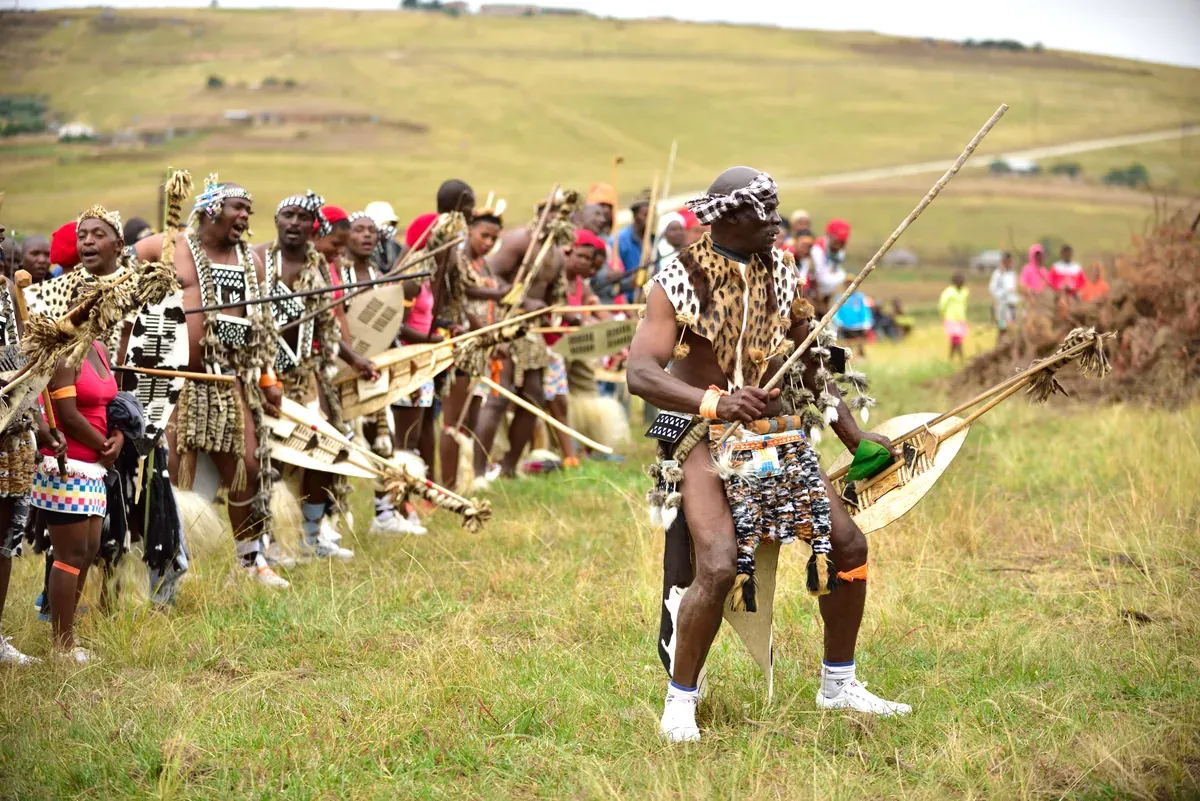
For more than a century the Zulu people have been flattened into a handful of images: the herding peasant of the postcard, or the bloodthirsty warrior in leopard skin brandishing a spear. Mass-produced for the tourist market and reinforced by apartheid-era propaganda, these clichés bear little resemblance to the lives of the roughly twelve million Zulu people who call South Africa home today.
The largest nation in South Africa
The Zulu are South Africa's largest ethnic group, and isiZulu is the country's most widely spoken home language, used by around a quarter of the population. The Zulu heartland is KwaZulu-Natal, where the great majority of isiZulu speakers live, though the single biggest urban concentration is now in Gauteng around Johannesburg. Most Zulu people today identify first as South Africans, and as the country has urbanised and globalised, traditional customs increasingly sit alongside modern, often Western, ways of life rather than being replaced by them.
A kingdom forged in the 19th century
The Zulu were once a small clan among many in the region. That changed in the early 19th century under Shaka, who from around 1816 welded neighbouring chiefdoms into a centralised, militarised kingdom during the upheavals of the Mfecane. The decades that followed were marked by conflict: the clash with Afrikaner Voortrekkers at the Battle of Blood River in 1838, and above all the Anglo-Zulu War of 1879, when the kingdom inflicted a stunning defeat on the British at Isandlwana before the famous stand at Rorke's Drift. Shaka remains a towering symbol of resistance and national pride.
From Inkatha to the Government of National Unity
In the late 20th century that legacy was harnessed by the Inkatha Freedom Party (IFP), the conservative, traditionalist movement founded by Mangosuthu Buthelezi. Buthelezi began his political life in the African National Congress (ANC) but became one of its fiercest rivals. Between the late 1980s and the dawn of democracy in 1994, supporters of the IFP and the ANC were drawn into a wave of political violence, especially in KwaZulu-Natal and the townships of the Reef. Often portrayed abroad as a simple tribal feud, the conflict was largely political, rooted in the struggle for power and local control in the dying years of apartheid.
Buthelezi went on to serve as Minister of Home Affairs from 1994 to 2004, led the IFP until 2019, and died in September 2023 at the age of 95. The party is now led by Velenkosini Hlabisa, who serves as a cabinet minister in the Government of National Unity formed after the 2024 election.
A living monarchy
The Zulu monarchy endures as a powerful cultural institution. King Goodwill Zwelithini, who reigned for half a century and reintroduced the Reed Dance in 1991, died in March 2021. After a contested succession, King Misuzulu kaZwelithini was recognised as the new monarch in 2022.
Customs that endure
For all the change, Zulu culture remains vivid and widely practised. Millions still pay lobola, the bridewealth a groom's family gives to the bride's family, traditionally in cattle. Many consult traditional healers, whether the inyanga (herbalist) or the sangoma (diviner who communicates with the ancestors), and belief in ancestral spirits stays strong even alongside Christianity. Married women are recognised by the flared red isicholo headdress, while the annual uMkhosi woMhlanga, or Reed Dance, gathers thousands of unmarried young women to celebrate heritage before the king.
Experiencing Zulu culture today
Post-apartheid South Africa has seen a genuine revival of indigenous culture, with official support for everything from music and theatre to traditional healing, and revised school history that lets children take pride in their heritage. Visitors can experience Zulu life at living cultural villages such as Shakaland near Eshowe, built on the set of the Shaka Zulu television series, and Gooderson DumaZulu near Hluhluwe, where guides demonstrate beadwork, pottery, spear-making and dance.
Stereotypes fade slowly, but the reality is far richer than any postcard: a proud nation, a living monarchy, and a culture confidently carrying its heritage into the modern South Africa.
Last updated: May 2026
What do you think?
Join the conversation on our South African community forum. Share your perspective, ask a question, or just say hello.