Exploring South Africa's Architectural Heritage: A Journey Through Time and Styles
Explore South Africa's architecture: Mapungubwe's stone walls, Ndebele murals, Cape Dutch gables, Art Deco Durban and the post-1994 Constitutional Court.
South Africa's architecture is a vivid record of its landscapes, its many cultures and more than a thousand years of history. From Iron Age stone cities and brightly painted homesteads to Cape Dutch gables, Victorian verandas, Art Deco towers and bold post-apartheid landmarks, the country's buildings tell the story of who has lived here and how they shaped their world. This guide traces that journey through the major styles and periods.
The oldest structures: from stone cities to the Castle
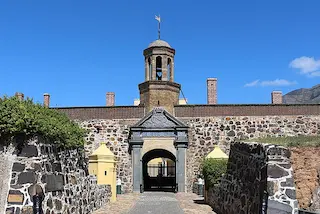
The oldest European-built structure still standing in South Africa is the Castle of Good Hope in Cape Town, built between 1666 and 1679 by the Dutch East India Company (VOC). Its five-pointed, star-shaped plan makes it the country's oldest surviving colonial building.
But people were raising substantial stone architecture here long before any European settlement. Sites across Limpopo and Mpumalanga preserve stone-walled ruins that are centuries older. The most important is Mapungubwe, near the confluence of the Limpopo and Shashe rivers, which flourished from about 1075 to 1300 AD as southern Africa's first known kingdom. Its rulers grew wealthy exporting gold and ivory through Swahili-coast ports such as Kilwa and Sofala, importing glass beads and cloth in return. When trade routes shifted northwards around 1300, Mapungubwe declined and the region's stone-building tradition reached its zenith at Great Zimbabwe, in present-day Zimbabwe. Related stone-walled sites survive on the South African side too, among them Thulamela and Dzata in Limpopo and the extensive Bokoni terraces of Mpumalanga. Mapungubwe is today a UNESCO World Heritage Site.

Indigenous African architecture
Long before, and alongside, the colonial styles, South Africa's communities developed rich building traditions shaped by climate, available materials and social life:
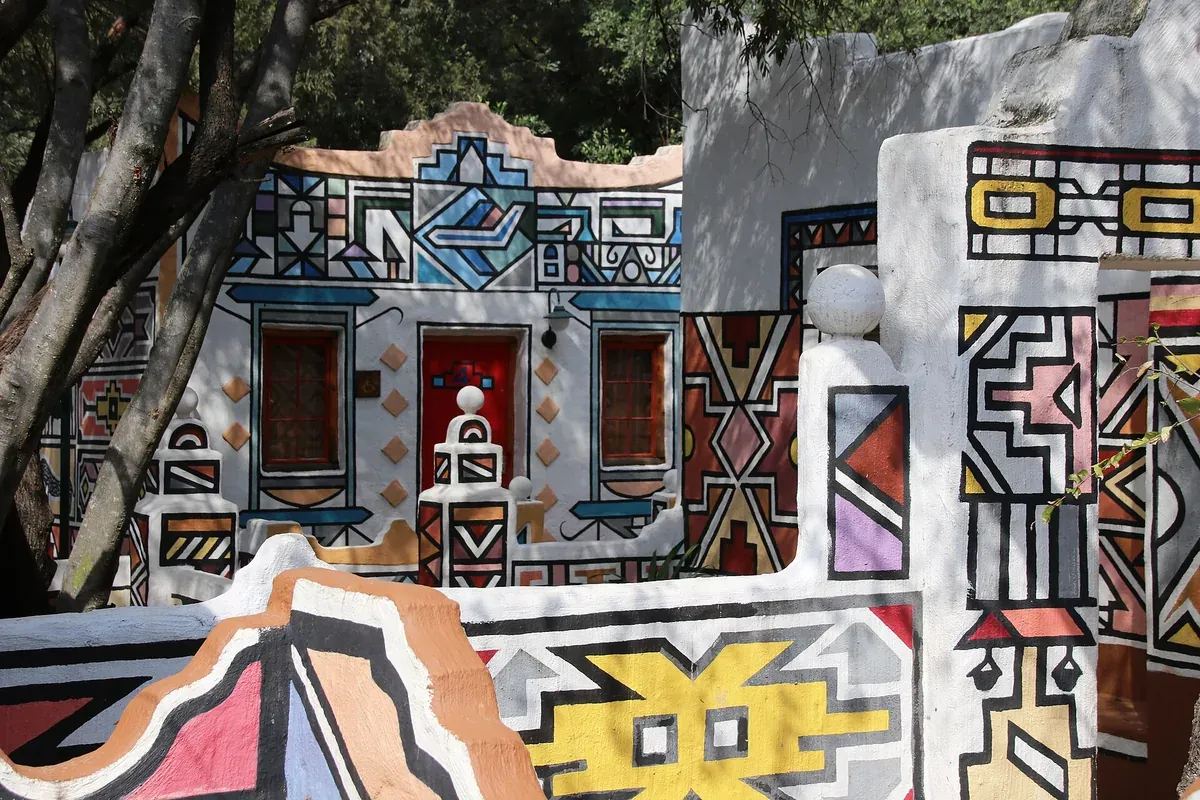
- Ndebele homes are world-famous for their walls, painted by women in bold geometric murals of vivid colour. The tradition has been carried into contemporary art by figures such as Esther Mahlangu.
- The Zulu iqhugwane, or “beehive” hut, is a dome of bent saplings tightly thatched with grass, set within a circular homestead (umuzi).
- Across the Eastern Cape and Free State, the round, thatched rondavel remains widespread, while Basotho builders finish their walls with litema, incised and painted geometric patterns.
- In Mpumalanga and the interior, Bokoni and Tswana-Sotho communities built extensive dry-stone walled towns, some once home to thousands of people.
Cape Dutch architecture
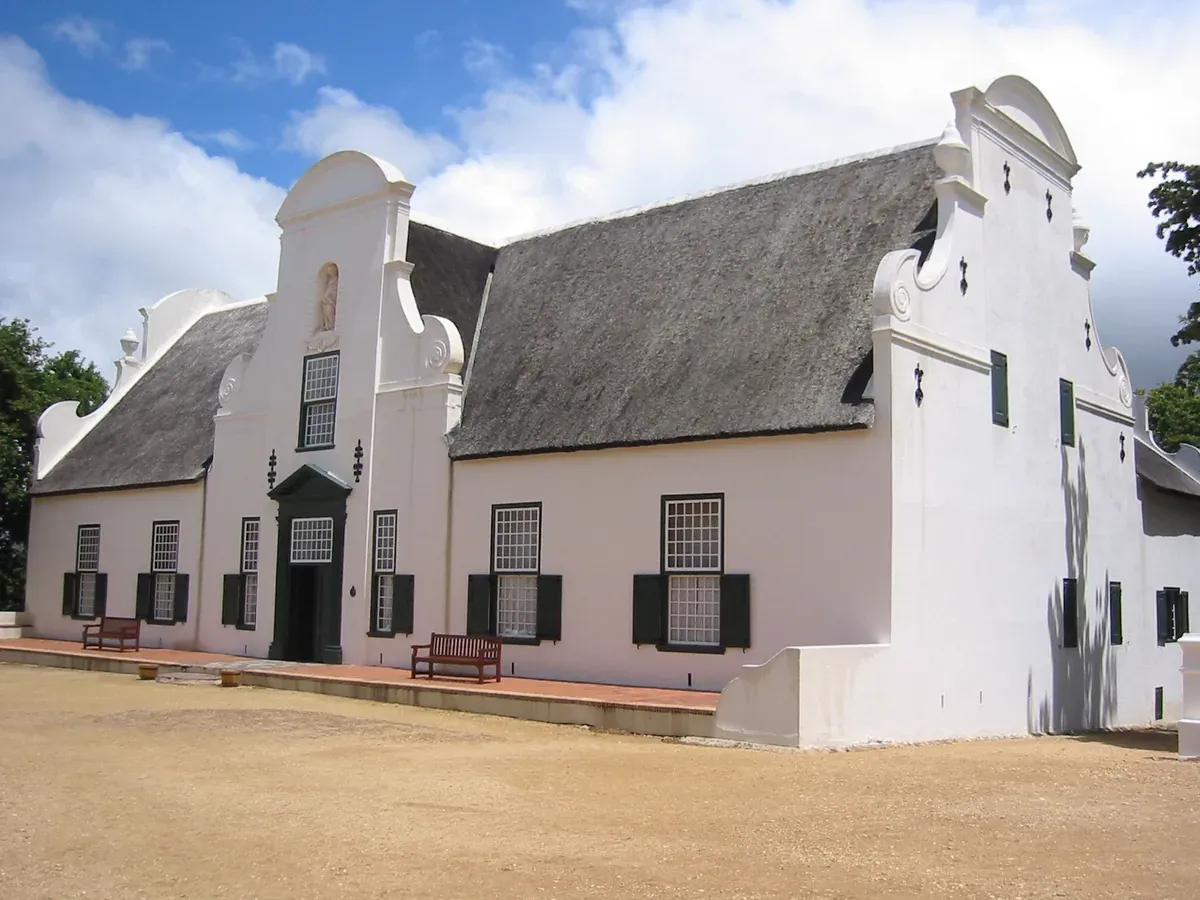
The Cape Dutch style developed among the 17th- and 18th-century settlers of the Cape in response to the local climate and available materials. Early homesteads, often built on a T- or H-shaped plan, featured pitched thatched roofs, whitewashed walls, ornate moulded gables and symmetrical facades with shuttered, small-paned windows. Groot Constantia near Cape Town is the best-known example: the estate was granted to Simon van der Stel (then Commander, and later the Cape's first Governor) in 1685, and its manor house remains a showpiece of the style.
Cape Town preserves many other early buildings, including the Tuynhuys (which grew from a 1670s VOC garden lodge and is today the office of the President), the old Slave Lodge built by the VOC in 1679 (now the Iziko Slave Lodge museum), the Old Town House on Greenmarket Square, and the South African Library, which since 1999 has formed the Cape Town campus of the National Library of South Africa.
The Bo-Kaap and Cape Malay quarter
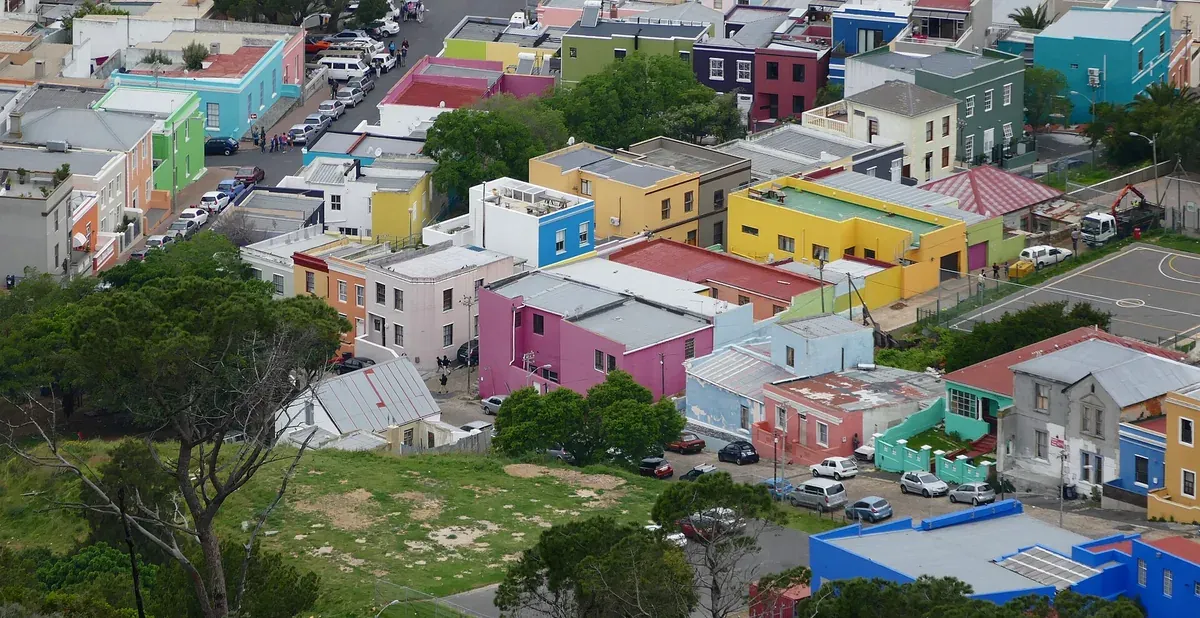
On the slopes of Signal Hill, the Bo-Kaap, historically Cape Town's Malay Quarter, is famous for its rows of flat-roofed houses painted in brilliant colours. The flat-roofed form became standard after fires in the 18th century made thatch a hazard in the crowded town. The earliest of these simple, single-storey huurhuisjes (rental houses) date from the 1760s and housed labourers, tradesmen and fishermen, many of them slaves and political exiles brought to the Cape from South and Southeast Asia. Their descendants gave the neighbourhood its distinctive Cape Malay culture.
The Karoo and the corbelled houses
As settlement pushed into the dry interior, a leaner vernacular emerged. The flat-roofed Karoo house adapted Cape Dutch ideas to a harsh, arid climate. In the treeless Northern Cape, early-19th-century trekboers (migrant stock farmers) overcame the shortage of timber by building beehive-shaped corbelled houses entirely of stone, laid without mortar in courses that step inwards to form a self-supporting dome. Examples survive around Williston, Carnarvon and Fraserburg.
British colonial architecture
The British settlers who arrived in the Eastern Cape in 1820 brought their own traditions. Around Makhanda (Grahamstown) a local vernacular blended Cape and British building, while in Gqeberha (formerly Port Elizabeth) the British influence shows in terraced houses with elegant Georgian and Regency verandas.
KwaZulu-Natal has an especially strong British character. Pietermaritzburg is celebrated for its Victorian buildings in warm red and salmon-orange face brick, topped with corrugated-iron roofs and trimmed with filigreed verandas; its red-brick City Hall is reputedly the largest such building in the southern hemisphere. In Durban, the building boom of the late 19th century produced the ornate Town Hall of 1885, designed by Philip Dudgeon, which today serves as the city's Main Post Office (the present City Hall, modelled on Belfast's, followed in 1910). Durban's large community of Indian descent also shaped its built environment, from Hindu temples to the landmark Juma Masjid mosque on Grey Street, one of the largest in the southern hemisphere.
Mining wealth, Art Deco and the Union Buildings
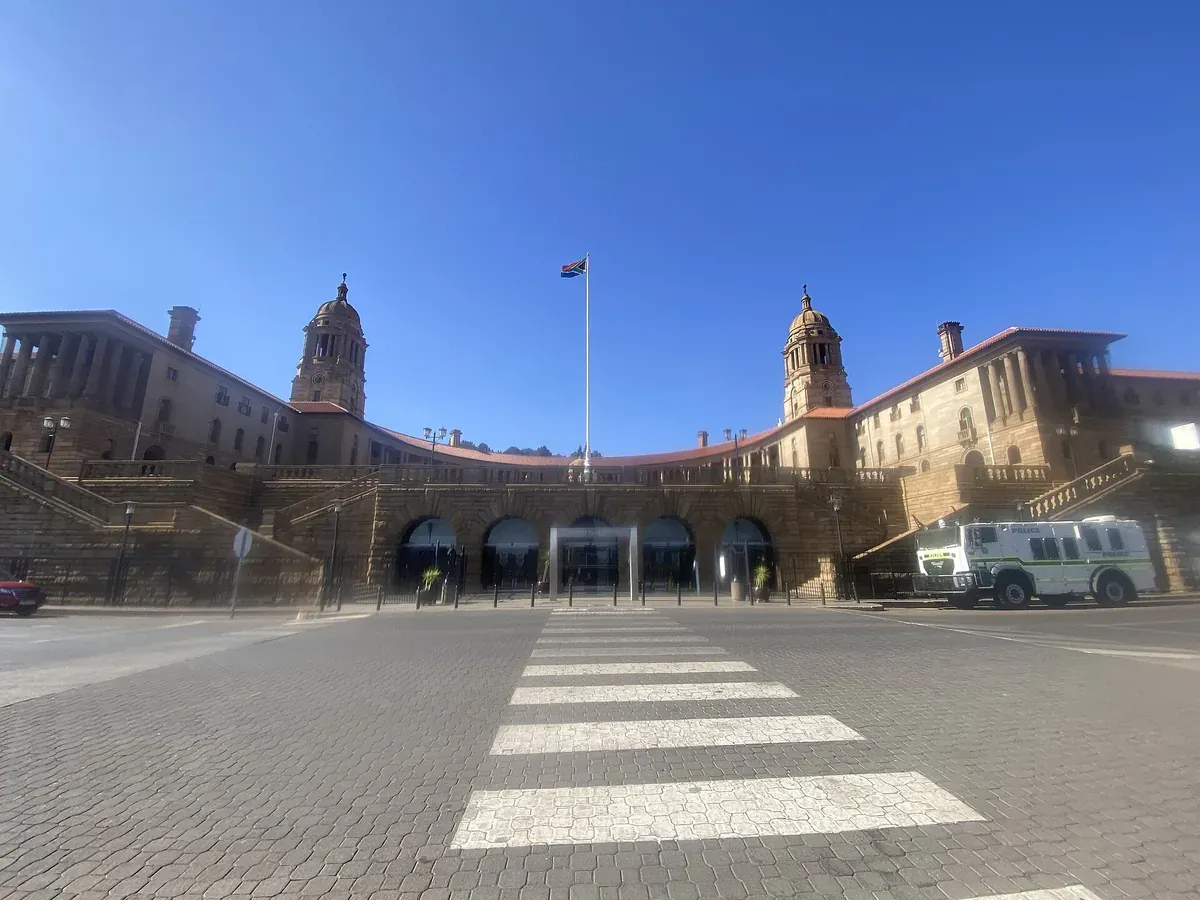
The mineral revolution, with diamonds in the Northern Cape from the late 1860s and gold on the Witwatersrand from 1886, funded a wave of ambitious building. Its grandest statement is the Union Buildings in Pretoria, the sandstone seat of government designed by Sir Herbert Baker and completed in 1913. Its twin towers and sweeping colonnade were meant to symbolise the 1910 union of the country's four provinces.
The interwar years brought Art Deco. Durban built one of the largest concentrations of Deco architecture in the world, well over a hundred apartment blocks, offices and shops from the 1930s, earning a reputation as South Africa's Art Deco capital, with fine examples also in Johannesburg, Springs and Cape Town.
Modernism and the architecture of apartheid
From the 1930s onwards, Johannesburg and Pretoria embraced Modernism and, later, the bold concrete forms of Brutalism. But the mid-20th century also produced an architecture of control. Under apartheid, the Group Areas Act forced the removal of communities such as Cape Town's District Six and Johannesburg's Sophiatown, while millions of people were housed in vast townships of standardised “matchbox” houses (the NE 51/6 design) and migrant-labour hostels. This planned segregation still shapes the layout of South African cities today.
Contemporary South Africa
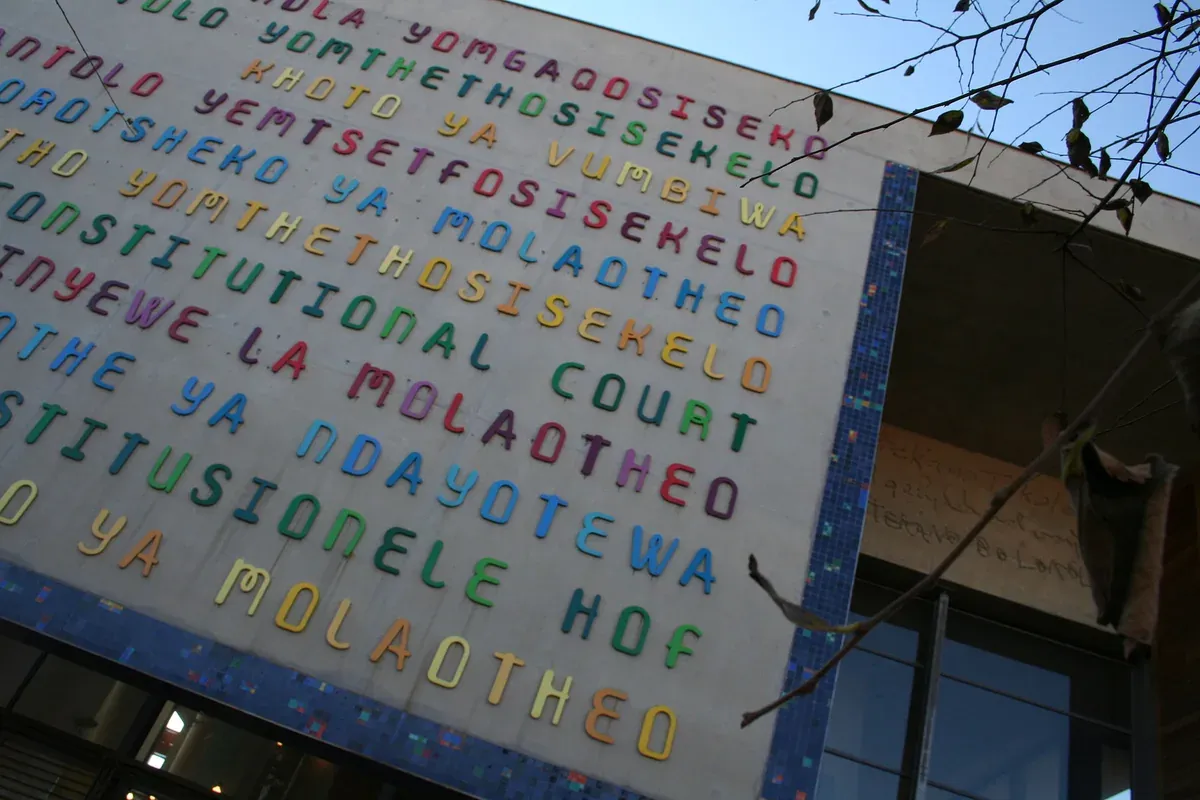
Since 1994, architecture has become part of how the country reimagines itself. The Constitutional Court at Constitution Hill in Johannesburg (2004) was built on the site of the notorious Old Fort prison, partly from its salvaged bricks, with a foyer of slanting columns evoking the idea of justice dispensed under a tree. The 2010 FIFA World Cup added striking stadiums, including Durban's arched Moses Mabhida, Cape Town Stadium and Soccer City (FNB Stadium) in Johannesburg. And in 2017 the designer Thomas Heatherwick transformed a 1920s grain silo on Cape Town's waterfront into the Zeitz Museum of Contemporary Art Africa (Zeitz MOCAA), among the largest contemporary art museums on the continent.
A living heritage
From Mapungubwe's stone walls to Heatherwick's carved silo, South African architecture is a layered record of its people, indigenous and settler, colonial and democratic. Each style answered the needs of its time and place, and together they make the country one of the most architecturally diverse on the continent.
Frequently asked questions
What is the oldest building in South Africa?
The oldest surviving colonial building is the Castle of Good Hope in Cape Town (1666–1679). Far older stone settlements predate it, however, including the Iron Age kingdom of Mapungubwe, which flourished from around 1075 AD.
What is Cape Dutch architecture?
A style developed at the Cape from the 17th century, recognisable by its whitewashed walls, thatched roofs, ornate curved gables and symmetrical, shuttered facades. Groot Constantia is a classic example.
Why are Ndebele houses painted?
Ndebele women paint their homes with bright geometric murals as an expression of identity and artistry. The tradition has become an internationally recognised South African art form.
Is Mapungubwe a World Heritage Site?
Yes. The Mapungubwe Cultural Landscape was inscribed as a UNESCO World Heritage Site in 2003.
What do you think?
Join the conversation on our South African community forum. Share your perspective, ask a question, or just say hello.