
Municipal Water Bill Calculator (South Africa)
Enter the kilolitres off your statement. See your 2026/27 water and sanitation bill for Johannesburg, Cape Town, Tshwane, Durban, Ekurhuleni or Buffalo City, block by block, including the Joburg conventional versus prepaid split.
Municipal Water & Sanitation Bill Calculator: record
Type the kilolitres off your own statement and pick your metro: Johannesburg, Cape Town, Tshwane (Pretoria), eThekwini (Durban), Ekurhuleni or Buffalo City (East London). This works out your water charge block by block, your sanitation charge the way your metro actually bills it (not assumed to simply track water use), and any fixed monthly charge, so the total should reconcile against your real bill.
Your metro
Your usage
Off the meter reading on your statement. 1 kL = 1,000 litres = one cubic metre.
What was entered
- Municipality
- Water used
- Erf size
💬 Questions about your water bill? Discuss this tool on the forum →
More on this: Prepaid Electricity Calculator · Rainwater Tank Calculator · Garden Watering Calculator
What does your municipal water bill actually charge you?
Most people can find the block rate for their metro if they search hard enough. What is harder to find is whether the sanitation line on the same bill tracks that water use at all, because in some metros it does not move no matter how much you save. This calculator takes the kilolitres off your own statement and your metro, and works out water block by block, sanitation the way your specific metro actually bills it, and any fixed monthly charge, so the total should reconcile against your real bill rather than approximate it.
It is the water half of the household municipal account. The Prepaid Electricity Calculator does the same job for the electricity half. Once you know your bill, the Rainwater Tank Calculator and the Garden Watering Calculator use these same tariffs to show what a change would actually save.
The six metros, at a glance
| Metro | Water blocks | Sanitation | Fixed monthly |
|---|---|---|---|
| Johannesburg, conventional meter | R0 to R100.40/kL, 8 blocks | Flat, by erf size (R397.85 to R1,688.12/month) | R107.74 |
| Johannesburg, prepaid meter | R0 to R94.92/kL, 8 blocks | Volumetric (R0 to R34.62/kL) | R107.74 |
| Cape Town | R25.05 to R109.98/kL, 4 blocks, first block not free | Volumetric, capped at 50 kL of deemed sewerage | R160.31 |
| Tshwane | R0 to R64.26/kL, 6 blocks | Volumetric, falling discharge share | R311.70 |
| eThekwini (Durban) | R52.40 to R137.40/kL, 5 blocks, first block not free | Volumetric, falling discharge share | R0 |
| Ekurhuleni | R28.99 to R89.80/kL, 5 blocks, first block not free | Volumetric, falling discharge share | R0 |
| Buffalo City (East London) | R32.07 to R73.87/kL, 5 blocks, first block not free | Flat, by erf size (R149.46 to R727.50/month) | R0 |
"First block not free" flags Cape Town, eThekwini, Ekurhuleni and Buffalo City, where the lowest water block is billed in full for an ordinary household. Johannesburg and Tshwane zero-rate their first block for everyone (6 kL in Joburg, 9 kL in Tshwane). Ekurhuleni and Buffalo City reserve a free first block only for registered indigent households, a distinction easy to miss reading the block table alone.
What 15 kL actually costs, metro by metro
Same 15 kilolitres, VAT included, 2026/27 tariffs. For Johannesburg conventional and Buffalo City the sanitation line uses a 500 m² erf, a typical suburban stand. Change the kilolitres or the erf size in the calculator above and the receipt updates.
| Metro | Water | Sanitation | Fixed | Total |
|---|---|---|---|---|
| Johannesburg, conventional meter | R309.48 | R774.48 | R107.74 | R1,191.70 |
| Johannesburg, prepaid meter | R264.84 | R169.90 | R107.74 | R542.48 |
| Cape Town | R550.89 | R288.80 | R160.31 | R1,000.00 |
| Tshwane (Pretoria) | R216.06 | R116.28 | R311.70 | R644.04 |
| eThekwini (Durban) | R870.60 | R154.05 | R0.00 | R1,024.65 |
| Ekurhuleni | R603.96 | R441.75 | R0.00 | R1,045.71 |
| Buffalo City (East London) | R550.27 | R618.86 | R0.00 | R1,169.13 |
Tshwane looks cheap at this usage because the first 9 kL of water is free and most of the total is the R311.70 fixed charge. Johannesburg conventional looks expensive because sanitation on that meter is R774.48 before a drop of water is billed. Those two facts, not a national average rate, are why the same 15 kL is R644.04 in Pretoria and R1,191.70 in Joburg.
Johannesburg conventional vs prepaid
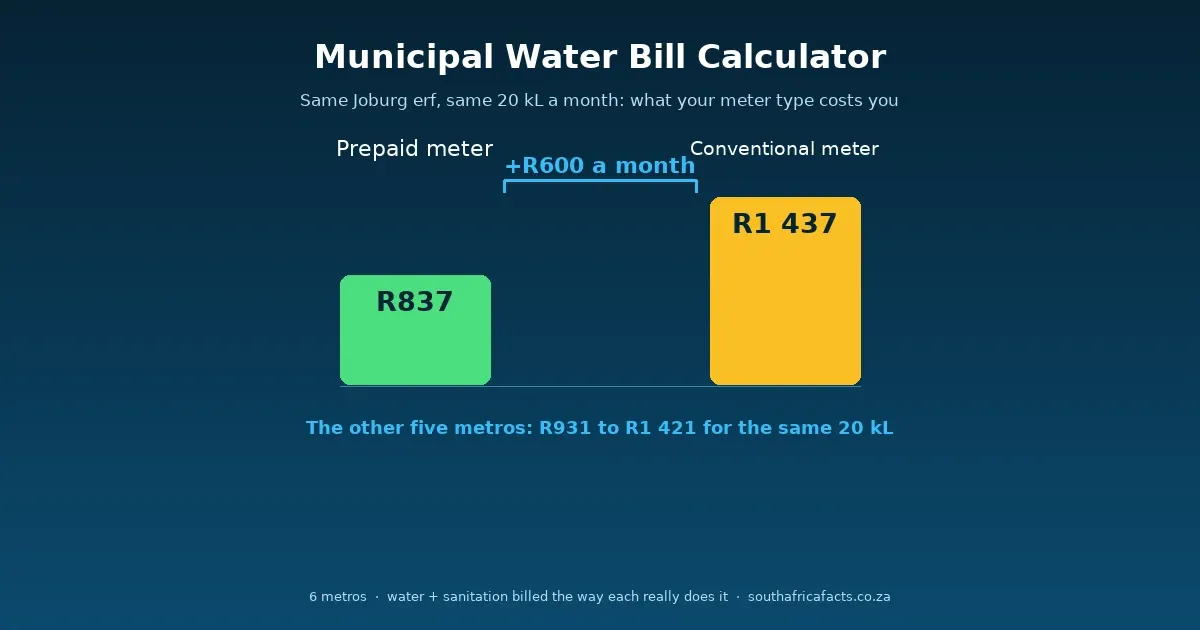
City of Johannesburg is the one metro on this page whose 2026/27 tariff book actually splits the rates by meter type. On a 500 m² erf, 20 kL a month costs R1,437.35 on a conventional meter and R837.33 on a prepaid meter, about R600 a month. At 10 kL the gap is about R727. Almost all of it is sanitation: conventional sanitation is a flat erf-banded charge (R774.48 at 500 m²) that does not fall when you use less water; prepaid sanitation is volumetric. The water blocks differ too, but they are the smaller part of the gap.
Tshwane, Ekurhuleni and eThekwini do not split prepaid and conventional water rates in the current books, so a prepaid toggle there would imply a Joburg-style saving that does not exist. If you are on a prepaid meter in those metros, the number this page shows is the one that applies.
Two things that catch households out
Sanitation does not always track water. Johannesburg on a conventional meter and Buffalo City bill it as a flat amount set by your stand size, so a household that cuts water use in half sees no change on that line at all. Where sanitation is volumetric, three of the four metros that bill it that way (Tshwane, eThekwini, Ekurhuleni) assume a smaller share of your water reaches the sewer as your usage climbs, so the saving on that line shrinks even as the water saving grows.
Water avoided comes off your top block, not your average rate. A household using 30 kL a month saves at a materially higher rand-per-kilolitre than one using 12 kL, because the water they stop buying was priced at whichever block they were sitting in.
Related tools
This page is the water half of the household municipal account. The Prepaid Electricity Calculator does the same job for the electricity half. Once you know the bill, the Rainwater Tank Calculator and the Garden Watering Calculator use these same tariffs to show what a change would actually save. Collecting from the roof is legal: Is it illegal to collect rainwater in South Africa?.
Frequently asked questions
Why is my Johannesburg water bill so high?
On a conventional meter in the City of Johannesburg, sanitation is a flat monthly charge banded by erf size, not by how much water you used. At 20 kL on a 500 m² stand that sanitation line alone is R774.48, plus a R107.74 demand levy that also does not move. The water blocks on top of that are steep once you leave the free first 6 kL, so a household that thinks it is paying for water is often paying more for the sewer and the levy. Johannesburg Water's own tariff book is the source; this page just applies it. Prepaid-meter households in Joburg are billed differently, see the conventional versus prepaid section above.
Does a prepaid water meter save money in Johannesburg?
On the same 500 m² erf and the same 20 kL a month, a conventional Joburg meter bills about R1,437.35 and a prepaid meter about R837.33, a gap of about R600 a month. At 10 kL the gap is about R727. Almost all of that is sanitation: conventional sanitation is a flat erf-banded charge, prepaid sanitation is volumetric. The water blocks also differ. This is a City of Johannesburg tariff-table difference, not a usage difference, and it does not apply in the other metros on this page, whose 2026/27 books do not split prepaid and conventional water rates.
How is a Cape Town water bill calculated?
The City of Cape Town bills three lines that this page models: water in four rising blocks (the first 6 kL is charged, it is not free for an ordinary household), sanitation as a deemed sewerage volume of 70% of your metered water, capped once water passes 50 kL, and a fixed monthly charge of R160.31. At 15 kL that comes to R1,000.00 in total. Cape Town's Think Water calculator estimates usage from household habits; this page takes the kilolitres off your statement and prices them.
How is a Tshwane water bill calculated?
City of Tshwane (Pretoria, Centurion, and the rest of the metro) zero-rates the first 9 kL of water for an ordinary household, then steps up through six water blocks. Sanitation is volumetric, but the assumed share of water that reaches the sewer falls as usage rises, so a heavy user saves less on that line than on water. There is also a large fixed monthly charge of R311.70. At 15 kL the total is R644.04, and R311.70 of that is the fixed charge, still almost half the bill.
Is the first 6 kL of water free in South Africa?
No, not nationally, and not even across these six metros. Johannesburg and Tshwane zero-rate their first block for everyone (Joburg's first 6 kL, Tshwane's first 9 kL). Cape Town, eThekwini (Durban), Ekurhuleni and Buffalo City (East London) charge the first 6 kL in full for an ordinary household; Ekurhuleni and Buffalo City reserve the free first block for registered indigents. At 6 kL, Cape Town already bills R150.30 for water before sanitation and the fixed charge, and Durban bills R314.40 for water. Free Basic Water is a national policy aimed at indigent households, not a universal 6 kL gift.
Why doesn't my sanitation charge go down when I use less water?
It depends on your metro. Johannesburg (conventional meter) and Buffalo City bill sanitation as a flat monthly charge banded by the size of your erf, not by how much water you use, so cutting water back saves nothing on that line. Cape Town, Tshwane, eThekwini and Ekurhuleni bill it volumetrically, tied to your metered water, but Tshwane, eThekwini and Ekurhuleni assume a shrinking share of your water reaches the sewer as usage rises, so a heavy user's marginal sanitation saving is smaller than their water saving. Only Johannesburg on a prepaid meter scales sanitation the same way water does.
Does this cover property rates or refuse removal?
No. This page is water and sanitation only. A rates bill needs your municipal valuation, which most people do not have to hand, plus a rebate ladder that differs by metro, and refuse is billed by bin count or erf size rather than water use. Both are different enough that folding them into this page would make a wrong answer on one line harder to spot in a total you can no longer check against your own statement line by line. Your rates and refuse lines still belong on your bill; this page just does not compute them.
Why does the same water use cost different amounts in different metros?
Each municipality sets its own block tariff, and the blocks are not the same width or shape. A metro with a low first block and a steep top block rewards frugal use far more than one with fewer, wider steps. There is also no single national sanitation rule: some metros scale it with water, some do not, and the ones that do use different discharge assumptions. Picking your own metro on this page, rather than reading a national average figure, is the point.
Where do these tariffs come from?
Each metro's water and sanitation figures were read directly from that municipality's own council-approved tariff annexure or tariff book for the current financial year, the same primary sourcing used for the Rainwater Tank and Garden Watering Calculators, which share this page's tariff data. Ekurhuleni's figures were additionally cross-checked against two independent press reports on the year's increase. Every metro's exact source is named in the breakdown once you select it.
Why are only six metros covered, not all eight?
Nelson Mandela Bay and Mangaung are left out on purpose rather than guessed. Nelson Mandela Bay bills by average daily consumption rather than a monthly total, and how a month's usage actually prices under that method is not confirmed from the municipality's own tariff book, so a number here could be wrong by close to a third. Mangaung's water tariff is sourced, but no sanitation figure could be found at the same standard as the other six. Both will be added once that sourcing is resolved.
What is a kilolitre and where do I find it on my bill?
One kilolitre (kL) is 1,000 litres, the same as one cubic metre, and it is the unit every South African municipality bills water in. Your statement will show either your meter reading in kL directly, or the current and previous readings with the difference already worked out as your usage for the period.
Why does this page ask for erf size?
Only for Johannesburg on a conventional meter and for Buffalo City. Those two charge sanitation as a flat amount banded by your stand size, so that is the one number that changes their sanitation line. Cape Town, Tshwane, eThekwini, Ekurhuleni and Johannesburg prepaid bill sanitation from your water use instead, which is why the field only appears for the two that need it.
Does this include VAT?
Yes. Every rate shown is the VAT-inclusive figure from the metro's own tariff document, the same figure that appears on your statement.
This calculator covers water and sanitation only, for a standard residential metered connection, in six South African metros: Johannesburg, Cape Town, Tshwane, eThekwini, Ekurhuleni and Buffalo City. It does not cover property rates, refuse removal, Nelson Mandela Bay or Mangaung. Figures are VAT-inclusive municipal tariffs for the 2026/27 financial year; your actual statement may add rounding or a prior-period adjustment. It is general information, not a bill dispute tool. Last reviewed 24 August 2026.