
Garden Watering Calculator (South Africa)
Works out what your lawn or garden actually needs this month from a daily soil water balance for 68 South African towns, then turns it into litres, minutes on the sprinkler, how often, and rands on your municipal bill. Built for kikuyu and LM, not Californian fescue.
Garden & Lawn Watering Calculator
Work out how much water your lawn or garden actually needs this month, how long to run the sprinkler, how often, and what it will add to your municipal bill. Built on a daily soil water balance using ten years of rainfall and evaporation data for 68 South African towns, so it accounts for the rain you are already getting, and it knows that a kikuyu lawn is not a Californian one.
How much water does a garden actually need?
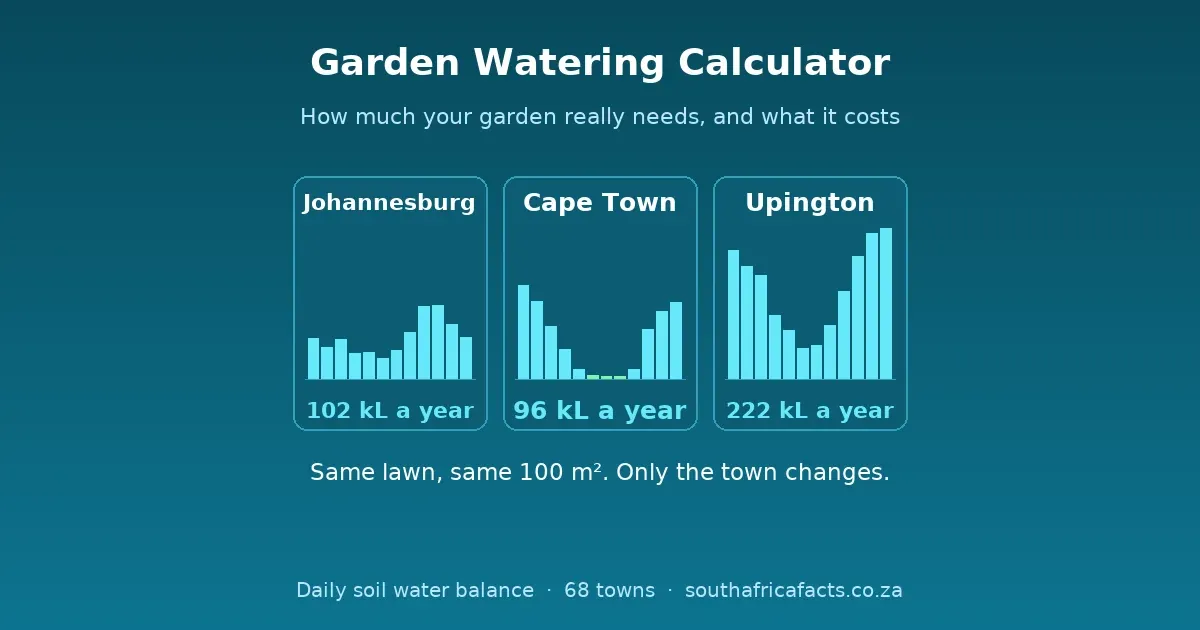
Almost every watering rule of thumb you will read, "give the lawn 25 mm a week", "water twice a week in summer", started life in a different climate. South Africa spans winter rainfall in the Western Cape, summer rainfall on the Highveld, and near-desert in the Northern Cape, and the same lawn in Upington needs more than four times the water it needs in Durban. A single national rule cannot be right in more than one of those places.
This calculator uses the method irrigation engineers actually use, the FAO-56 soil water balance. It works in three steps.
1. How much water the plants lose
Reference evapotranspiration, written ET0, is how fast water leaves a standard well-watered grass surface in a given place on a given day. It bundles temperature, humidity, wind and sunshine into a single figure in millimetres per day. Multiply it by a plant coefficient, Kc, and you get how much your particular planting actually uses. A vegetable bed in full production uses close to the reference figure. Indigenous waterwise planting uses roughly a quarter of it.
One thing surprises people: a lawn is not Kc = 1.0. The reference surface is a cool-season grass grown with unlimited water. South African warm-season lawns, kikuyu, LM, buffalo and the cynodons, run well below that, and drop further through winter as growth slows.
2. How much of that the rain already covers
This is the step most calculators get wrong, and they get it wrong in the dangerous direction. Rain does not arrive spread evenly through the month, it arrives in storms. A root zone that can only hold 20 mm of usable water cannot keep a 60 mm downpour, most of it drains past the roots or runs off. Subtracting monthly rainfall from monthly demand quietly assumes your soil caught every drop.
So this tool runs a day-by-day soil water balance over ten years of rainfall and evaporation for the nearest of 68 towns, filling and draining a root zone sized to your actual soil and planting. Compared against that, the standard monthly shortcut over-credits rainfall on sandy soil by 26% in Johannesburg and 45% in Durban. Over-crediting rain means telling you to water less than you should.
3. How much has to leave the sprinkler
No sprinkler waters evenly. Distribution uniformity measures how much more the wettest parts get than the driest, and it is why the figure leaving your sprinkler has to exceed the figure the roots need. The Irrigation Association puts achievable uniformity at about 75% for spray heads and 80% for rotors, but audits of installed residential systems routinely measure closer to 45% and 59%. This calculator assumes something nearer the audited reality, because you have an installed system rather than a freshly commissioned one.
Water deeply, and less often
The single most useful habit in a dry country is to refill the root zone completely and then leave it alone until the plants have used it. Light daily sprinkles wet only the top few centimetres, so roots stay shallow and the plant becomes less drought-tolerant, not more. That is why this calculator gives you a large amount per watering and a long gap, rather than a little every day, and why the litres per watering figure stays the same all year while the frequency changes.
How often should you water kikuyu grass?
Kikuyu, LM and buffalo are warm-season grasses, and they behave very differently from the cool-season grass that most international watering advice assumes. They use less water than the reference surface even at their peak, and they slow right down in winter, so their demand swings harder through the year than a fescue lawn's would.
For a kikuyu lawn on loam soil, this calculator gives roughly every 9 days in Johannesburg in October, stretching to about 16 days in January once the summer rain arrives, and about 23 days in July when the grass is barely growing. The same lawn on sandy soil needs it about every 5 days in January, because a sandy root zone holds less than half what loam does. In Cape Town, where summer is the dry season, January comes out at about every 7 days.
Those are ten-year averages the tool computes, not a rule of thumb. Pick your own town, month and soil above.
Common questions
How often should I water my lawn in South Africa?
Your soil matters as much as your town. In Johannesburg in October, the hardest month on the Highveld, a warm-season lawn needs watering roughly every 3 days on sandy soil but only about every 9 days on loam, because a sandy root zone holds far less and empties sooner. The same Johannesburg lawn in June needs it about every 13 days on sand and about every 5 weeks on loam. In Cape Town, June and July usually need nothing at all, because winter rainfall covers the whole demand. Enter your own town, month and soil above.
How much water does a lawn need per week?
Far more than most rules of thumb suggest, and it varies enormously. In its peak month, a 100 m² warm-season lawn on loam needs about 1 700 litres a week in Durban, about 3 500 in Johannesburg, about 4 400 in Cape Town and about 7 200 in Upington. In the quietest months, several of those towns need nothing at all. The often-quoted "25 mm a week", which is 2 500 litres over 100 m², is therefore right for almost nobody: it badly under-waters a Karoo garden in December and badly over-waters a Cape Town garden in July.
How long should I run my sprinkler?
Long enough to refill the root zone, which depends on your soil and how fast your sprinkler applies water. A pop-up spray head puts down about 38 mm an hour, a rotor about 13, an oscillating sprinkler about 20. Deeper-rooted plantings on clay need the longest runs. The calculator gives a figure, but the honest answer is to measure your own: put three or four straight-sided tins around the area, run the sprinkler 15 minutes, and measure the depth caught. Spacing and water pressure matter more than the type of head, so a measured rate beats any assumption.
Is it better to water the garden in the morning or the evening?
Early morning, and in several municipalities it is not optional. Watering in the heat of the day loses a large share to evaporation before it reaches the roots. Evening watering reaches the roots fine but leaves foliage wet overnight, which encourages fungal disease on lawns and vegetables. Early morning avoids both. In Johannesburg, Tshwane and Cape Town, daytime watering is also restricted by by-law, see below.
What are the water restrictions in Johannesburg?
Johannesburg has been on Level 1 restrictions under section 44(3) of the Water Services By-law for years, and Johannesburg Water has repeatedly confirmed they were never withdrawn. Between 1 September and 31 March you may not water or irrigate your garden between 06:00 and 18:00. Between 1 April and 31 August the prohibited window is 08:00 to 16:00. Using a hosepipe to clean paved areas and driveways with municipal water is prohibited outright. Restriction levels change, so check Johannesburg Water for a current notice before assuming this is still the position.
What are the water restrictions in Pretoria and Tshwane?
The City of Tshwane is on Level 1 restrictions under its Water Supply By-law, and states that these were never withdrawn and remain applicable. You may not water or irrigate your garden with a hosepipe or sprinkler system between 06:00 and 18:00, all year round, and you may not use a hosepipe to clean driveways or patios or fill swimming pools. The City has said it will fine, restrict or disconnect consumers who do not comply.
Can I water my garden in Cape Town?
Yes. Cape Town has had no declared water restrictions since 1 November 2020. Its permanent water-saving rules still apply though, and they are not a drought measure, they are the standing by-law: watering with municipal drinking water is allowed only before 09:00 or after 18:00, hosepipes must have a shut-off nozzle, and hosing down paved areas with drinking water is not allowed.
What about Durban and eThekwini?
eThekwini's Water By-law sets no standing time-of-day limit on watering a garden with municipal water, which makes it unusual among the big metros. Its restrictions have taken the form of supply-side rationing instead, throttling reservoirs and mains. Early-morning watering is still the sensible choice, and it is worth checking for a current notice, since rationing there has been frequent.
How often should you water kikuyu grass?
Kikuyu is a warm-season grass, so it uses noticeably less water than the cool-season grass most international advice is written for, and it slows right down in winter. On loam soil in Johannesburg this calculator gives about every 9 days in October, about every 16 days in January once the rains arrive, and about every 23 days in July. On sandy soil in January it is about every 5 days. LM and buffalo behave much the same way, so choose "Lawn, warm-season" above.
How much water does a garden sprinkler use per hour?
It depends on the type and on how much ground it covers. Over 50 square metres, a pop-up spray head uses about 1 900 litres an hour, an oscillating sprinkler about 1 000, a rotor about 650 and a soaker hose about 400. Those follow directly from the application rate, because 1 mm of water over 1 square metre is exactly 1 litre: a sprinkler putting down 20 mm an hour over 50 square metres is using 1 000 litres an hour. Measure your own with the catch-can method above rather than trusting the type alone.
How much does water cost per kilolitre in South Africa?
It rises in blocks, so there is no single figure. On a conventional Johannesburg meter the 2026/27 residential water blocks run from R33.57 per kilolitre in the lowest paid block up to R100.40 at the top. What matters for a garden is that its water sits on top of your indoor use and is billed in your highest blocks: 10 kilolitres of garden water on top of a 15 kilolitre indoor baseline works out at about R58.52 per kilolitre in Johannesburg and about R84.13 in Cape Town, once volumetric sanitation is counted. The calculator does this properly rather than quoting an average rate.
How often should I water a vegetable garden?
More often than a lawn, and for less time each go. Vegetables use water at close to the full reference rate when they are in production, but their roots are shallower than an established lawn's, so the root zone holds less and empties faster. On sandy soil in summer that can mean every second or third day. The calculator handles this: choose "Vegetable beds" and your soil type.
Do I need to water in winter?
On the Highveld, yes, and this catches people out. Johannesburg's driest months are winter months, and although a dormant warm-season lawn uses much less water, it still uses some, and almost no rain falls between May and August. In the winter-rainfall Western Cape the opposite holds and watering in June and July is usually pointless. The calculator will tell you plainly when a month needs nothing at all.
Why does the calculator sometimes say I need no water at all?
Because sometimes you genuinely do not. Over the last ten years, rainfall alone has covered the full demand for waterwise planting on clay soil in Durban for most of the year, and for almost any planting in Cape Town in June and July. That is a real answer, not a failure to compute one, and acting on it is the cheapest saving on this page.
My soil is clay and the calculator says to split the watering. Why?
Clay is a trap in both directions at once. It holds the most water of any soil, so it wants the largest amount per watering. But it also absorbs water the slowest, about 3 mm an hour against a pop-up spray head's 38. So the soil that needs the biggest drink is the one least able to take it quickly, and the excess runs off down the driveway instead of soaking in. Splitting the run into several shorter cycles with 30 to 60 minutes between them lets each lot soak in. Watch the first run: if water starts running off the surface, stop and let it soak.
How does the cost estimate work?
Garden water sits on top of your indoor use, so it is charged in the highest tariff blocks your household reaches, not at the average rate on your bill. That is why the calculator asks what you use indoors. It then charges the garden volume as the difference between your bill with and without it. Tariffs are the 2026/27 figures for Johannesburg, Cape Town, Tshwane and eThekwini, taken from each council's own budget annexure or tariff book. Fixed monthly charges are excluded because they do not change with how much you water.
Why does saving water not cut my Johannesburg sewer bill?
Because on a conventional meter in Johannesburg, residential sanitation is a flat monthly charge banded by the size of your erf, from about R398 up to R1 688, and it does not scale with consumption at all. Cutting your water use reduces the water blocks and nothing else. Only prepayment-meter households in Johannesburg pay volumetric sanitation. Tshwane and eThekwini do charge sanitation by volume, but the share of water they assume reaches the sewer falls as usage rises, precisely because the city assumes high-block water is going onto the garden.
Where does the rainfall and evaporation data come from?
The Open-Meteo historical archive, which serves ERA5-Land reanalysis at about 11 km resolution blended with ECMWF's IFS HRES at about 9 km from 2017 onward. Both daily rainfall and daily reference evapotranspiration come from the same reanalysis, so the two series are physically consistent day by day, which is what makes a daily balance worth running. The window is 2015 to 2024 deliberately: a longer record would be smoother, but recent decades in South Africa are measurably drier than the late twentieth century, and averaging that away would understate how much water a garden needs now.
How accurate is this?
Treat it as a well-grounded starting point, not a meter reading. The monthly volumes carry real uncertainty, roughly 10 to 20% at the extremes, because ten years of a variable summer-rainfall climate leaves the month-by-month split noisy even though annual totals are stable to a couple of percent. The run time per watering is the most robust number here and the frequency the least. Your own soil can also differ from the regional type within a single garden. The catch-can measurement is the single biggest accuracy improvement you can make, since it replaces an assumed sprinkler rate with a measured one.
Does this apply to borehole or rainwater tank water?
The watering schedule does, since plants do not care where the water came from. The cost estimate does not, so set the tariff to "skip the cost estimate" if you are not on municipal water. Note that by-law watering windows in Cape Town apply to municipal drinking water, while borehole and well-point users are separately required to register and are asked to observe the same watering times. If you are sizing a tank rather than scheduling irrigation, the rainwater tank calculator on this site is the better tool.