
Heat Pump vs Electric Geyser Calculator (South Africa)
How much a heat pump geyser costs installed in South Africa, what it saves a month vs your electric geyser, and how long until it pays back.
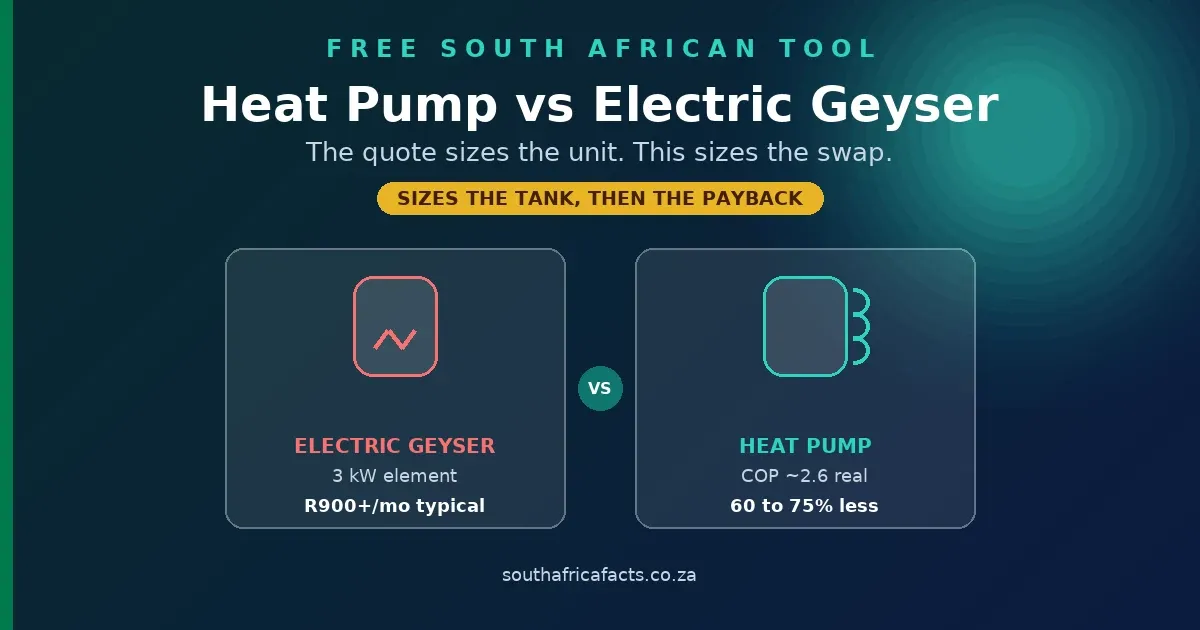
Every heat pump quote leans on a spec-sheet coefficient of performance measured on a warm test bench, not a Highveld morning in July, and none of them ask whether the tank you're buying can actually keep up with two teenagers showering back to back. This tool sizes the swap first, the tank and recovery rate you actually need, then shows the running-cost payback next to the number you'll likely get quoted, and what closes the gap between them.
Everyone drawing hot water at home, not just adults.
Sets litres per person per day at your geyser's setpoint (60°C). Typical works out to about 40 litres a person, which is the standard plumbing industry planning figure.
The size of the electric geyser you have now, and the heat pump tank you're pricing against it. If the sizing check below says you need bigger, come back and bump this up.
A heat pump's efficiency depends on outside air temperature, so this sets both your realistic seasonal coefficient of performance (COP) and your average incoming water temperature.
A timer only cuts the standing heat loss while the tank sits idle, it does nothing for the energy that actually heats your water. It's a real saving, just a much smaller one than the folklore "cuts your bill by a third" suggests.
How concentrated your heaviest draw is. This is what actually determines whether a heat pump's slower recovery rate leaves you finishing a shower in cold water.
This is the single biggest lever on your payback. If you're replacing a dead geyser anyway, the capital you're actually staking on the heat pump is only the extra over a same-size electric replacement. If your geyser is fine, the full installed cost is on the heat pump, your working geyser has no resale value to credit against it.
A retrofit is only possible while your existing tank is still sound, so it only applies if your geyser still works. A dead geyser needs a new tank either way, which means an integrated unit.
Auto-filled from a typical installed quote at this tank size, anchored to a real 200 L integrated unit at Builders in 2026 (R27,999 plus a R6,280 install). Overwrite with your actual quote, brands and installers vary by thousands of rand either way.
What a like-for-like electric replacement would cost you, unit plus a Certificate of Compliance install. Only counted against the heat pump when your geyser just died, since that's the money you'd spend either way.
Rands per kWh. Use your top marginal block, not your average bill divided by units, since water heating is the extra kWh sitting at the top of an inclining block tariff.
Tariffs climbing faster makes the running-cost gap, and so the payback, look better over time.
Default is a booked technician visit. You can clean the evaporator yourself; Kwikot's full accredited service is every 2 to 3 years, not every year. A booked visit is typically R500 to R1,350. Overwrite if you have a contract, or drop it if you do the coil yourself. An electric geyser has no equivalent, just an occasional element at a few hundred rand every several years, small enough next to this gap that it's left out.
The honest cost of tying up cash in the upgrade instead of a money market account. Defaults to 6%, a realistic after-tax return. Set to 0 to ignore it.
A quality integrated unit is typically good for 10 to 15 years, so 12 is a reasonable middle. Stretch it if you expect to stay in the house longer.
What size do you actually need?
--
What closes the gap between the quote and reality
Totals over the whole comparison period in future rands, which is why they look larger than a single month's bill.
Money in your pocket over time
Estimates to sanity check a quote, not a substitute for one. Get the installer's actual tank size, compressor rating and warranty terms in writing before you decide, and always compare at least two quotes.
💬 Questions about a heat pump quote? Discuss this tool on the forum →
More household tools: Solar Savings Calculator · Prepaid Electricity Calculator · Municipal Water Bill Calculator · Garden Watering Calculator · Rainwater Tank Calculator
Heat pump vs electric geyser, the swap you actually get quoted
Most heat pump quotes in South Africa lean on a spec-sheet coefficient of performance measured on a warm test bench, not a Highveld morning in July. None of them ask whether the tank you are buying can keep up with two teenagers showering back to back. The solar calculator on this site sizes a whole system. The prepaid calculator prices a tariff. This one sizes the appliance swap itself, the tank and recovery rate you actually need, then shows the running-cost payback next to the number you will likely get quoted, and what closes the gap between them.
A heat pump does not make heat the way a geyser element does. It moves heat from the outside air into the tank, which is why even a realistic South African COP of around 2.6 still cuts the electricity used to heat water by more than half. The catch is recovery rate: 3.6 kW of heat into the tank on the spec sheet (0.9 kW of electricity, which is how you get the nameplate COP of 4.0), and less than that on a Highveld winter morning, so an undersized tank quietly falls back on its electric backup during the morning peak, at the same running cost as the geyser you just replaced, for that slice of your hot water. The other catch is capital: if your geyser has already died, you are only staking the extra over a same-size electric replacement. If it still works, the full installed cost is on the heat pump, because a working geyser has no resale value.
Prices used as starting points are real 2026 retail figures from Builders, a 200 litre integrated unit at R27,999 plus a R6,280 install, and a 150 litre electric geyser at R4,699. Overwrite them with your own quote. Seasonal COP comes from peer-reviewed South African field studies, not the 4.0 on the box. A booked annual service of around R800 is counted because an electric geyser does not need it; overwrite that if you clean the coil yourself.
How much does a heat pump geyser cost in South Africa?
A budget to mid-range 150 to 200 litre integrated unit, fully installed, is typically R25,000 to R35,000. The starting prices in this tool are real 2026 Builders retail: a 200 litre integrated heat pump at R27,999 plus a R6,280 install quote, a 150 litre electric geyser at R4,699, and a 200 litre electric at R7,599. Premium brands with longer warranties run higher, a Stiebel Eltron 300 litre unit lists at R43,999 before install. A retrofit that keeps your existing tank and only adds the heat pump unit is cheaper, typically R12,000 to R20,000, and this tool only offers that path if your geyser still works.
Those are starting points, not a quote. Overwrite them with the number on the paper in front of you. The payback then restates itself around your actual capital, not a catalogue price.
How long until a heat pump geyser pays for itself?
On the default four person household at R3.20/kWh, an electric geyser costs about R935 a month to run and a heat pump about R420, a saving of around R510 a month after an R800 booked service. If the geyser has already died, you are only staking the extra over a same-size electric replacement, and that pays back in about three and a half years. If it still works, the full installed cost is on the heat pump and the realistic payback is closer to four and a half years, not the two to three years a COP 4.0 brochure implies. A typical R16,000 retrofit on a sound tank lands around two and a half years.
Installer pages often quote R450 to R800 a month saved and a two to three year payback. Those numbers usually use a nameplate COP of 4 and skip servicing. This tool's realistic figure is the one to take to the quote, the optimistic figure is the one you were probably sold.
How the sizing check works
The tool first works out how many litres of 60°C water your household draws in a day, then how much of that lands in one morning rush. A typical four person home at 40 litres a person is 160 litres a day, of which a typical morning takes about 56 litres. A 150 litre tank can actually deliver about 85 percent of its nominal volume at full temperature. The sizing check uses the spec-sheet heating capacity of 3.6 kW of heat into the tank, not 3.6 kW of electrical draw, which recovers about 73 litres an hour at a 42.5°C rise (0.9 kW compressor input on the Kwikot HP-200-V spec, the nameplate COP of 4.0). If the usable tank plus that hour of recovery covers the peak, the backup element stays off. If it does not, the shortfall runs at COP 1, which is the same cost as a standard geyser, and the tool says so rather than pretending the nameplate COP still applies.
Related tools
Holding a solar geyser quote or a gas geyser quote as well? Put all three on the same household and climate with the Heat Pump vs Solar vs Gas Geyser Calculator. The ranking is allowed to flip: Highveld winters favour evacuated tubes, Cape Town favours the heat pump. If you are looking at a whole-home solar system rather than just the geyser, use the Solar Savings and Payback Calculator, which shows the realistic payback next to the salesman's number. To see what a rand of prepaid electricity actually buys on your municipal tariff, use the Prepaid Electricity Calculator.
Frequently asked questions
How much does a heat pump geyser actually cost installed in South Africa?
A budget to mid-range 150 to 200 litre integrated unit runs roughly R25,000 to R35,000 fully installed. A real 200 litre unit at Builders was R27,999 plus a R6,280 install quote in 2026. Premium brands with longer warranties run higher, a Stiebel Eltron 300 litre unit lists at R43,999 before install. A retrofit that keeps your existing tank and only adds the heat pump unit is cheaper, typically R12,000 to R20,000.
What is the real coefficient of performance, not the marketing number?
Spec sheets quote a nameplate COP around 4.0, measured on a warm test bench. Peer-reviewed South African field studies put the real seasonal average closer to 2.3 in winter and 3.0 in summer, roughly 2.6 to 2.9 blended across the year depending on your climate. That is still a large saving over a resistive element, just not the number on the box.
Can a heat pump keep up with two showers back to back?
It depends on tank size and how concentrated your morning draw is. Off the spec-sheet COP a heat pump recovers slower than a 3 kW resistive element, so an undersized tank falls back on its electric backup element during a peak, which runs at the same cost as a standard geyser for that portion of your hot water. This tool's sizing check flags that and suggests a bigger tank where it applies.
Does a geyser timer already get me most of the savings, without a heat pump?
No, and this is the most common myth. A timer only cuts the standing heat loss while the tank is idle, typically worth R50 to R100 a month. It does nothing for the far larger cost of actually heating the water you draw. A heat pump cuts both, which is why the saving is usually 60 to 75 percent, not the 20 to 30 percent a timer alone gets you.
Should I switch now, or wait until my geyser dies?
Whichever situation you are actually in changes the payback the most. On the default four person household at R3.20/kWh, a dead geyser pays back in about three and a half years, because you are only staking the extra over a same-size electric replacement. If it still works, the full installed cost is on the heat pump, since a working geyser has no resale value, and that lands closer to four and a half years on the same household. Overwrite the people, tariff and quote and the years will move. A two person home or a cheaper tariff can stretch it toward five to seven years, which is why the calculator is there.
What maintenance does a heat pump geyser need that an electric geyser does not?
The coil and filter are owner jobs, every few months. A booked technician visit is typically R500 to R1,350 and covers a refrigerant check plus an electrical inspection. Kwikot's full accredited service is every 2 to 3 years, not every year. This tool defaults to R800, a conservative booked-visit figure, and you can overwrite it or drop it if you do the coil yourself. Skip the coil clean and a clogged evaporator forces the compressor to work harder, which quietly erodes both the running-cost saving and the unit's lifespan. An electric geyser has no equivalent, just an occasional element or thermostat swap for a few hundred rand.
How long does a heat pump geyser last?
10 to 15 years for a quality unit with proper maintenance, similar to a good electric geyser tank. Compressor warranties typically run 5 years, with some brands offering longer on the tank itself. Check the warranty is backed by a local service network, cheap imports often carry only 2 years and no local parts supply.
How much can a heat pump geyser save a month in South Africa?
On the tool's default four person household at R3.20/kWh, an electric geyser costs about R935 a month to run and a heat pump about R420, a saving of around R510 a month. That already counts an R800 booked service. The kWh cut is closer to 60 to 75 percent; the rand figure is a bit less because servicing is counted and winter COP is below the spec sheet. Overwrite the tariff with the number on your bill, Johannesburg homes on a higher block will save more in rands even if the kWh cut is similar.
Does a heat pump geyser still work on a Johannesburg winter morning?
Yes, but not at the number on the box. Highveld winter COP in the field studies this tool uses is about 2.1, against a nameplate 4.0. That is still roughly half the electricity of a resistive element, not a quarter. The blended year on the Highveld is about 2.7, close to the national 2.6, because Highveld summers are strong. The compressor also recovers slower in the cold, which is why the sizing check matters more in Johannesburg than in Durban.
Can I keep my existing geyser and only add a heat pump?
Yes, that is a retrofit, typically R12,000 to R20,000 against R25,000 to R35,000 for an integrated unit with a new tank. It is only offered in this tool if your geyser still works, because a dead tank has to be replaced either way. The existing tank must be sound, and the heat pump unit needs outdoor or well ventilated space with airflow. Payback on a typical R16,000 retrofit is around two and a half years on the default household, faster than buying the whole integrated unit, provided the tank has years left in it.
Where does this tool's data come from?
Real 2026 retail prices from Builders (Massmart) for both electric geysers and integrated heat pump units, manufacturer spec sheets (Kwikot) for compressor input power, heating capacity and backup element rating, and peer-reviewed South African studies on split and integrated air-source heat pump water heater performance for realistic seasonal COP. It does not use marketing comparison sites, several of which contradict themselves on price from one page to the next.
Estimates to sanity check a quote, not a substitute for one. Get the installer's actual tank size, compressor rating and warranty terms in writing before you decide, and always compare at least two quotes. Last reviewed August 2026.