
Farm Fencing Calculator (South Africa)
Work out the real shared fence length across your camps, then posts, droppers, wire or mesh rolls and an estimated cost, using South Africa's own fencing standards.
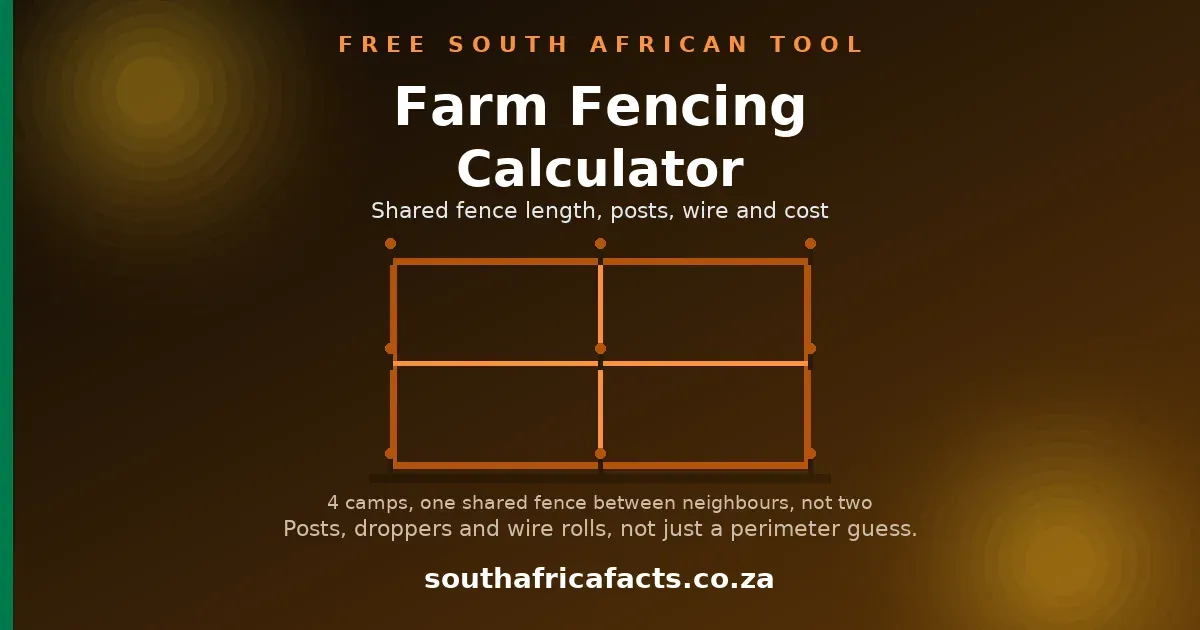
Subdivide one camp into a grid and the fences between neighbouring camps are shared, so a naive number-of-camps-times-perimeter sum can overorder wire and posts by 25% or more. This tool works out the real shared fence length first, then applies South Africa's own fencing standards, from a fencing catalogue and technical guide grounded in the historic ARC-IAE/SAIAE farm fencing manual, for post spacing, dropper counts and strand numbers by fence type, and finishes with a materials and cost estimate you can hand straight to a supplier.
Each camp fully fenced on its own, no shared boundary with another camp.
One block split into a grid of camps. Internal dividers are shared between neighbours and only counted once, the actual saving over fencing each camp separately.
Skip the geometry if you already know how much fence you need, a single boundary run for example.
Count every corner and every point the fence changes direction, each needs a heavy strainer post.
Drives what's on the shopping list below, staples fasten wire to timber posts, steel Y-standards are tied with binding wire instead.
A gate replaces a stretch of wire and standards with two heavy strainer-grade posts either side, that trade-off is worked out for you below.
Advanced: unit prices and waste allowance
No single South African source prices a complete strainer assembly, post, anchor block or stay, and labour together. This default is a rough multiple of a standard post's price to account for the heavier post and anchor materials, replace it with your own supplier or contractor quote.
No official South African standard sets this, 5 to 10% is a commonly used rule of thumb for ties, joins, tensioning and corners. Applied to wire and mesh only, not to post or dropper counts.
A common 50kg coil of double-strand barbed wire, 2 times 2.50mm, runs to about 540m. Change this to match your own supplier's roll.
Prefabricated woven wire fencing is typically supplied in 100 to 200m rolls.
Fastens wire to timber posts only, steel Y-standards are tied with binding wire instead. No sourced South African price found, a rough estimate.
A rule of thumb, not an official figure, scale up for more wire strands per post.
South Africa's fencing reference gives one 50kg coil of 2.8mm binding wire as covering roughly 4km of a 6-strand fence, 24,000 strand-metres, adjust for a different gauge or coil size.
2 hinges and a latch per gate, no sourced South African price found, a rough estimate.
Based on a real current South African heavy farm gate range, R720 for a 0.75m gate up to R2 367 for a 4.8m gate, averaged per metre. Smaller gates cost more per metre than this average, due to fixed frame and hardware costs, so treat it as a starting estimate for your actual gate width, not an exact quote.
| Item | Quantity | Unit price | Subtotal |
|---|
Plain quantities, no prices, to take to your co-op or supplier.
Materials estimate for planning and quoting purposes, not an engineering design. Assumes a broadly rectangular layout with corner or strain points as entered above, real terrain, gates and existing fence lines will shift the exact count. Extra mid-run strainer posts for long straight stretches are estimated off the total fence length rather than each individual run, so a block split into many short camps may show a couple more strainers than it strictly needs. Post spacing, dropper and strand figures come from South Africa's standard fencing reference, prices are editable defaults, always confirm against your own supplier's current pricing. Last reviewed July 2026.
💬 Discuss this tool, or check the numbers against your own fencing job, on the forum →
Why a simple perimeter sum overorders fencing materials
Multiply the number of camps by one perimeter and you'll overorder wire and posts by 25 percent or more, because fences between neighbouring camps in a subdivided block are shared, not doubled up. This calculator works out the real shared length first, using South Africa's own fencing reference for post spacing, dropper counts and strand numbers by fence type, cattle, mixed stock, sheep, jackal-proof, game-proof or mesh, then splits the materials into strainer posts, standard posts, droppers and wire or mesh rolls with an editable cost for each, the same breakdown you'd want to check a supplier's quote against, plus an overall cost per metre so you can compare different fence types and camp layouts on equal footing. Choose timber or steel for your strainer and standard posts and it also works out staples, binding wire and gate hardware, then lays the whole thing out as a plain shopping list you can print or save as a PDF to take to your co-op or supplier.
Working out how many animals your fenced camps can actually carry? Our Stocking Rate Calculator works that out from your veld condition. Planning water for the same camps? The Farm Dam Volume Calculator works out how many days your dam will last. Setting strainer or gate posts in concrete? The Concrete & Mortar Calculator works out the cement, sand and stone for your post holes, in real bags rather than a guess. Building a timber or composite deck on the same property? Our Decking Calculator works out the boards, joists, bearers and posts, and links through to the same concrete calculator for the footings. Need an electrified security fence instead of livestock fencing? Our Electric Fence Cost Calculator covers wall-top and freestanding wire, brackets, earthing and the energiser, plus what a Certificate of Compliance adds. You can also browse all our free South African tools and calculators.
How far apart should fence posts and droppers be in South Africa?
Standard, or intermediate post, spacing and the droppers needed between them, from the South African fencing reference this calculator is built on. The closer the spacing and the more droppers between posts, the sturdier the fence, at a higher materials cost.
| Post spacing | Droppers per span | Typical use |
|---|---|---|
| 12m | 2 to 3 | Intensive stock farming, soft soil, sturdiest option |
| 16m | 3 to 4 | Average conditions, the most commonly used spacing |
| 20m | 4 to 5 | Extensive farming, animals rarely contact the fence |
| 15m | 4, 3m apart | Jackal-proof and game-proof fences |
| 10m | None, self-supporting | Mesh or woven wire, game camps |
| 16m | None, self-supporting | Mesh or woven wire, stock camps |
How many wire strands does a South African stock or game fence need?
Minimum strand counts and fence heights by what you're fencing against. Game figures are the standard South African game-fencing specification, also used by fencing suppliers and catalogues nationally.
| Fence type | Strands | Height |
|---|---|---|
| Cattle only | 5 minimum | 1200mm |
| Mixed stock, cattle and sheep | 6 minimum | 1200mm |
| Sheep only | 5 minimum | 900mm |
| Sheep and angora goats | 7 minimum | 1050mm |
| Jackal-proof (netting plus strands) | 2 to 6 extra | 900 or 1200mm net |
| Game, Group I: kudu, eland, impala, waterbuck, buffalo | 21 | 2.4m |
| Game, Group II: gemsbok, red hartebeest, wildebeest, zebra | 16 | 1.8m |
| Game, Group III: blesbok, bontebok, springbok, rhebok | 13 | 1.4m |
| Game, Group IV: ostriches (plain wire only) | 6 | 1.8m |
Frequently asked questions
Why does a subdivided block cost less to fence than the same camps built separately?
Because the fences between neighbouring camps in a subdivided block are shared, one fence line serves both camps either side of it, and only needs to be built once. Fence four standalone 100 by 100 metre camps and you need 1 600 metres of fence, one full perimeter each. Split one 200 by 200 metre block into the same four camps with a shared internal cross and you only need 1 200 metres, a 25 percent saving on wire, posts and droppers for the exact same grazing area. This calculator works out the shared length for you under the subdivided block option, rather than the naive number of camps times perimeter sum that overorders materials.
How far apart should fence posts be in South Africa?
12, 16 or 20 metres, depending on how sturdy a fence you need. 12 metres is used for intensive stock farming or soft soil, where you want the sturdiest fence. 16 metres suits average conditions and is the most commonly used spacing. 20 metres is used for extensive farming where stock rarely contact the fence. Jackal-proof and game-proof fences use a tighter 15 metre spacing regardless of stock type, and mesh or woven wire fencing uses 16 metres for stock or 10 metres for game.
How many droppers do I need between fence posts?
It scales with your post spacing: 2 to 3 droppers between posts spaced 12 metres apart, 3 to 4 for 16 metres, and 4 to 5 for 20 metres, with the higher number in each pair used when mixed stock, both large and small animals, share the fence. Jackal-proof and game-proof fences use a fixed 4 droppers between standards, spacing them 3 metres apart regardless of the exact post interval chosen. Mesh or woven wire fencing doesn't need droppers at all, its own vertical stay wires do that job.
How many wire strands does my fence need?
5 strands minimum for cattle only or sheep only, 6 for mixed cattle and sheep, and 7 if you're running sheep with angora goats, since goats are notorious fence creepers and need the denser wire spacing. Add 1 or 2 extra strands beyond the minimum for a boundary fence, since it takes more pressure than an internal camp division. Game fencing uses a completely different, much higher strand count, see the question on game fences below.
What's the difference between a strainer post and a standard fence post?
A standard, or intermediate post, just holds the wires at the right height and spacing along a straight run, it doesn't resist much sideways pull. A strainer post is the one the wire is actually tensioned against, at every corner, every gate, and at regular intervals along a long straight run, so it has to be far heavier and properly anchored, either with a buried concrete or timber dead man block, or a diagonal stay to a second anchor post, forming what's called a box anchor. Mixing these up in your budgeting is the single biggest way to underestimate a fencing job's real cost, since a strainer assembly typically costs several times what a standard post does.
How far apart do strainer or corner posts need to be?
No further than 500 metres apart on even ground for an ordinary stock fence, closer on broken terrain, and no further than 300 metres for a game-proof fence, since the wire tension in game fencing runs higher. Every corner and every gate also needs its own strainer post regardless of that interval, since a change in direction pulls the wire sideways the same way a long straight run does over distance.
How many strands does a game fence need in South Africa?
It depends on the species you're fencing against. The standard South African specification is 21 strands at 2.4 metres high for Group I game, kudu, eland, impala, waterbuck and buffalo, 16 strands at 1.8 metres for Group II, gemsbok, red hartebeest, wildebeest and zebra, and 6 strands of plain wire at 1.8 metres for ostriches. Group III, smaller game like blesbok, bontebok, springbok and rhebok, is specified at 13 strands and 1.4 metres in the fencing guide this calculator uses, some suppliers still build small-game fencing denser than that though, closer to the Group II spec, so check which one your local supplier actually quotes before finalising an order. Standard spacing for the conventional strand-wire game fence is commonly quoted at 10 metre intervals by South African fencing suppliers, though the general fencing guide allows up to 15 metres.
What size gate do I need on a farm fence?
1 metre is enough for pedestrians or moving a single animal through. 2.5 to 3 metres suits general stock movement between camps. Vehicles and farm machinery need 3.5 to 5 metres. Placing gates at the corner where four camps meet, rather than mid-fence, is the usual South African convention, since it's the natural point to drive stock toward and lets one set of gates serve all four camps.
Is barbed wire sold by weight or by length in South Africa?
Both, on the same product. Fencing wire is packaged as a fixed-mass coil, commonly 25, 35 or 50 kilograms, and the length that coil actually runs to depends on the wire's gauge, a thicker or double-strand wire gives you fewer metres for the same weight. A common 50 kilogram coil of double-strand barbed wire at 2 times 2.50 millimetres runs to around 540 metres, for example, while a lighter 35 kilogram single-strand coil can run to 845 metres. This calculator works in metres per roll so you don't need to convert, just check your own supplier's roll length and update the advanced price settings if it differs.
How much should I budget for wastage when fencing?
5 to 10 percent extra on wire and mesh is a commonly used rule of thumb, to cover ties, joins, tensioning losses and the extra length corners and uneven ground eat up. There's no official South African standard figure for this, so treat it as a sensible allowance rather than an exact number, and adjust it up if your terrain is broken or your fence has a lot of corners relative to its length.
Do I need droppers with mesh or woven wire fencing?
No. Woven wire fencing, sold under brand names like Bonnox or Veldspan, already has vertical stay wires built into the roll at close spacing, and those do the job droppers do on a strand fence, keeping the horizontal wires evenly spaced. You only need droppers if you're stringing extra plain or barbed strands above the mesh to reach a taller fence height than the roll itself provides.
Does this calculator include labour costs?
No, materials only, and that's deliberate. Fencing labour in South Africa is normally quoted separately from materials by contractors, and it varies enormously by region, terrain and how far the job is from the contractor's base, broken or rocky ground alone can add several days to a job, so there's no single reliable national labour figure that would mean much added into this total. The calculator's materials breakdown is exactly what you'd want in hand before getting a labour quote anyway, since it lets you sanity check what a contractor is actually pricing for against your own post, dropper and wire counts.
How much fencing do I need for a given number of hectares?
There's no fixed answer, since it depends entirely on the camp's shape, not just its area. A square uses less fence than any other rectangle of the same area, so a square 10 hectare camp, 100 000 square metres, has a side of roughly 316 metres and a perimeter of about 1 264 metres, while a long, narrow 10 hectare camp could easily need double that or more for the identical grazing area. That's exactly why this calculator asks for actual dimensions rather than a single area figure, enter your camp's real length and width, or your block's dimensions under the subdivided option, and it works out the true fence length rather than a rough area-based guess.
Can I get a printable shopping list from this calculator?
Yes. Below the cost breakdown, the calculator lays out the same quantities as a plain shopping list, no prices, just item names and counts, ready to take to your co-op or supplier. A print button turns that into a clean, single page printout or PDF, everything else on the page, the inputs, the tabs, the advanced settings, drops out of the printed version, leaving just the list and a one line summary of what it's for.
Why does it matter whether my posts are timber or steel?
Because it changes what you actually buy to fasten the wire. Wire is stapled onto treated timber posts, but steel Y-standard posts use binding wire or clips instead, staples don't work on steel. Choosing timber or steel separately for your strainer, corner and gate posts and for your standard, intermediate posts in this calculator changes both the post cost and whether staples show up on your shopping list at all, a common real-world combination is treated timber for the heavy strainer and corner posts with cheaper steel Y-standards for everything in between, which is the calculator's default.
This calculator gives planning and quoting estimates, not an engineering design. Post spacing, dropper and strand figures come from South Africa's standard fencing reference, cross-checked against multiple South African fencing suppliers for the game-fence strand counts. Unit prices are editable defaults, not sourced facts, always confirm against your own supplier's current pricing. Last reviewed July 2026.