
Stocking Rate Calculator (South Africa)
Work out how many cattle, sheep or goats your farm can carry, by veld type, condition and rainfall. Free South African stocking rate and grazing capacity calculator.
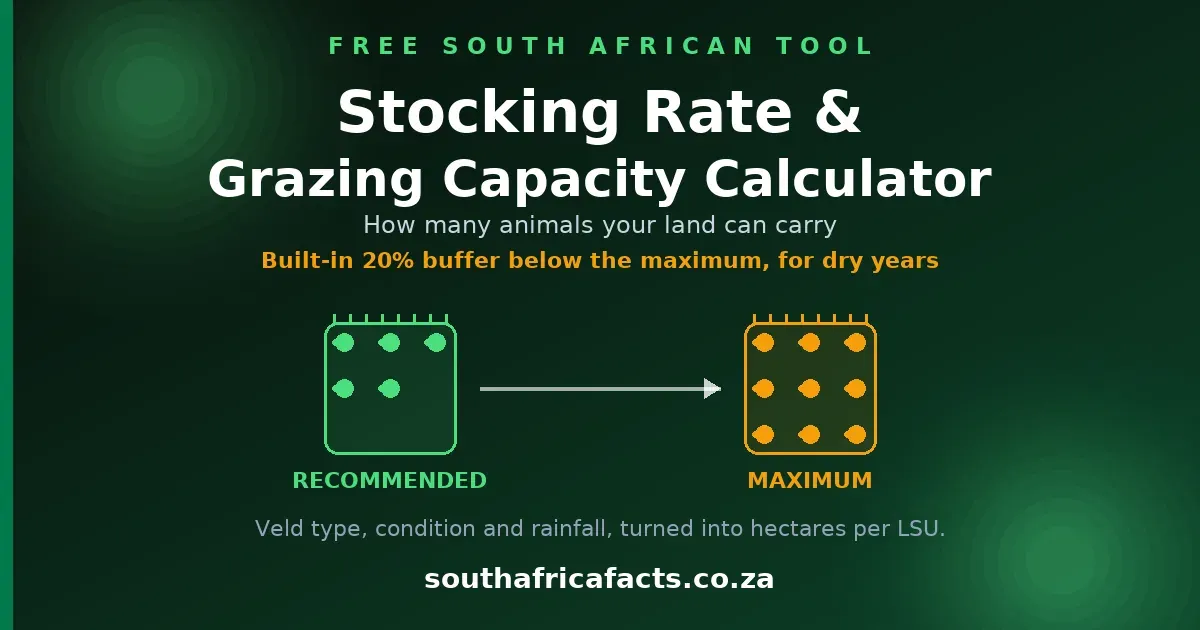
Most stocking rate rules of thumb are either a single national average that is wrong for most of the country, or they quietly assume your veld is in perfect condition. This tool starts from the hectares per Large Stock Unit figures the Department of Agriculture uses under the Conservation of Agricultural Resources Act, lets you adjust for how your veld condition and the season are actually looking, and keeps the number you can safely plan around separate from the ceiling you should never cross.
New here? Try an example farm:
The grazing area available, not counting cropland, homestead, or land you cannot access.
Picking a province only suggests a likely veld type below, it does not set your figure for you. Provinces span more than one veld type, so check the veld type against your own land, or your local gazetted grazing capacity if you know it.
Sets the base grazing capacity in hectares per Large Stock Unit (ha/LSU), from the Department of Agriculture's long term grazing capacity norms for veld in good condition. Grassland averages 6 ha/LSU, savanna (bushveld) 12 ha/LSU, and Nama-Karoo 25 ha/LSU. "Other" uses a rough national mid-range figure, use it only if none of the others fit, and get your local gazetted figure if you can.
If you already know the gazetted grazing capacity for your farm, or have had it assessed by a pasture scientist, enter it here to override the veld type default.
The official ha/LSU figures already assume veld in good condition, meaning the right mix of palatable grass species, full ground cover with no bare patches or erosion, and no serious bush encroachment or overgrazing damage. If your veld does not meet that, it carries fewer animals per hectare than the base figure suggests, so choose fair or poor honestly rather than optimistically.
The base figures are long term averages. In a poor rainfall year the veld simply cannot grow as much, so this pulls the safe number down for the season, in line with how commercial farmers destock ahead of a dry year rather than after the damage is done.
Treated as an average mature animal at 1.0 Large Stock Unit each. Tick below to break this down by age class for a more accurate figure.
About 200 kg, 0.4 LSU each.
About 300 to 350 kg, 0.65 LSU each.
About 450 kg, 1.0 LSU each.
550 kg and up, 1.3 LSU each.
0.17 LSU each, about 6 sheep to 1 LSU.
0.17 LSU each, same grass-equivalent rate as sheep.
Goats are browsers, not grazers, so a grass-based grazing capacity figure fits them poorly. If your goats mostly eat bush and shrub rather than grass, the real capacity for them depends on browse, not this figure, treat the goat numbers here as a rough guide only.
Grazing pressure: --
Effective grazing capacity used: -- ha/LSU (base -- ha/LSU for the veld type selected, adjusted for condition and rainfall).
If you ran only one type of animal
These use the recommended stocking figure, not the maximum, so there is still a buffer built in.
These figures are a planning estimate to help you sanity check your herd against your land, not the legally gazetted grazing capacity for your farm. Under the Conservation of Agricultural Resources Act, the binding figure is the one recorded for your district, and any exception needs a veld condition survey by a registered pasture scientist. Always confirm your actual grazing capacity locally and adjust for your own veld before making stocking decisions.
💬 Discuss this tool, or share your own stocking numbers, on the forum →
How stocking rate actually works in South Africa
South African grazing capacity is planned around a single unit, the Large Stock Unit, and a single question, how many hectares does it take to carry one of those units without wearing the veld down over time. The Department of Agriculture answers that question with a national grazing capacity map built under the Conservation of Agricultural Resources Act, and the figure that matters most is your veld type, not your province. Grassland averages six hectares per LSU, savanna or bushveld averages twelve, and the semi-arid Nama-Karoo averages twenty five, and those three numbers alone explain most of the difference between a Free State cattle farm and a Karoo sheep farm.
Two things then move that base figure. The official numbers assume veld in good condition, so if yours has thinning grass cover, bare patches, or bush encroachment, it genuinely carries fewer animals than the map suggests, and being honest about that here matters more than any other input. The season matters too, because the long term averages are exactly that, averages, and a below normal or drought year pulls the safe number down for as long as the dry spell lasts. Commercial farmers destock ahead of a bad season rather than after the grazing is already gone, and the earlier that decision is made the less damage the veld carries into the next year.
The calculator above keeps two numbers separate on purpose, a maximum that is the theoretical ceiling for your land, and a recommended figure at roughly eighty percent of that, which leaves a buffer for the years that do not go to plan. Mixed herds of cattle, sheep and goats are converted onto the same Large Stock Unit scale so you can see total grazing pressure in one number, with an honest note that goats are browsers rather than grazers and do not fit a grass based figure as neatly as cattle and sheep do.
None of this replaces the legally gazetted grazing capacity figure for your specific district, which is the binding number under the Conservation of Agricultural Resources Act, or a proper veld condition assessment by a registered pasture scientist. Use this tool to sanity check your herd against your land and to plan ahead of a dry season, then confirm the exact figure locally before making a stocking decision that is expensive to reverse. For the full picture on how many cattle or sheep per hectare is realistic where you farm, and how stocking rate, grazing capacity and stocking density differ, see our grazing capacity guide. If you are weighing up selling weaners off the veld against feeding them out yourself, our Feedlot / Weaner Break-Even Calculator works out the sale price a feedlot batch actually needs to clear. You can also browse all our free South African tools and calculators.
Frequently asked questions
What is a Large Stock Unit (LSU)?
A Large Stock Unit is the standard measure South African grazing capacity is planned around, defined as an animal with a mass of 450 kilograms gaining half a kilogram a day on forage of average quality. A mature cow or ox is close to 1.0 LSU, a weaner is roughly 0.4, and six sheep or six goats work out to about 1.0 LSU between them. Grazing capacity is then expressed as hectares needed per LSU, so a lower number means richer grazing and a higher number means you need more land to carry the same animal.
What is the difference between stocking rate, grazing capacity and stocking density?
Stocking rate and grazing capacity both describe the long term number of animals a piece of land can carry without degrading, expressed as hectares per Large Stock Unit, and in South Africa the two terms are largely used interchangeably, which is also how this calculator uses them. Stocking density is a different, shorter term measure, how concentrated animals are on a specific camp at a specific moment, for example during rotational grazing, and it is normally much higher than the stocking rate because it only applies while animals are grouped there, not across the whole farm all year. For working out how many animals to own in the first place, the number you want is the stocking rate, which is what this tool calculates.
How do I know if my veld is in good, fair, or poor condition?
The Department of Agriculture's grazing capacity figures already assume veld in good condition, so this is the input most farmers get wrong by being optimistic. Good condition means the right mix of palatable grass species for your area, full ground cover with no bare patches or visible erosion, and no serious bush encroachment or overgrazing scars. If your veld has thinning cover, patchy bare ground, more unpalatable or invasive species than it should, or woody encroachment eating into open grazing, that is fair to poor condition, and it genuinely carries fewer animals per hectare than the base figure suggests.
What is the difference between my recommended and maximum stocking rate?
The maximum is the theoretical ceiling your land can carry before it starts to degrade, calculated straight from your area and effective grazing capacity. The recommended figure sits at about eighty percent of that, which is standard conservative practice because it leaves headroom for a dry season, a slow start to summer rain, or a patch of veld resting after a fire. Running right up to the maximum works fine until the first bad year, then there is nowhere left to cut from and the veld itself starts paying the price.
Is this the same as my legal grazing capacity figure?
No. Under the Conservation of Agricultural Resources Act, the binding grazing capacity for your farm is the figure recorded for your district on the Department of Agriculture's official grazing capacity map, and any exception for an individual farm needs a veld condition survey by a registered pasture scientist. This calculator uses the same national methodology and the published biome averages to give you a fast planning estimate, but it is not a substitute for your district's gazetted figure or a professional veld assessment.
Why don't goats fit the Large Stock Unit model well?
The LSU system was built around grazing animals eating grass, and goats are mostly browsers that eat leaves, twigs and shrubs rather than grass. On veld with a good mix of browse, goats can carry well above what a grass-only grazing capacity figure implies, and on grass-dominated veld with little browse they may struggle to reach even that figure. This tool applies the same small stock rate to goats as sheep for a rough comparison, but treat that number as a starting point only, not a substitute for knowing your own bush cover.
How much should I destock ahead of a drought?
There is no single national rule because it depends on how bad the season looks and how much buffer you were already carrying, but the principle commercial farmers work to is destocking early rather than late. Cutting numbers before the veld is stressed protects the grass reserve and the animals you keep, while waiting until the grazing is visibly gone means selling into a falling market alongside every other struggling farmer, and leaves the veld more damaged going into the next season. This tool's drought setting gives a rough sense of how far to pull back, treat it as a planning signal to act on early, not a wait and see number.
This calculator gives planning estimates based on the Department of Agriculture's published grazing capacity norms, it is general information and not a substitute for your district's gazetted figure or a professional veld assessment. Last reviewed July 2026.