
Prescribed Minimum Benefits (PMB) Checker for South Africa
See whether your condition is a PMB or Chronic Disease List item, and what your South African medical scheme must cover in full.
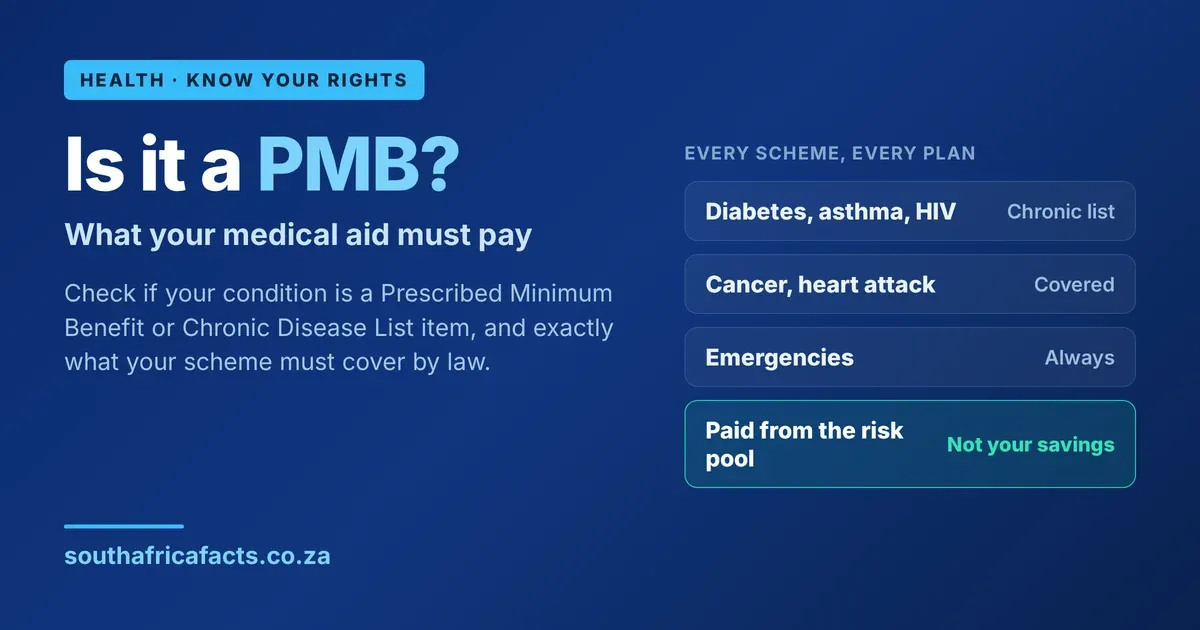
Find out whether your condition is a Prescribed Minimum Benefit or a Chronic Disease List item, and exactly what your medical scheme must pay for by law. Browse the categories by body system, or search for your condition, then check your rights before you accept a "your benefits are finished" answer. Every scheme has to cover these benefits in full, on every plan.
Browse common conditions by category
Open a category and tap a condition to check whether it is a Prescribed Minimum Benefit, and what your medical scheme must pay for by law. These are common examples, the law covers about 270 conditions in total.
Or search for your condition
Type your condition or diagnosis, or pick a common one below. Every registered medical scheme in South Africa must, by law, cover Prescribed Minimum Benefits (PMBs), no matter which plan you are on.
💬 Discuss this tool, or share your PMB experience, on the forum →
How Prescribed Minimum Benefits work in South Africa
Prescribed Minimum Benefits, or PMBs, are the floor of cover that the law sets for every medical scheme. They exist so that no member is left without help for a serious illness, whatever option they can afford. There are three kinds of PMB, any genuine medical emergency, a defined list of about 270 conditions called diagnosis and treatment pairs, and the 26 long term conditions on the Chronic Disease List. If your condition is in any of these groups, your scheme must cover the diagnosis, the treatment and the care, and it must do so in full.
Two rules catch many members by surprise. First, a PMB must be paid from the scheme’s risk pool, not from your medical savings and not from your day to day benefits. Second, a PMB cannot run out, so a scheme may not refuse it because you have reached a yearly limit. To get the full benefit with no co-payment you usually have to use the scheme’s designated service provider and its approved medicine list, but in a real emergency you may go to any hospital. If a formulary medicine does not suit you, your doctor can motivate for an alternative.
Knowing this matters when you choose a plan and when you query a rejected claim. While you are here, you can compare medical aid plans for your household, work out your bank fees, or browse all our free South African tools and calculators.
Frequently asked questions
What are Prescribed Minimum Benefits (PMBs)?
PMBs are a set of conditions that every registered medical scheme in South Africa must cover, no matter how cheap your plan is. They were written into the Medical Schemes Act so that members would not run out of cover for serious conditions and be forced to use state hospitals. PMBs fall into three groups, any genuine medical emergency, a list of about 270 conditions known as diagnosis and treatment pairs, and the 26 chronic conditions on the Chronic Disease List.
What is the Chronic Disease List (CDL)?
The Chronic Disease List is the set of 26 ongoing conditions, such as diabetes, asthma, high blood pressure and epilepsy, that schemes must cover as a PMB. HIV is also covered, as a separate PMB through the scheme's HIV programme rather than the chronic list. For a CDL condition your scheme must pay not only for your chronic medicine, but also for the doctor consultations and the tests needed to diagnose and monitor it. You usually have to register the condition on your scheme's chronic benefit first.
Can my medical scheme pay a PMB from my savings account?
No. A PMB must be paid from the scheme's risk pool, which is the scheme's own money, not from your personal medical savings account and not from your day to day benefits. If your scheme has been taking PMB costs off your savings, that is not allowed, and you can ask for it to be corrected.
Can my scheme say I have run out of benefits for a PMB?
No. A PMB cannot be capped or used up. The cover does not stop when you reach an annual limit or a plan limit, because the whole point of a PMB is that it is guaranteed. If a scheme refuses a PMB by saying your benefits are finished, that is a sign the rule is being broken.
What is a designated service provider, and when do I pay in?
A designated service provider, or DSP, is the doctor, pharmacy or hospital your scheme has chosen for a PMB. If you use the DSP and the scheme's approved medicine list, the PMB is paid in full with no co-payment. A co-payment can only apply if you choose to go to a different provider voluntarily, and even then it may never be the full cost. In a real emergency you may use any hospital, including a non-DSP one.
What do I do if my scheme refuses to pay a PMB?
First complain to your scheme in writing, state that it is a PMB and give the ICD-10 diagnosis code from your doctor. If they still refuse, complain to the Council for Medical Schemes, the free government regulator, which can investigate and order the scheme to pay. You can reach the CMS on 0861 123 267 or at [email protected].
Sources: Medical Schemes Act 131 of 1998 and the Regulations, and Council for Medical Schemes guidance on Prescribed Minimum Benefits. This page is general information, not legal or medical advice. Always confirm your cover with your own medical scheme and, in a dispute, with the Council for Medical Schemes. Last reviewed June 2026.