
Compare South African Bank Fees
See which South African bank is cheapest for the way you actually bank, across the seven main banks.
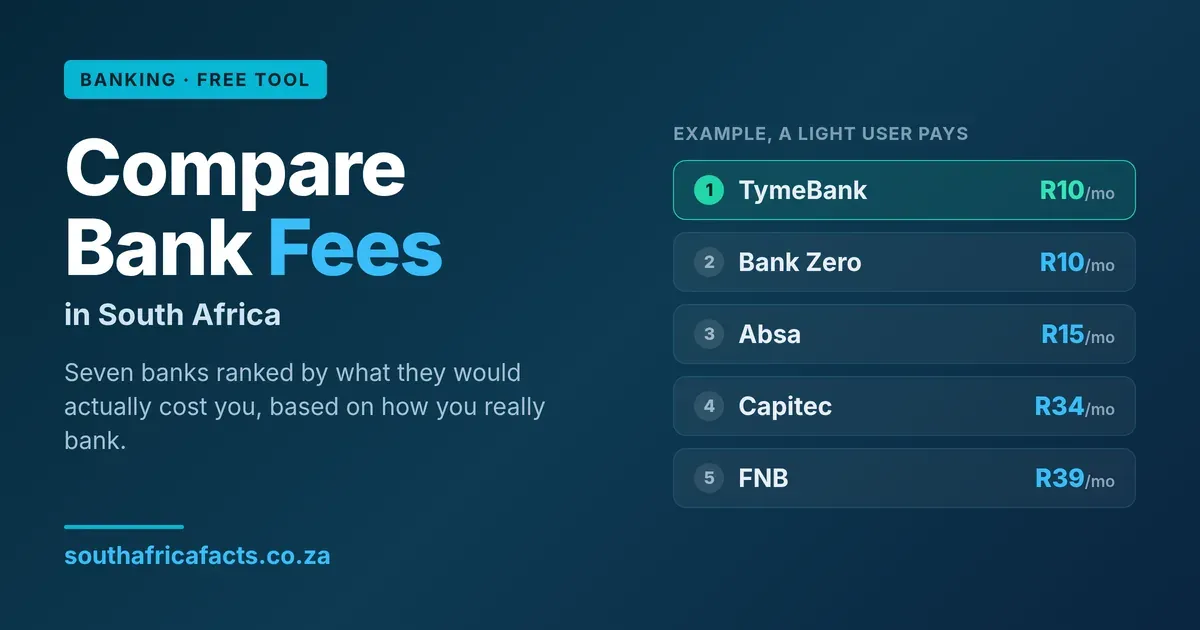
South African bank fees are notoriously hard to compare, because each bank charges a fixed monthly fee plus a separate fee for almost every transaction, and a glossy advert never shows what you would actually pay. This free tool fixes that. Set how you really bank each month, the cash you draw and deposit, your debit orders and your payments, and it ranks the seven main banks on what each would cost you, so you can see whether a free digital account or a bundle works out cheaper for you.
Compare South African Bank Fees
The cheapest bank depends on how you actually bank. Set your monthly habits below and we rank the seven main banks on what each would cost you.
Quick start
Pick a profile, then fine-tune
Card swipes are free at all seven banks, so how often you tap or swipe to pay does not change the ranking. Fees only come from cash, debit orders and payments to other people.
Your cheapest banks
How we work it out, and what to check
- One account per bank. We use each bank's cheapest everyday transactional account: Capitec Global One, Standard Bank Access Account, FNB Easy PAYU, Absa Transact, Nedbank MiGoals, TymeBank EveryDay and Bank Zero. Banks also sell other options that can suit you better at the extremes, FNB has a no fee Easy Zero account for very light users, and most have pricier bundle accounts that include more free transactions for heavy users, so check those too if your usage is unusually low or high.
- Cash fees are charged per slice, on each transaction. Withdrawals are billed per R1,000 and deposits per R100, and every separate transaction is rounded up on its own. So we split your monthly cash total across the number of withdrawals and deposits you enter, round each one up, then add them together. That is why more, smaller cash transactions cost a little more than one big one. We assume your transactions are roughly equal in size, so it stays a close estimate, but entering your transaction counts makes it considerably tighter.
- What is included free. Card purchases are free at every bank. On TymeBank and Bank Zero, EFTs, debit orders and instant payments are free. Nedbank's entry MiGoals account is cheap monthly (R8) but pay-as-you-use, so each debit order costs R12, its MiGoals Plus bundle at R99 a month is the one that includes debit orders and digital payments for heavy payers. Absa Transact gives free withdrawals at Absa ATMs and free digital payments.
- Bank Zero and cash deposits. Bank Zero does not have a standard cash deposit fee, deposits are made at selected retailer tills and the store sets the fee, so when your profile includes cash deposits we leave Bank Zero out of the ranking and flag it.
- Older accounts you already hold. We only rank accounts a new customer can open today. A discontinued account you still have, like Nedbank Go Banking, can work out cheaper than anything on this list, especially when it pays interest on your balance. If you are already on one of those and happy with it, there may be no reason to move.
- This compares fees only, not interest, rewards, app quality, branch access or service. A few rands a month may be worth paying for features you value. Always confirm the latest fees on the bank's own site before you switch.
- Fees were taken from each bank's official 2026 pricing guide and are current as of 3 June 2026. They include VAT.
💬 Discuss this tool on the forum →
How South African bank fees actually work
Every bank account in South Africa charges in two parts, a fixed monthly admin fee, and a fee for many of the things you do, such as drawing cash at an ATM, paying cash into your account, a debit order going off, or sending money to another person. The trick is that a low monthly fee can hide high transaction fees, and a higher monthly bundle can include those same transactions for free. So the cheapest account is not the same for everyone, it depends on how you bank.
As a rough guide, the no monthly fee digital banks, TymeBank and Bank Zero, are cheapest if you pay mostly by card and use little cash. Capitec, Absa Transact and the Standard Bank Access Account suit moderate users, and a bundle such as Nedbank MiGoals or an FNB or Absa bundle can win if you have many debit orders and payments. Use the tool above to see your own answer rather than guessing.
If you are over 55, do not assume the free digital banks are automatically cheapest. Most big banks waive their monthly fee for pensioners who keep a minimum balance, which can beat even TymeBank or Bank Zero if you keep savings there anyway. See how FNB, Absa, Standard Bank, Nedbank and Capitec compare for seniors in our banking for seniors guide, and check our pensioner discounts finder for other savings.
Once you have picked a bank, you can trim other monthly costs too. Compare prepaid mobile data prices, home fibre deals and 5G and LTE home internet deals. If you send money abroad or pay in another currency, our currency converter and forex fee comparison shows which provider costs the least, or browse all our free South African tools and calculators.
Frequently asked questions
Which bank has the lowest fees in South Africa?
It depends on how you bank. For someone who pays mostly by card and makes few cash transactions, TymeBank and Bank Zero are effectively free because they charge no monthly fee and no fee for card swipes, EFTs or debit orders. For someone who draws or deposits a lot of cash, or has many debit orders, a bank with a low monthly fee but per transaction charges can work out more expensive than a bundle. The tool above ranks all seven for your own usage.
Are TymeBank and Bank Zero really free?
Almost. Both charge no monthly account fee, and card purchases, EFTs and debit orders are free. You mainly pay for cash, an ATM withdrawal costs about R10 per R1 000, though TymeBank lets you withdraw free with a TymeCode at Pick n Pay or Boxer. Bank Zero takes cash deposits at selected retailer tills where the store sets the fee.
Why is the monthly fee not the whole story?
Because the per transaction fees add up. A bank can advertise a low monthly fee but charge for every cash withdrawal, cash deposit, debit order and payment, so a heavy user can end up paying far more than the headline fee. A bundle account with a higher monthly fee that includes those transactions can then be cheaper overall.
Do all banks charge for card swipes?
No. Point of sale card purchases, tapping or swiping your card to pay in a shop, are free at all seven banks, local and often international too. That is why how often you swipe does not change the ranking in the tool, only cash, debit orders and payments to other people carry fees.
How often do South African bank fees change?
Once a year. Each bank publishes an annual pricing guide, most taking effect on 1 January, while FNB runs from July to June. We take the figures from those official guides and refresh the tool when the new guides are released.
What's the cheapest bank account for me in South Africa?
It depends entirely on your own habits, not a generic ranking. Someone who banks mostly by card should look at TymeBank or Bank Zero, someone who draws cash weekly may do better with Capitec or Absa Transact, and someone with many debit orders may find a Nedbank or FNB bundle cheaper overall. Enter your own monthly cash, debit orders and payments in the tool above and it ranks all seven banks for your exact usage, rather than a one size fits all answer.
How does Capitec compare to TymeBank and Bank Zero?
Capitec charges a flat monthly fee, around R7.50 for Global One, and then a small fee for ATM withdrawals and cash deposits. TymeBank and Bank Zero charge no monthly fee at all and no fee for card purchases, EFTs or debit orders, so they usually work out cheaper if you rarely use cash. Capitec tends to pull ahead once you draw or deposit cash often, since its own branches and self-service kiosks are cheaper for cash than the digital banks' retail tie-ups. The tool above shows which one wins for your own mix.
Which bank is cheapest for pensioners in South Africa?
It depends on your balance more than your age. Most big banks waive the monthly fee for account holders over 55 if you keep a minimum balance, often between R5 000 and R20 000, which can beat even the free digital banks if you already keep savings there. If you carry little balance, TymeBank or Bank Zero usually still work out cheapest. We cover the exact balance thresholds for FNB, Absa, Standard Bank, Nedbank and Capitec in our banking for seniors guide.