
Child Immunisation Schedule Calculator (South Africa)
See when your child is due for each vaccine on South Africa's EPI-SA schedule by date of birth, add visits to your phone calendar, and spot overdue doses.
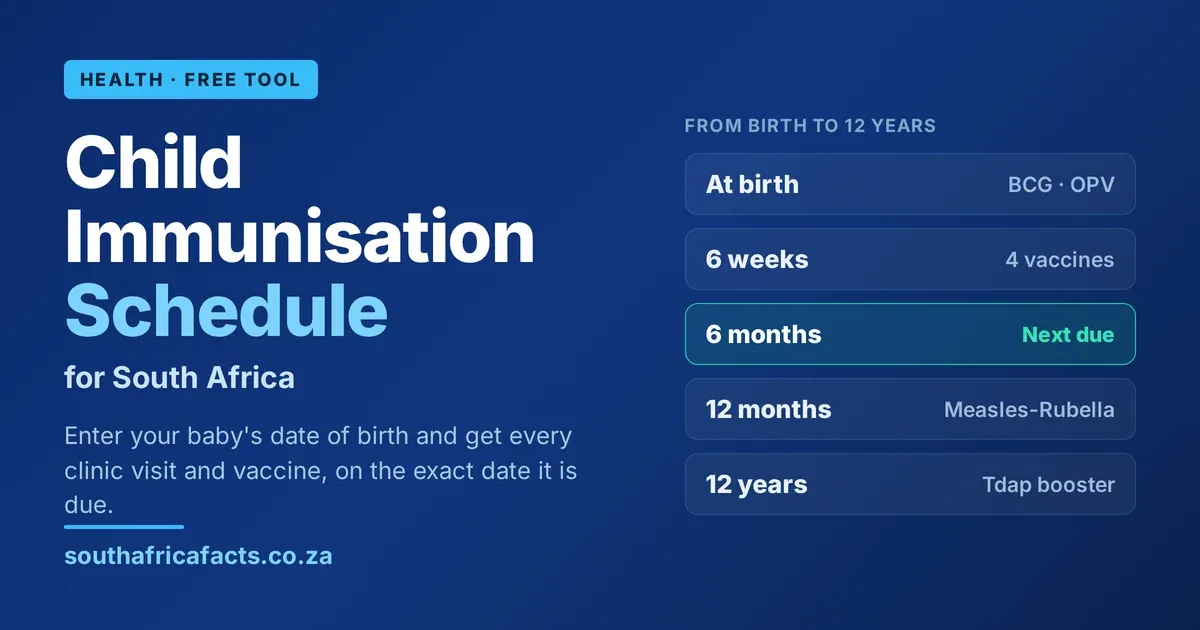
Enter your child’s date of birth and get the full EPI-SA immunisation schedule as real calendar dates, every clinic visit and vaccine from birth to 12 years, all free at state clinics. Tick off each dose as it is done, and print the list for the Road to Health booklet. If your child has fallen behind, switch on the overdue check to see which doses may be outstanding for their age, and there is a toggle for the extra vaccines that private practices commonly offer.
Child Immunisation Schedule (South Africa)
🔒 The date you enter is worked out here in your browser. It is not sent to us or saved on any server, and your ticks stay on this device.
💬 Discuss this tool on the forum →
How the South African immunisation schedule works
South African children follow a fixed schedule of clinic visits from birth, at 6, 10 and 14 weeks, then at 6, 9, 12 and 18 months, and finally boosters at 6 and 12 years. At each visit the nurse gives one or more vaccines, some as drops or liquid by mouth and some as a small injection in the thigh or arm. Because the visits are spaced by weeks and months rather than fixed dates, it is easy to lose track, which is why this tool turns your child’s date of birth into the real date of every visit.
All of these vaccines are free at government clinics, and full immunisation is one of the cheapest and most effective things you can do for your child’s health. Keep the Road to Health booklet safe, take it to every visit, and use the printable list from this tool as a backup reminder of what is due next. You can also tap “Add upcoming visits to calendar” to drop every coming visit straight into your phone, with a reminder set for the morning before each one. That file is built on your phone, so it works offline and uses no data.
Checking for missed or overdue vaccines
If your child has missed a clinic visit or started the schedule late, switch on the overdue check, tick the doses they have already had, and the tool shows which vaccines may be overdue for their age. It follows the South African national catch-up guidance, so it can tell the difference between a dose that can still be caught up and one that is no longer given past a certain age, like the rotavirus drops which are not given after 24 weeks. Think of it as a guide to take to the clinic, not a replacement for the nurse, who will confirm the proper catch-up plan.
Looking after a young family also means watching the budget. While you are here, you can compare medical aid plans for your household, South African bank fees, or browse all our free South African tools and calculators.
Frequently asked questions
What is the South African childhood immunisation schedule?
It is the list of vaccines, set by the National Department of Health under the Expanded Programme on Immunisation (EPI-SA), that every child should get from birth to twelve years of age. It protects against tuberculosis, polio, measles, rubella, hepatitis B, tetanus, diphtheria, whooping cough, rotavirus and pneumococcal disease. The version in this tool is the revised schedule that took effect in January 2024.
Are these vaccines free in South Africa?
Yes. Every vaccine on the EPI-SA schedule is given free of charge at government clinics, whether or not you are on a medical aid. You just take your child and the Road to Health booklet, also called the clinic card, to your nearest clinic on or near the due date.
Can I add the clinic visits to my phone calendar?
Yes. Once you have entered the date of birth, tap the “Add upcoming visits to calendar” button and the tool builds a small calendar file on your phone itself, so it works offline and uses no data. When you open that file, your phone adds every visit that is still coming up, each one as an all day entry that lists the vaccines due. Each visit also carries a reminder set for the morning before, at about nine o’clock, so your phone alerts you a day ahead even when you have no signal. Visits that have already passed are left out, and if you switch on the private extras toggle first, those dates are added too. Importing the file again later updates the same dates instead of creating duplicates, and it works with the usual calendar apps on Android and iPhone. The clinic visit time is not set, because clinics do not work by appointment, so treat it as an all day reminder and go when it suits you that day.
What happens if my child misses a vaccine?
Do not panic, and do not start again from the beginning. Take your child to the clinic as soon as you can, and a nurse will catch the schedule up using the standard catch-up intervals. The one timing rule to know is that the rotavirus vaccine must not be given after 24 weeks of age, so that early dose matters most.
How is this schedule different from the older one?
The revised schedule replaced the plain measles vaccine at 6 and 12 months with the combined measles and rubella vaccine, and it gives Tdap, a tetanus, reduced strength diphtheria and acellular pertussis booster, at 6 years and 12 years to both boys and girls. If you are reading an older clinic card or website you may still see the previous wording.
Does this cover private vaccines like chickenpox or flu?
The state schedule is shown by default, but you can switch on the commonly recommended private extras toggle to also see vaccines that private practices offer, such as chickenpox, hepatitis A, the yearly flu shot and the meningococcal vaccines. Those extras are paid for out of pocket or through medical aid. The HPV vaccine is different. The state provides it free to girls in Grade 5 through a school campaign, so it is not only available through private care. If you use a private practice, ask your doctor which extra vaccines they recommend and when.
What if my child has missed vaccines or is behind on the schedule?
Switch on the “check for doses that may be overdue” toggle, tick every dose your child has already had, and the tool flags anything that looks outstanding for their age. It sorts each one into doses that can still be caught up, doses that need the nurse to decide, and the few that are no longer given once a child is past a certain age, such as the rotavirus drops which are not given from 24 weeks. It is only a guide, so take your child and the Road to Health booklet to your nearest clinic, where a nurse will work out the proper catch-up plan using the national catch-up schedule.
Source: Expanded Programme on Immunisation (EPI-SA) Revised Childhood Immunisation Schedule, effective January 2024, South African National Department of Health. This page is for information and is not medical advice, always confirm with your clinic or doctor.