20 Facts About South Africa
20 Facts About South Africa
A snapshot of the Rainbow Nation — geography, people, history, and more.
South Africa sits at the southern tip of the African continent, flanked by both the Atlantic and Indian Oceans.
It covers 1,221,037 km² — roughly twice the size of Texas — making it the 25th-largest country in the world.
South Africa completely encircles Lesotho and almost entirely surrounds Eswatini — a geographical quirk unique on the continent.
As of 2024, South Africa is home to approximately 63 million people (Stats SA mid-year estimate).
Black Africans make up 81.7% of the population, followed by Coloured (8.5%), White (7.2%), and Indian/Asian (2.6%) — Stats SA 2024 estimates.
South Africa has 11 official languages, including isiZulu, isiXhosa, Afrikaans, Sepedi, Setswana, and English — more than any other country in Africa.
Christianity is practised by roughly 85% of the population, alongside traditional African religions and Islam.
South Africa has the largest economy in Africa, with a GDP of approximately $400 billion in 2024. It is the continent's most industrialised and technologically advanced economy.
Despite its economic strength, South Africa has one of the world's highest unemployment rates — officially 31.9% in Q4 2024, and 44.6% among youth aged 15–34 (Stats SA QLFS).
The landscape is dominated by a vast interior plateau rimmed by rugged hills and a narrow coastal plain.
Ntheledi (Mafadi) rises to 3,450 m in the Drakensberg range, making it the highest peak in South Africa.
South Africa holds vast reserves of gold, platinum, chromium, diamonds, coal, iron ore, and rare earth elements — among the richest mineral endowments in the world.
Agricultural land accounts for 79.4% of total land area, supporting a wide range of crops, livestock, and wine production.
The country faces recurring droughts. Marion Island in the sub-Antarctic Prince Edward Islands group is home to South Africa's only historically active volcano.
Bantu-speaking groups began settling in what is now northeastern South Africa around A.D. 500, laying the foundation of its rich cultural heritage.
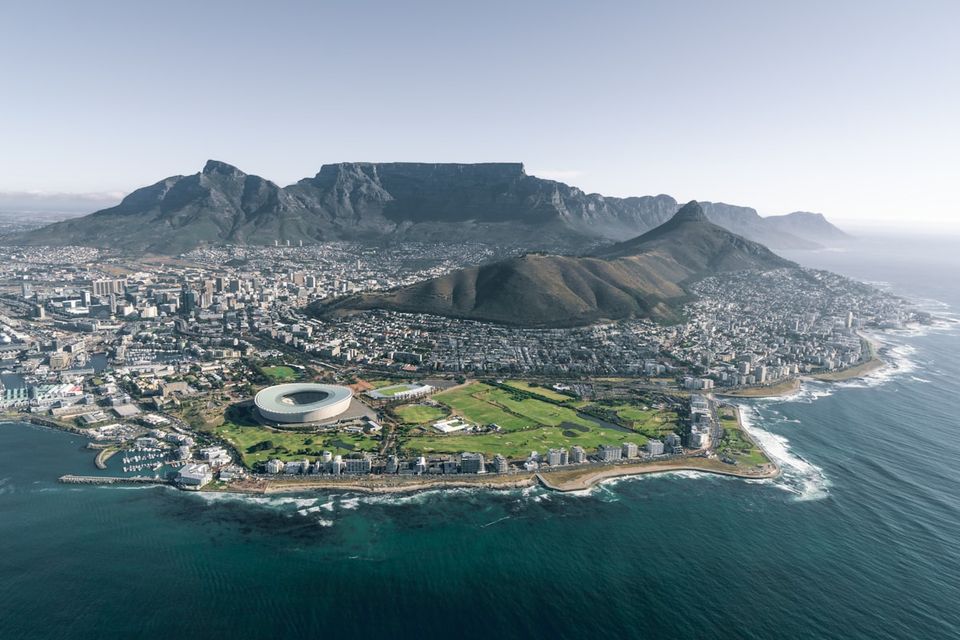
Dutch traders arrived at the Cape in 1652, establishing a supply station on the spice route between Europe and the East — and founding what became Cape Town.
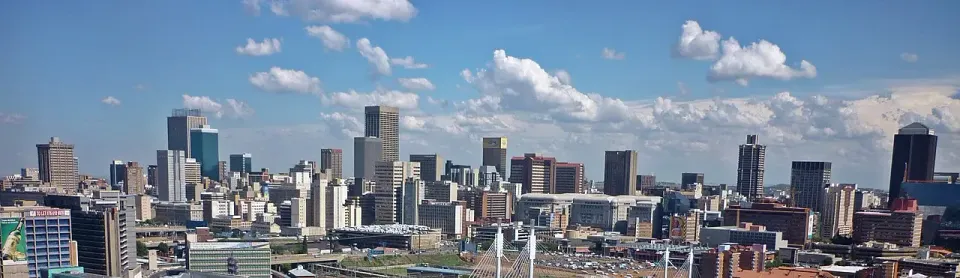
The discovery of diamonds in 1867 and gold in 1886 triggered waves of immigration and investment that transformed the country's economy and led to the founding of Johannesburg.
The African National Congress (ANC) led the struggle against apartheid. Nelson Mandela and other leaders spent decades imprisoned before the system finally fell.
South Africa's first fully democratic elections were held in April 1994, ushering in majority rule under Nelson Mandela and an ANC-led government.
Cyril Ramaphosa was re-elected in 2024 to lead a Government of National Unity (GNU) coalition — the first since the post-apartheid transition — as the ANC lost its outright majority for the first time in 30 years.